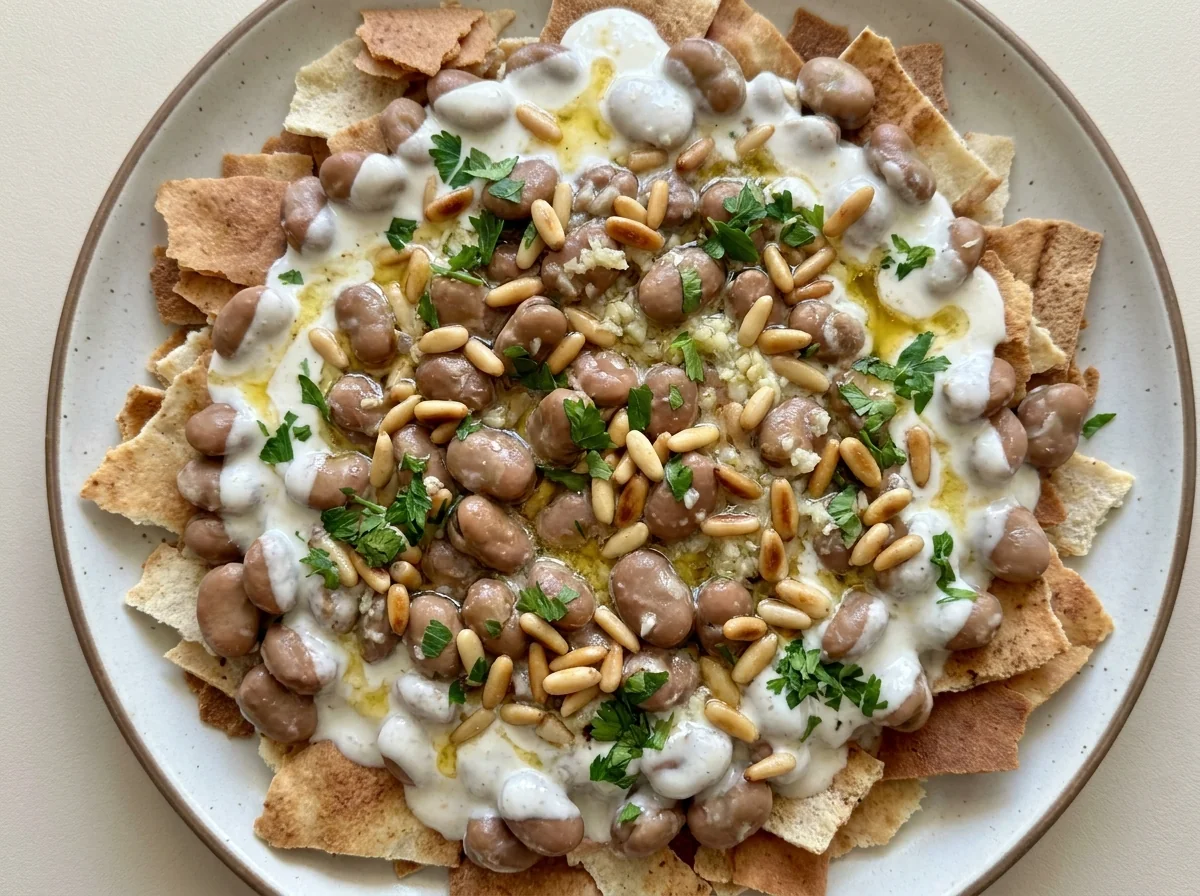
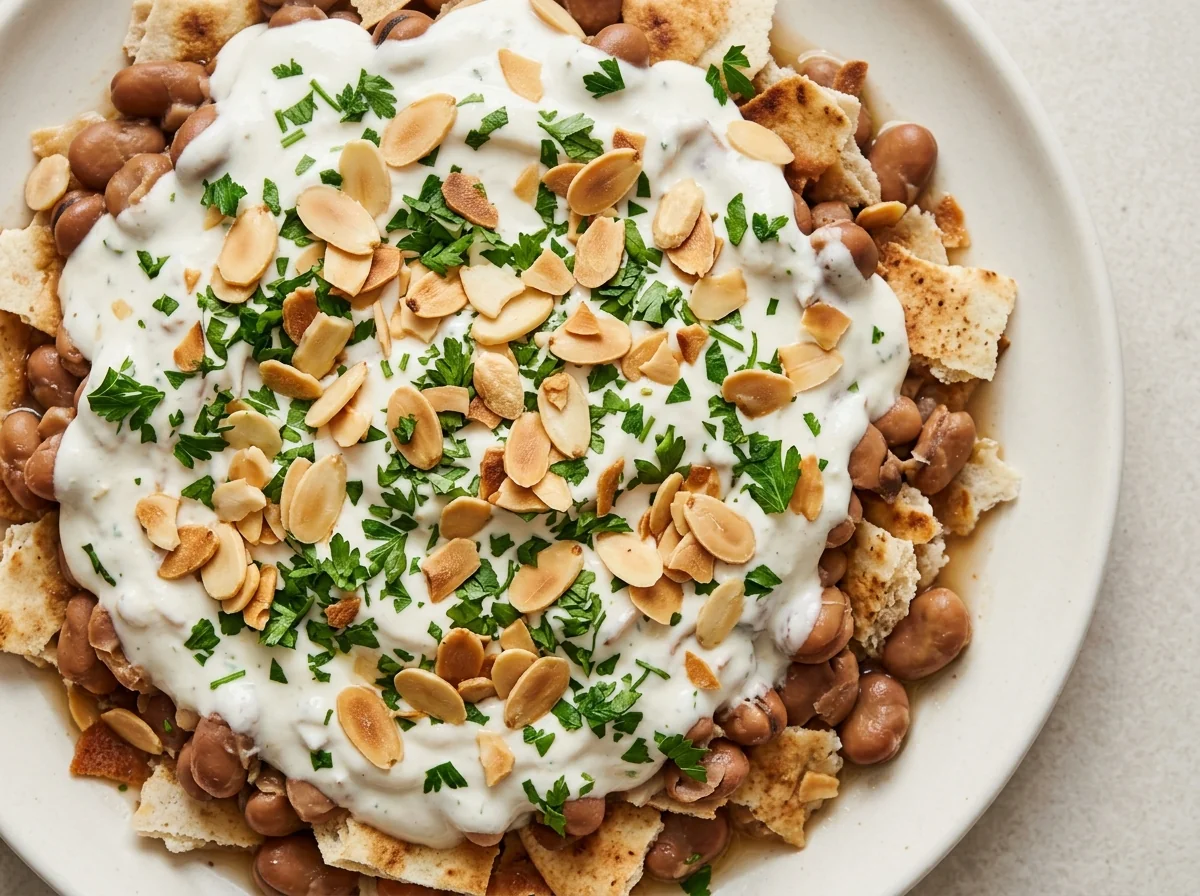
Fatteh is an old Levantine way of making use of bread: layers of toasted bread topped with hot ingredients and a yogurt sauce.
Hummus fatteh is its most famous type, and ful fatteh is a common Ramadan version that brings together legumes and yogurt in one satisfying Suhoor.
Preparation Steps
Toast the bread
Cut the Arabic flatbread into squares and toast it in the oven at 180 degrees for ten minutes until it dries, browns, and turns crisp. Crispness is the foundation of fatteh, because soft bread dissolves under the sauce.
Whisk the yogurt-tahini sauce
In a bowl, whisk the yogurt with the tahini, crushed garlic, lemon juice, and salt until the sauce is smooth and its consistency coats the back of the spoon. Taste it: what you want is a clear acidity and a present garlic flavor without it overpowering.
Heat the ful and mash a third of it
Heat the ful with half its liquid, then mash a third of it until the consistency thickens. The ful stays hot, because fatteh is built on the meeting of hot ful with cold yogurt sauce.
Build the layers right before serving
In a deep dish, place a layer of toasted bread, the hot ful over it, then pour the yogurt sauce until it covers the whole top. Build the layers right before serving, because doing it early soaks the bread and loses its crispness.
Add the hot ghee and pine nuts
Wash and chop the parsley. Heat the ghee well and drizzle it over the yogurt so it makes the familiar sizzle of fattehs, then scatter the toasted pine nuts and chopped parsley and serve immediately.
Blood Sugar Impact
The glycemic index (GI) measures how quickly a food raises blood sugar, while the glycemic load (GL) measures how much a full serving raises it. Together they give the complete picture.
Glycemic Index
GI
40Low
Low0–55Medium56–69High70+
A low value (≤55) means a gradual rise in blood sugar — the most suitable range for diabetes and insulin resistance.
Glycemic Load
GL
16Medium
Low0–10Medium11–19High20+
Glycemic load reflects the impact of the full serving. To lower it: take half a serving, or pair the recipe with a source of protein and fiber.
Nutritional Information
Per ServingMakes 4 servings · one serving is about 260 g of raw ingredients
Calories384 kcal19%of Daily Value*
Protein17 g34%of Daily Value*
Carbohydrates46 g17%of Daily Value*
Fat16 g21%of Daily Value*
Fiber7 g25%of Daily Value*
Sodium410 mg18%of Daily Value*
* Percent Daily Values are based on a 2,000-calorie diet per FDA food-label reference values — your daily needs may be higher or lower. Values are derived from the recipe's ingredients via the USDA database.
Troubleshooting
The most common problems when preparing Fatteh Ful with Yogurt and Tahini, and how to fix them:
The bread soaked and turned to dough
The layers were assembled early, or the bread was not toasted enough. Toast the bread until fully crisp, and assemble the fatteh right before serving.
The sauce is thin and runs
The yogurt used is thin in consistency. Use Greek yogurt, or strain ordinary yogurt in a sieve for half an hour before whisking.
The garlic overpowers
Start with half the amount, because the taste of raw garlic in yogurt intensifies as the minutes pass, then add to taste.
The whole fatteh is cold
The ful was not heated enough. Heat it well before building the layers, for the heat of the ful beneath the coolness of the yogurt is what distinguishes fatteh.
Storage and Make-Ahead
Right away
Served the moment it is assembled, as it loses its crispness within about ten minutes.
As separate parts
The toasted bread keeps a week in an airtight container, the sauce two days in the fridge, and the ful three days.
Not suitable for freezing
The yogurt separates when frozen and the bread loses its texture.
Tested Ingredient Substitutions
Original Ingredient
Tested Substitute
Ratio
Flavor Difference
Ful
Boiled chickpeas
1:1
It becomes a traditional hummus fatteh
Pine nuts
Peeled toasted almonds
1:1
Cheaper with the same crunch
Ghee
Hot olive oil
1:1
A lighter version, and the sizzle is softer
Oven-toasted bread
Bread toasted in a dry pan
1:1
For those who do not want to run the oven at Suhoor
How Much Does It Make? Scaling Guide
Ingredient
4 servings
2 servings
8 servings
Fava beans (ful)
400 g
200 g
800 g
Yogurt
400 g
200 g
800 g
Bread
120 g
60 g
240 g
EEINA Nutrition Tip
In fattehs, everything is prepared in advance and the assembly is at the last minute before eating: the toasted bread is kept in an airtight container, the sauce in the fridge, and the ful is heated before serving, then the layers are built directly. This order keeps the bread crisp and shortens the time of preparing Suhoor.
Add This Recipe to Your Plan
The EEINA app saves your favorite recipes, calculates them from their real ingredients, and shows your daily numbers toward your goal. Try it free now.