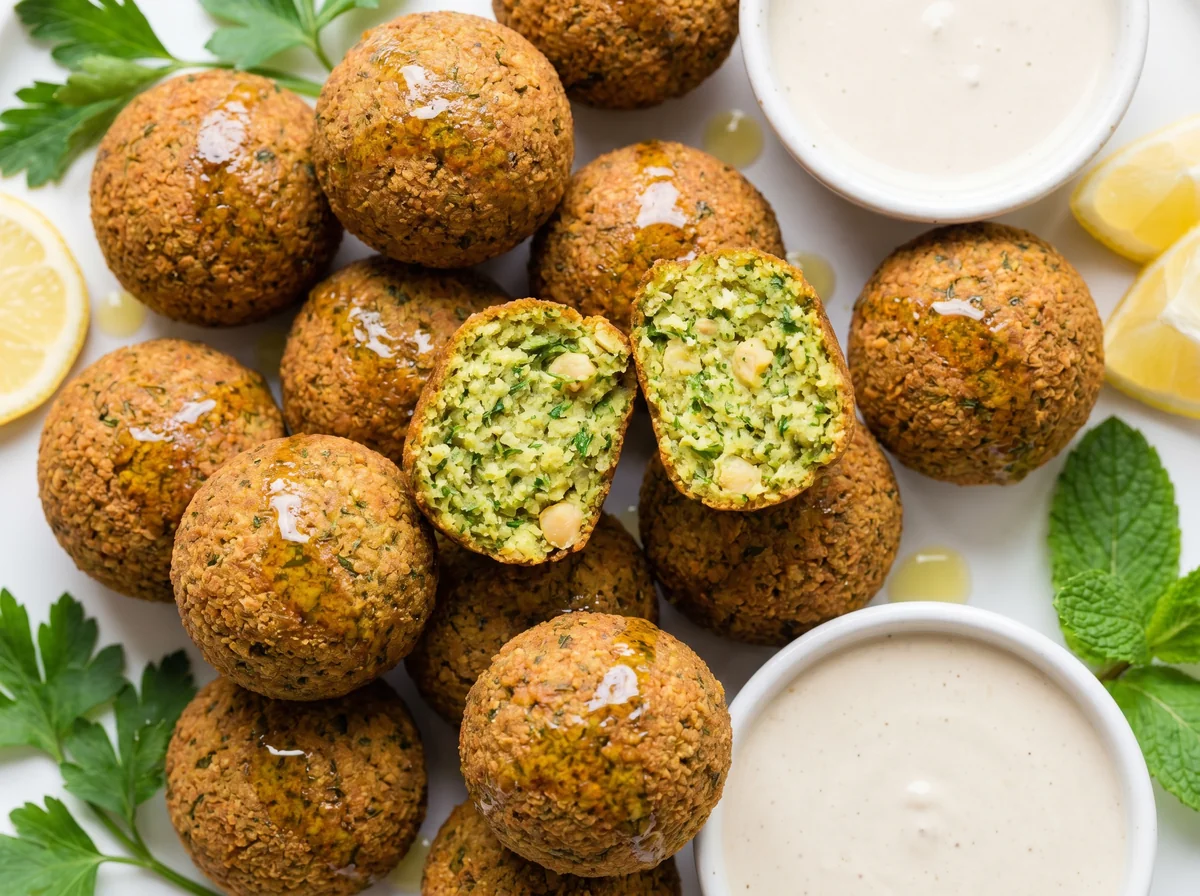
Chickpeas blended with parsley, coriander, garlic, and cumin, shaped into patties and fried or baked — a Middle Eastern classic rich in plant protein and fiber, served in flatbread or as part of a meze spread.
Falafel is one of the oldest dishes of the Middle East: herb-spiced chickpeas shaped and cooked until crispy.
We offer the baking option instead of deep frying to reduce fat while preserving the flavor. High in plant protein and fiber.
Preparation Steps
Blend the mixture
Blend the chickpeas, onion, parsley, coriander, garlic, salt, chilli, and cumin in a food processor until finely crumbled but not a completely smooth paste. A slightly coarse texture gives the falafel a better consistency.
Mix the dough
Add the baking powder and chickpea flour and mix until the mixture holds together and is easy to shape, then let it rest for fifteen minutes. Resting helps the mixture bind.
Shape
Shape the mixture into small patties by hand or with an ice cream scoop, keeping them uniform in size so they cook evenly.
Cook
Arrange the patties on a baking sheet, drizzle with olive oil, and bake at 200°C for about twenty-five minutes, turning them halfway, until they turn golden — or deep-fry in oil for the traditional version. Baking is a lighter option than frying.
Serve
Serve the falafel in Arabic flatbread with tahini and fresh vegetables, or as part of a meze spread. A satisfying Middle Eastern classic rich in plant protein.
Blood Sugar Impact
The glycemic index (GI) measures how quickly a food raises blood sugar, while the glycemic load (GL) measures how much a full serving raises it. Together they give the complete picture.
Glycemic Index
GI
28Low
Low0–55Medium56–69High70+
A low value (≤55) means a gradual rise in blood sugar — the most suitable range for diabetes and insulin resistance.
Glycemic Load
GL
12Medium
Low0–10Medium11–19High20+
Glycemic load reflects the impact of the full serving. To lower it: take half a serving, or pair the recipe with a source of protein and fiber.
Nutritional Information
Per ServingMakes 4 servings · one serving is about 240 g of raw ingredients
Calories350 kcal18%of Daily Value*
Protein18 g36%of Daily Value*
Carbohydrates57 g21%of Daily Value*
Fat7 g9%of Daily Value*
Fiber15 g54%of Daily Value*
Sodium1236 mg54%of Daily Value*
* Percent Daily Values are based on a 2,000-calorie diet per FDA food-label reference values — your daily needs may be higher or lower. Values are derived from the recipe's ingredients via the USDA database.
Troubleshooting
The most common problems when preparing Homemade Falafel (with Baking Option), and how to fix them:
The surface did not brown
The heat was too low or the time too short. Raise the temperature in the last few minutes or use the top broiler while watching closely.
Dry on the inside
Overbaked. Stick to the time and use a thermometer, and remove as soon as done — residual heat continues the cooking.
Bland flavor
Insufficient salt or spices. Season well and taste; add fresh herbs or a dash of acidity (lemon) to elevate all the flavors.
Storage and Make-Ahead
Fridge (4°C)
Three days in a sealed container after cooling. Reheat until fully hot before serving.
Freezer (-18°C)
One to two months in individual portions. Thaw in the fridge before reheating.
Advance prep
Prepare and cut the ingredients in advance and keep in the fridge — assembly and cooking takes just minutes at serving time.
Reheating
Over low heat with a splash of water or in a moderate oven until hot. Do not leave out of refrigeration for more than two hours [2].
Tested Ingredient Substitutions
Original Ingredient
Tested Substitute
Ratio
Flavor Difference
Meat
minced chicken or lentils
same weight
Lighter in fat or plant-based and rich in fiber
Wheat component
gluten-free alternative (rice/lentil/wholegrain as appropriate to the dish)
same quantity
For those sensitive to gluten
Oil/fat
extra virgin olive oil
same quantity
Monounsaturated fats that are better for the heart
Salt
herbs, spices, and lemon juice
to taste
Reduces sodium while keeping generous flavor
How Much Does It Make? Scaling Guide
Number of servings
Ratio
2 (individual × 2)
Half the quantities
4 (base)
Quantities as listed
6 (family)
1.5×
8 (entertaining)
Double the quantities
EEINA Nutrition Tip
Baking falafel instead of deep frying reduces fat significantly while maintaining the crunch. Chickpeas are rich in plant protein and fiber. Using chickpea flour makes them gluten-free. Serve with tahini and vegetables rather than heavy sauces.
Add This Recipe to Your Plan
The EEINA app saves your favorite recipes, calculates them from their real ingredients, and shows your daily numbers toward your goal. Try it free now.
Yes — its glycemic index is low and the protein and fiber slow sugar absorption. Keep to a moderate portion and serve with vegetables or salad, and avoid large amounts of white starches alongside it.
How do I store leftovers?
In a sealed container in the fridge for a few days, or in the freezer in portions for later (except salads and seafood dishes which have a shorter shelf life). Reheat until fully hot just once.
Can I adapt it to suit my diet?
Yes — see the substitutions table: you can swap the protein, make it dairy-free or gluten-free, or reduce the salt and fat without losing the flavor.
Sources: USDA · University of Sydney · Gulf GSO · Our methodology · Updated on