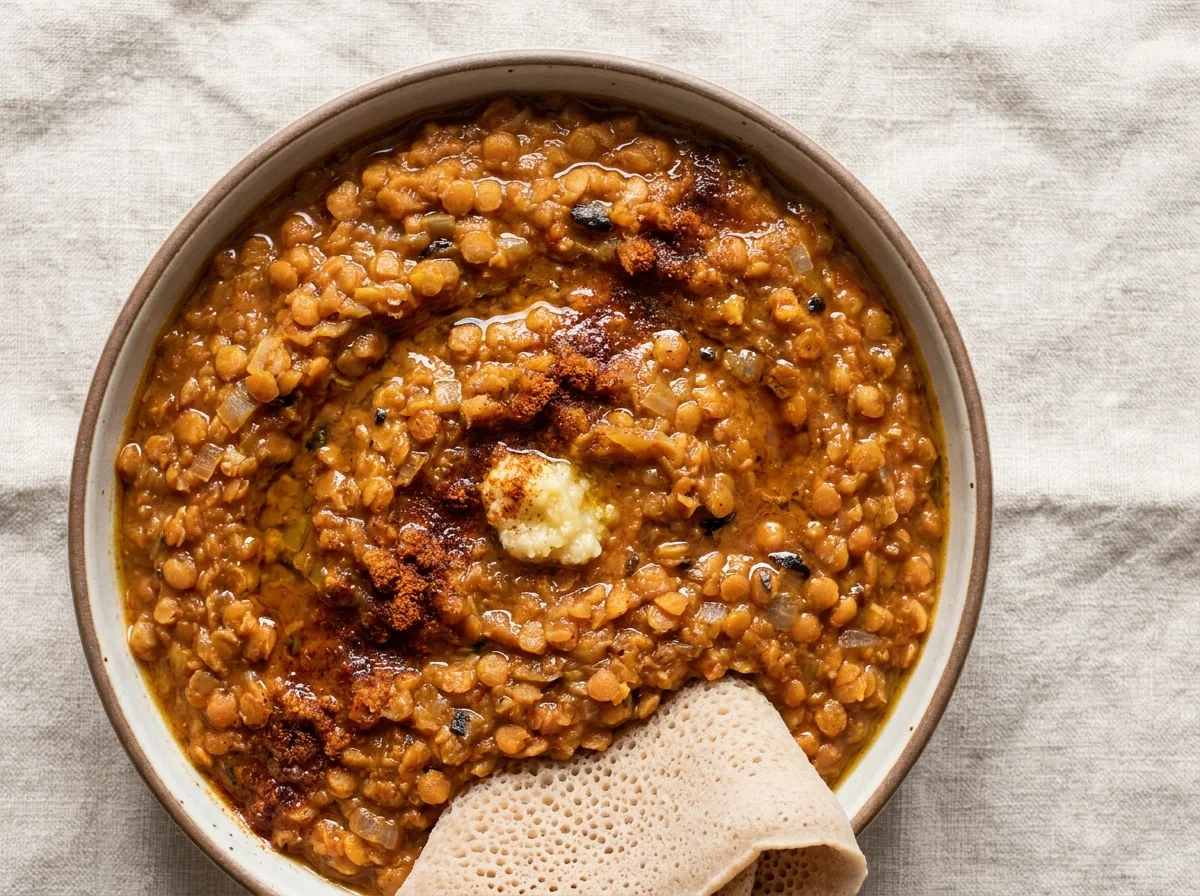
Misir wot is a traditional Ethiopian and Eritrean dish of red lentils and the spicy berbere blend.
It is one of the staple fasting dishes in Ethiopian cuisine, cooked free of any animal ingredient and usually eaten with spongy injera bread. What sets it apart is cooking the onion slowly first, then toasting the berbere, which is what builds its renowned deep flavor.
Preparation Steps
Rinse the lentils
Rinse the split red lentils with cold water several times until the water runs clear, then drain and set aside.
Cook the onion slowly
In a heavy-bottomed pot, place the chopped onion without oil over medium-low heat and stir constantly for five minutes until it softens and its moisture evaporates. This dry step is the foundation of Ethiopian cooking and gives the misir wot its depth of flavor.
Add the oil, garlic, and ginger
Add the olive oil, minced garlic, and grated ginger, and stir for three minutes until fragrant and the onion turns golden and soft.
Toast the berbere and tomato paste
Add the berbere spice and tomato paste and stir for four minutes over low heat until the spice toasts and its color deepens. Toasting the berbere brings out its flavor and removes the raw spice taste, so don't let it burn.
Cook the lentils until creamy
Add the drained lentils, salt, and hot water, raise the heat to a boil, then lower it and cover the pot. Cook it for twenty minutes, stirring from time to time, until the lentils break down and the texture becomes thick and creamy. Add hot water if it dries before it's done.
Add lemon and serve
Turn off the heat, add the lemon juice, and stir. Serve the misir wot hot with bread or rice; in its homeland it's served with spongy injera bread.
Blood Sugar Impact
The glycemic index (GI) measures how quickly a food raises blood sugar, while the glycemic load (GL) measures how much a full serving raises it. Together they give the complete picture.
Glycemic Index
GI
27Low
Low0–55Medium56–69High70+
A low value (≤55) means a gradual rise in blood sugar — the most suitable range for diabetes and insulin resistance.
Glycemic Load
GL
10Low
Low0–10Medium11–19High20+
Glycemic load reflects the impact of the full serving. To lower it: take half a serving, or pair the recipe with a source of protein and fiber.
Nutritional Information
Per ServingMakes 4 servings · one serving is about 345 g of raw ingredients
Calories351 kcal18%of Daily Value*
Protein17 g34%of Daily Value*
Carbohydrates46 g17%of Daily Value*
Fat11 g14%of Daily Value*
Fiber9 g32%of Daily Value*
Sodium400 mg17%of Daily Value*
* Percent Daily Values are based on a 2,000-calorie diet per FDA food-label reference values — your daily needs may be higher or lower. Values are derived from the recipe's ingredients via the USDA database.
Troubleshooting
The most common problems when preparing Ethiopian Misir Wot Lentils, and how to fix them:
The spice tastes raw and sharp
The berbere wasn't toasted enough. Toast it with the tomato paste for four minutes over low heat until its color deepens before adding the lentils.
The berbere burned and turned bitter
The heat was too high. Toast the spice over low heat while stirring constantly, and add a splash of water if it starts to stick.
The lentils stayed whole and didn't turn creamy
The right lentils are split red lentils, which dissolve when cooked. Make sure of the type, and let them simmer covered for twenty minutes, adding hot water as needed.
It came out too dry and thick
Too much water evaporated. Add hot water gradually and stir until you reach the desired creamy texture.
Storage and Make-Ahead
Right away
Serve hot with bread or rice, and in its homeland with injera bread.
In the fridge
Keep for three days in an airtight container; its flavor deepens the next day. Reheat by adding a little water.
Freezing
Freezes well for up to three months. Thaw in the fridge then reheat with a little water.
Tested Ingredient Substitutions
Original Ingredient
Tested Substitute
Ratio
Flavor Difference
Berbere spice
Sweet paprika + chili + a little cumin and cinnamon
~
An approximate substitute when ready-made berbere isn't available
Split red lentils
Hulled orange lentils
1:1
Both dissolve when cooked and give a creamy texture
Olive oil
Another vegetable oil
1:1
To keep the dish plant-based, instead of the clarified ghee traditionally used
Tomato paste
Fresh grated tomato
~
Cook a little longer until its moisture evaporates
How Much Does It Make? Scaling Guide
Ingredient
4 servings
2 servings
8 servings
Red lentils
250 g
125 g
500 g
Onion
250 g
125 g
500 g
Berbere spice
20 g
10 g
40 g
Hot water
750 ml
375 ml
1.5 L
EEINA Nutrition Tip
The proteins of legumes and grains complement each other, so when lentils are eaten with a grain such as rice or bread, the plant protein comes closer to a complete protein in its amino acids. Vitamin C, such as that in lemon juice, also raises the body's absorption of the plant-based iron found in lentils.
Add This Recipe to Your Plan
The EEINA app saves your favorite recipes, calculates them from their real ingredients, and shows your daily numbers toward your goal. Try it free now.
Yes, in its fasting version it's cooked free of any animal ingredient. The traditional version may use clarified ghee, and here we replaced it with olive oil to keep it purely plant-based.
What is berbere spice?
A spicy Ethiopian spice blend based on dried chili with spices such as coriander, ginger, cinnamon, and fenugreek. It is the soul of this dish and its core flavor.
Why is the onion cooked without oil first?
The slow dry cooking evaporates the onion's moisture and concentrates its sweetness, which is the foundation of the deep flavor in Ethiopian cooking before adding the oil and spice.
How is it served?
In Ethiopia with spongy injera bread, and it can be served with rice or regular bread. Adding a grain alongside the legumes makes the plant protein more complete.