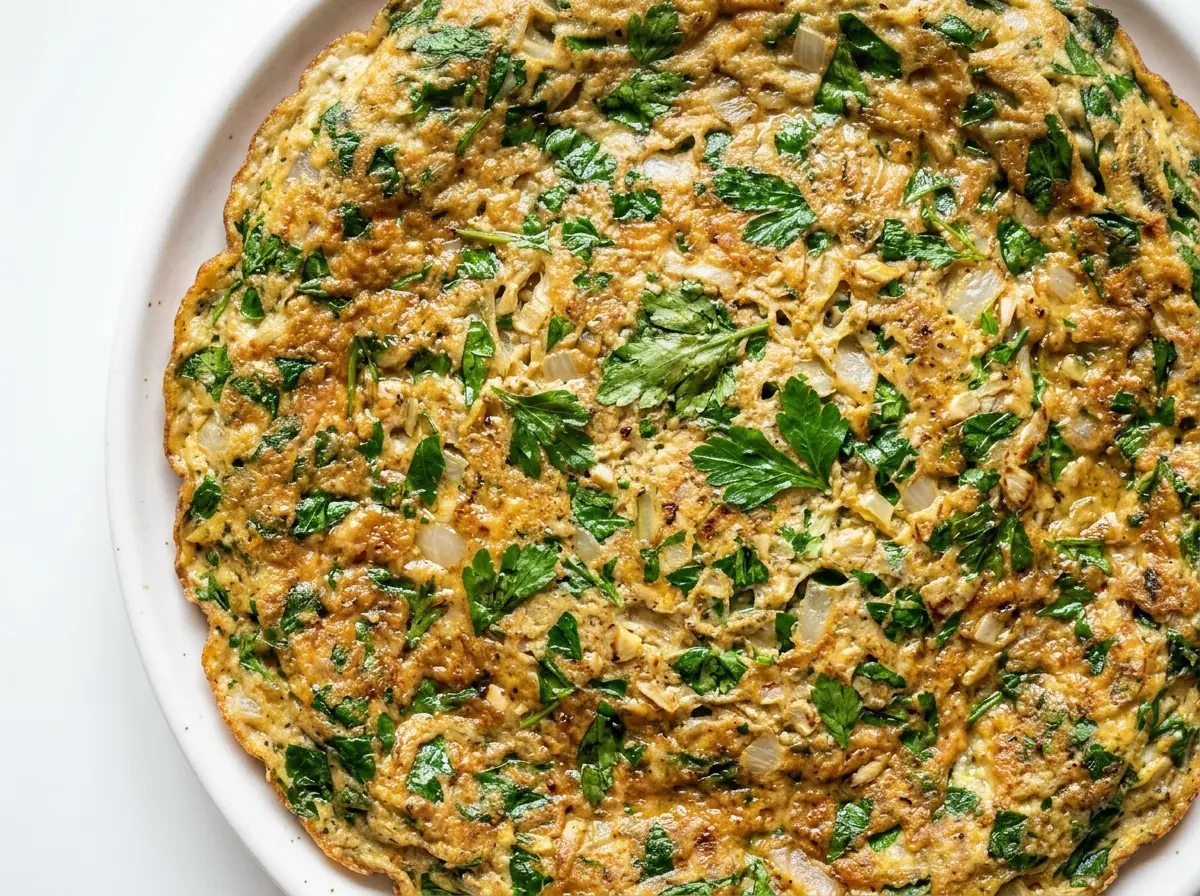
Grated onion, crushed garlic, and chopped parsley beaten with eggs, salt, and mixed spices, then cooked in ghee and olive oil on both sides until done.
Levantine ejjeh is not an omelet: an omelet is egg folded around a filling, while ejjeh is greens beaten into the egg until the green becomes part of its body rather than a layer on top.
The parsley ratio here is deliberately generous, since it is the dish's flavor rather than its garnish.
Preparation Steps
Prepare the aromatics
In a mixing bowl put the grated onion, the crushed garlic, and the chopped parsley; the onion is grated rather than chopped so it releases its water and blends into the egg instead of staying in pieces.
Crack in the eggs
Crack the eggs straight over the previous ingredients in the same bowl.
Season and beat
Season with the salt and the mixed spices and beat everything well with a fork until the color is uniform and turns pale green from the parsley.
Heat the fat
Heat the ghee and the olive oil in a pan over the heat; combining them is deliberate, the ghee for flavor and the oil to raise the smoke point.
Cook both sides
Pour in the ejjeh mixture and cook it on both sides until done and golden, flipping it with a plate once the edges set, and serve hot.
Blood Sugar Impact
The glycemic index (GI) measures how quickly a food raises blood sugar, while the glycemic load (GL) measures how much a full serving raises it. Together they give the complete picture.
Glycemic Index
GI
5Low
Low0–55Medium56–69High70+
A low value (≤55) means a gradual rise in blood sugar — the most suitable range for diabetes and insulin resistance.
Glycemic Load
GL
0Low
Low0–10Medium11–19High20+
Glycemic load reflects the impact of the full serving. To lower it: take half a serving, or pair the recipe with a source of protein and fiber.
Nutritional Information
Per ServingMakes 3 servings · one serving is about 155 g of raw ingredients
Calories222 kcal11%of Daily Value*
Protein14 g28%of Daily Value*
Carbohydrates6 g2%of Daily Value*
Fat16 g21%of Daily Value*
Fiber1 g4%of Daily Value*
Sodium538 mg23%of Daily Value*
Potassium259 mg6%of Daily Value*
Phosphorus219 mg18%of Daily Value*
* Percent Daily Values are based on a 2,000-calorie diet per FDA food-label reference values — your daily needs may be higher or lower. Values are derived from the recipe's ingredients via the USDA database.
Troubleshooting
The most common problems when preparing Ejjeh Egg and Parsley Omelet, and how to fix them:
The ejjeh broke when flipped
Its edges had not set. Wait until the rim looks dry, then flip it with the help of a plate.
It came out watery
That is the grated onion's water. Squeeze it lightly before mixing, or add a spoon of flour to the mixture.
The surface burnt and the center is runny
The heat is too high. Lower it after the first two minutes and cover the pan until the center sets.
It tastes heavy
Ghee alone. Combine it with olive oil as in the source and the flavor lightens.
Storage and Make-Ahead
Refrigerator (4°C)
In a sealed container for two days, eaten cold or reheated in a dry pan.
Serving
Hot with bread and yogurt, or cold in a sandwich.
Make ahead
Chop the vegetables and keep them in the refrigerator for a day, adding the eggs at cooking.
Not recommended
Freezing: cooked egg turns spongy and watery on thawing.
Tested Ingredient Substitutions
Original Ingredient
Tested Substitute
Ratio
Flavor Difference
Ghee
Butter
14 g
A lighter flavor, closer to a Western omelet.
Parsley
Fresh coriander
30 g
A sharper flavor, closer to the Egyptian version.
Whole eggs
4 eggs and 2 whites
250 g
Less cholesterol with similar protein.
Grated onion
Chopped green onion
110 g
Less water so the ejjeh holds, with a gentler flavor.
How Much Does It Make? Scaling Guide
Servings
Eggs
Parsley
Onion
1.5 servings (half the amount)
150 g
15 g
55 g
3 servings (base)
300 g
30 g
110 g
6 servings (double)
600 g
60 g
220 g
EEINA Nutrition Tip
Grate the onion rather than chop it as the source advises: grated onion releases its water and sugar into the mixture, giving sweetness and color, while chopped onion stays in pieces that break the ejjeh apart. Squeeze off excess onion water if there is a lot so the ejjeh does not slacken.
Add This Recipe to Your Plan
The EEINA app saves your favorite recipes, calculates them from their real ingredients, and shows your daily numbers toward your goal. Try it free now.
What is the difference between ejjeh and an omelet?
An omelet is egg folded around a filling placed on top, while ejjeh is greens beaten into the egg before cooking so they become part of its body. That is what gives ejjeh its green color and density.
Is it cooked as one round or several?
The source cooks it on both sides without specifying, and both ways are common. One large round is easier to flip with a plate, while small rounds cook faster and turn more easily.
Why ghee and olive oil together?
The ghee gives flavor and the oil raises the fat's smoke point so it does not darken. That is the source's own touch.
How many eggs per serving?
Six eggs for three servings, so two per serving. The values are calculated on the source's estimate.
Sources: USDA · University of Sydney · Our methodology · Updated on