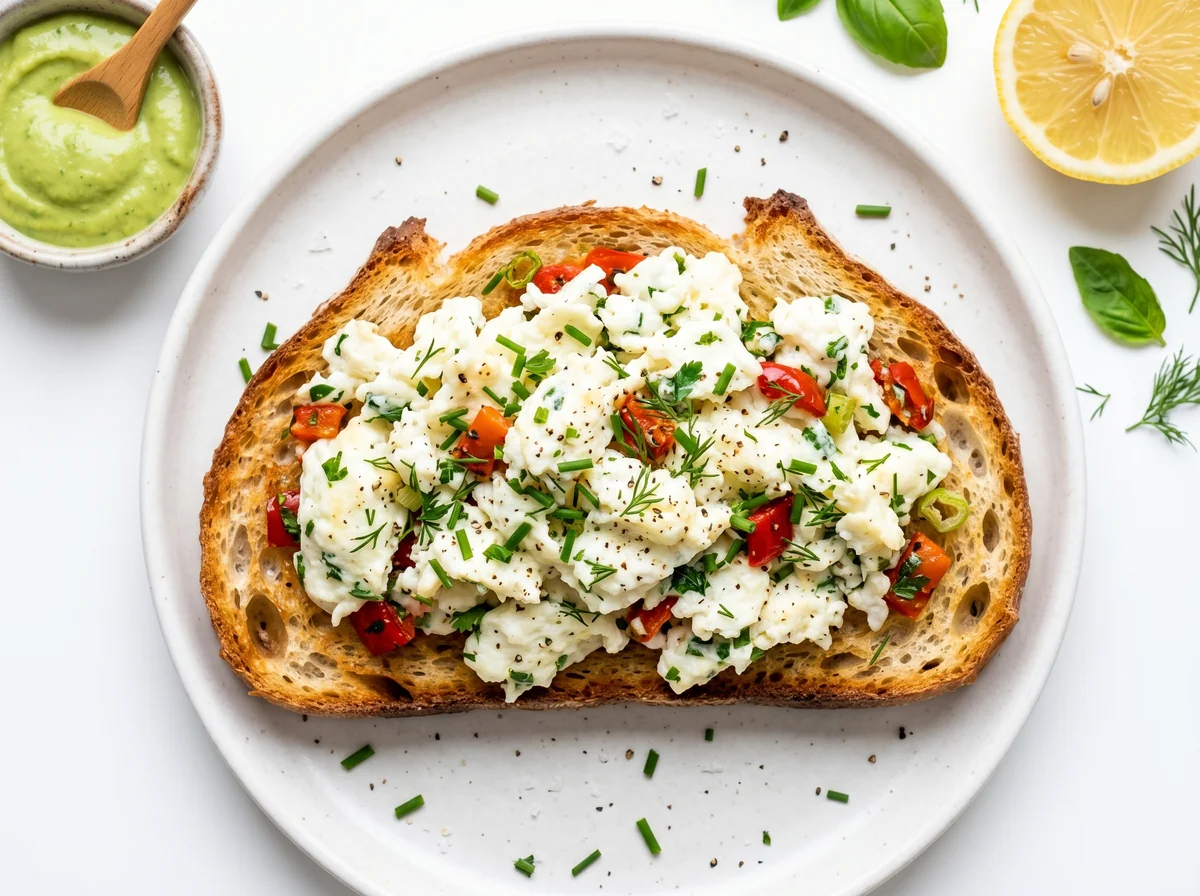
Scrambled egg whites on white toast — a renal-diet breakfast low in phosphorus, potassium and sodium, with red pepper, herbs and lemon instead of salt.
On renal diet mornings, breakfast becomes a small challenge — most familiar morning dishes carry more phosphorus or sodium than a stressed kidney can handle. This dish was born from a simple idea: take egg whites, that pure protein that leaves phosphorus behind in the yolk, scramble them soft over golden, crispy white toast.
Garnish with red pepper cubes for color and flavor, green herbs and a squeeze of lemon to compensate for the absence of salt and cheese. The result is a warm, familiar-looking breakfast that is light on the kidneys, proving that dietary restrictions do not have to mean a bland plate.
Preparation Steps
Prepare the vegetables
Cut the red pepper into small 0.5 cm cubes, and finely chop the parsley and the green part of the green onion. Small pieces ensure quick, even cooking and distribute the flavor evenly in every bite.
Whisk the egg whites
Whisk the egg whites in a bowl with a fork for about 30 seconds until uniform and light bubbles appear on the surface. Good whisking incorporates air that makes the scramble tender rather than rubbery.
Toast the bread
Toast the white bread slices in the toaster on medium for 2 minutes until light golden with crisp edges. The golden color signals a texture that holds the topping without crumbling under it.
Sauté the vegetables
Heat the olive oil in a non-stick pan over medium heat, then add the minced garlic and red pepper and stir for a minute and a half until the garlic is fragrant and the pepper softens slightly. Brief sautéing releases the garlic flavor without burning and turning it bitter.
Cook the egg whites
Reduce the heat to low, pour the whisked egg whites over the vegetables, and leave for about 20 seconds, then gently stir with a wooden spoon from the edges toward the center for 2 minutes until set but still moist and glossy. Low heat and intermittent stirring prevent the whites from drying out and clumping.
Season and serve
Turn off the heat. Add the green onion, parsley, lemon juice and black pepper, and stir gently. Spoon the whites over the toasted bread slices and serve immediately. Lemon and herbs compensate for the lack of salt with a refreshing flavor, and serving immediately preserves the bread's crunch.
Blood Sugar Impact
The glycemic index (GI) measures how quickly a food raises blood sugar, while the glycemic load (GL) measures how much a full serving raises it. Together they give the complete picture.
Glycemic Index
GI
65Medium
Low0–55Medium56–69High70+
A low value (≤55) means a gradual rise in blood sugar — the most suitable range for diabetes and insulin resistance.
Glycemic Load
GL
16Medium
Low0–10Medium11–19High20+
Glycemic load reflects the impact of the full serving. To lower it: take half a serving, or pair the recipe with a source of protein and fiber.
Nutritional Information
Per ServingMakes 2 servings · one serving is about 200 g of raw ingredients
Calories250 kcal12%of Daily Value*
Protein15 g30%of Daily Value*
Carbohydrates27 g10%of Daily Value*
Fat8 g10%of Daily Value*
Fiber2 g7%of Daily Value*
Sodium389 mg17%of Daily Value*
Potassium293 mg6%of Daily Value*
Phosphorus65 mg5%of Daily Value*
* Percent Daily Values are based on a 2,000-calorie diet per FDA food-label reference values — your daily needs may be higher or lower. Values are derived from the recipe's ingredients via the USDA database.
Troubleshooting
The most common problems when preparing Scrambled Egg Whites on White Toast, and how to fix them:
Egg whites came out dry and rubbery
Heat was too high or cooking time too long. Cook over low heat and turn off while the whites are still slightly glossy — they finish cooking in their own residual heat.
Egg whites stuck to the pan
Use a non-stick pan and make sure the oil is hot and covering the base before pouring in the whites — do not stir in the first twenty seconds until a cohesive surface forms.
Toast became soft under the topping
Serve the dish immediately after assembling, and spoon the whites onto the toast at the moment of serving, not before. You can also toast the bread a shade darker so it resists moisture longer.
Dish tastes bland because of reduced salt
Increase the lemon juice, black pepper and parsley, and add more of the green part of the green onion. Acidity and herbs trick the palate into perceiving a deeper flavor without sodium.
Red pepper stayed raw and hard
Cut it smaller and sauté for an extra minute before pouring in the egg whites, or soften it with a spoonful of water covered for half a minute.
Storage and Make-Ahead
Refrigerator
Store the cooked egg whites alone in an airtight container for up to two days, and toast fresh bread at serving time. Do not store the assembled dish — the bread will become soggy.
Reheating
Reheat the egg whites in a pan over low heat for a minute with a splash of water to restore moisture, or in the microwave for twenty seconds. Avoid over-reheating as they will dry out.
Meal prep
You can cut the pepper and herbs and store them in the refrigerator overnight in a sealed container, so your morning routine is reduced to whisking the egg whites and cooking.
Freezing
Freezing cooked egg whites is not recommended — the texture becomes watery and rubbery after thawing. Best cooked fresh.
Tested Ingredient Substitutions
Original Ingredient
Tested Substitute
Ratio
Flavor Difference
Egg whites
Pasteurized packaged egg whites
200 g for 200 g
Read the label and choose a variety free from added sodium — some packaged products contain added salt.
White bread
Low-sodium white bread
Slice for slice
A better option for kidney patients if available — some commercial breads hide added phosphates and sodium.
Red bell pepper
Diced zucchini
60 g for 60 g
Zucchini is also low in potassium and gives a softer texture — sauté exactly as you would the pepper.
Olive oil
Canola oil
15 ml for 15 ml
A flavor-neutral alternative low in saturated fat — suitable if you prefer a lighter taste.
Parsley
Fresh coriander
10 g for 10 g
Gives a different refreshing flavor — both are green herbs to be added at the end to preserve their color.
How Much Does It Make? Scaling Guide
Ingredient
2 servings
4 servings
6 servings
Egg whites
200 g
400 g
600 g
White bread
3 slices
6 slices
9 slices
Red pepper
60 g
120 g
180 g
Olive oil
15 ml
30 ml
45 ml
Lemon juice
10 ml
20 ml
30 ml
EEINA Nutrition Tip
To reduce potassium further, soak the diced red pepper in cold water for ten minutes before cooking then drain it — soaking draws out some of the soluble potassium. Also make sure the bread is refined white, not brown, and read the product label to check for the added phosphate and sodium content that can hide in some commercial breads.
Add This Recipe to Your Plan
The EEINA app saves your favorite recipes, calculates them from their real ingredients, and shows your daily numbers toward your goal. Try it free now.
Yes — egg whites are one of the best protein sources for kidney patients because they are high biological value protein and very low in phosphorus, as phosphorus concentrates in the yolk. But the allowed amount of protein differs depending on your disease stage and the presence of dialysis, so adjust the number of egg whites with your renal dietitian.
Why white bread and not the healthier brown bread?
In a renal diet, the usual rule is reversed. Brown bread and whole grains retain the bran that is rich in phosphorus and potassium — minerals that accumulate dangerously when the kidneys weaken. Refined white bread is lower in these minerals, making it the more suitable choice here despite being lower in fiber.
How do I give the dish flavor without much salt?
Rely on acidity, herbs and garlic. Lemon juice, parsley, green onion, black pepper and garlic build layers of flavor that occupy the palate in the absence of salt. Add salt in only the minimum necessary amount, and avoid salt substitutes containing potassium as they are dangerous for the kidneys.
Can I use a whole egg instead of whites only?
It is possible but requires caution. The yolk significantly raises phosphorus, so if you want to add it, limit it to one yolk for the whole dish and discuss this with your nephrologist — your phosphorus allowance may be precisely limited based on your test results.
Is this recipe suitable for someone undergoing kidney dialysis?
It is generally suitable and dialysis patients may actually need higher protein, as protein needs increase after dialysis begins. But this is an entirely individual decision that depends on your test results and program — do not adopt it without consulting your medical team.