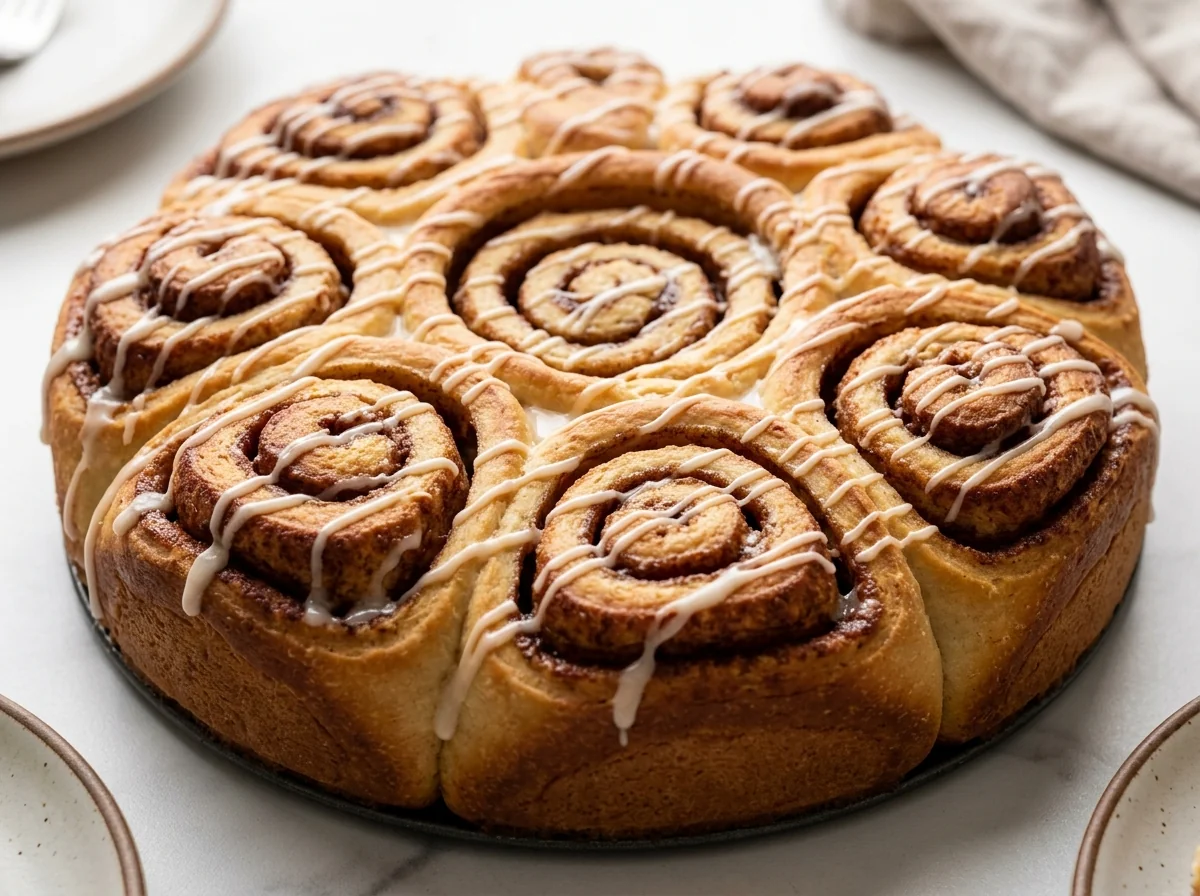
A yeasted dough with milk, butter, and egg rises for an hour, is brushed with butter and sprinkled with a mixture of sugar, cinnamon, and walnuts, then cut into ropes and wound into one large coil and baked at 190°C, with a powdered sugar and vanilla mixture drizzled over the top in threads.
Cinnabon in the form of a single cake rather than separate rolls: the dough is cut into ropes after being filled with cinnamon, then wound rope around rope into one large coil that fills the pan.
The shape gives what separate rolls cannot, since every turn fuses with its neighbor and stays tender inside, and the threads of powdered sugar on top are the signature of this pastry.
Preparation Steps
Knead and prove
Knead the dough ingredients together until smooth, and leave the dough to rise for an hour until doubled in size.
Butter and fill
Brush the rolled-out dough with the butter and sprinkle the filling mixture of sugar, walnuts, and cinnamon over it, pressing the filling onto the surface of the dough so it holds.
Cut into ropes
Cut the dough crosswise into ropes, trimming away the edges the filling did not reach.
Wind the coil
In a greased dish or pan, start by rolling the first strip like a roll, then wind the remaining ropes around it until you have one large coil.
Bake
Heat the oven to 190°C and bake for 25 to 30 minutes until cooked and lightly golden on top.
Decorate
Mix the topping ingredients of powdered sugar and vanilla and drizzle them over the cake in threads.
Blood Sugar Impact
The glycemic index (GI) measures how quickly a food raises blood sugar, while the glycemic load (GL) measures how much a full serving raises it. Together they give the complete picture.
Glycemic Index
GI
67Medium
Low0–55Medium56–69High70+
A low value (≤55) means a gradual rise in blood sugar — the most suitable range for diabetes and insulin resistance.
Glycemic Load
GL
54High
Low0–10Medium11–19High20+
Glycemic load reflects the impact of the full serving. To lower it: take half a serving, or pair the recipe with a source of protein and fiber.
Nutritional Information
Per ServingMakes 6 servings · one serving is about 160 g of raw ingredients
Calories513 kcal26%of Daily Value*
Protein9 g18%of Daily Value*
Carbohydrates84 g31%of Daily Value*
Fat16 g21%of Daily Value*
Fiber3 g11%of Daily Value*
Sodium408 mg18%of Daily Value*
Potassium151 mg3%of Daily Value*
Phosphorus191 mg15%of Daily Value*
* Percent Daily Values are based on a 2,000-calorie diet per FDA food-label reference values — your daily needs may be higher or lower. Values are derived from the recipe's ingredients via the USDA database.
Troubleshooting
The most common problems when preparing Cinnamon Roll Cake, and how to fix them:
The coil came apart in the pan
The ropes were wound loosely, or they were cold. Wind them slightly taut with the dough at room temperature, and set them snug in the pan so they support one another.
The top browned while the middle stayed raw
The coil is thick and the heat high. Keep to 190°C as the source says, and cover the top with foil if the color deepens before the center is done.
The filling leaked out of the coil
The butter was melted rather than at room temperature, so the sugar ran with it. Use soft butter that spreads, as the source specifies.
The cake came out dry
It baked past thirty minutes. The cue is a lightly golden top, not a deeply browned one, and checking starts at minute twenty-five.
Storage and Make-Ahead
At room temperature
Covered for two days, and it is at its most tender on the first day.
Reheating
In the oven at 150°C for five minutes to restore its softness, or half a minute in the microwave for a single slice.
Freezing
Freeze baked and undecorated for up to a month, reheat in the oven, then decorate fresh.
Make ahead
Knead and wind it and keep it in the refrigerator overnight, taking it out half an hour before baking.
Tested Ingredient Substitutions
Original Ingredient
Tested Substitute
Ratio
Flavor Difference
Walnuts
Pecans, or leaving them out
30 g
The source lists them as optional anyway, and pecans are sweeter in flavor and softer in texture.
Powdered sugar in the topping
Half the amount
60 g
A full cup of topping is very sweet, and half is enough for visible threads.
Butter
Coconut oil
42 g
A plant-based swap for both dough and filling, with a light flavor that shows alongside the cinnamon.
Milk
Unsweetened almond milk
60 ml
A dairy-free option; the dough comes out slightly less rich.
How Much Does It Make? Scaling Guide
Servings
Flour
Filling sugar
Cinnamon
Butter
3 servings (half the quantity)
180 g
34 g
4 g
21 g each
6 servings (base)
360 g
67 g
8 g
42 g each
12 servings (double)
720 g
134 g
16 g
84 g each
EEINA Nutrition Tip
Trim away the edges the filling did not reach, as the source instructs: leaving them gives a rope with no cinnamon that breaks up the flavor of the coil. And wind the ropes while the dough is soft, not cold, because cold dough cracks as it winds and will not fuse.
Add This Recipe to Your Plan
The EEINA app saves your favorite recipes, calculates them from their real ingredients, and shows your daily numbers toward your goal. Try it free now.
Why cut the dough into ropes instead of rolling it into rolls?
That is the source's method, and it is what makes this a single cake rather than separate rolls: the ropes wind around one another into a large coil that holds its moisture better than small individual rolls.
Are the walnuts necessary?
No. The source lists them as optional in the filling ingredients, and the filling works with the sugar and cinnamon alone.
What is the sign it is done?
Twenty-five to thirty minutes at 190°C as the source specifies, with a lightly golden top as the cue. A skewer pushed into the center of the coil should come out clean.
When do I drizzle the topping?
Right after baking while the cake is warm, so the mixture runs in threads and sets. Drizzling it on a very hot cake melts it and floods the surface.
Sources: USDA · University of Sydney · Our methodology · Updated on