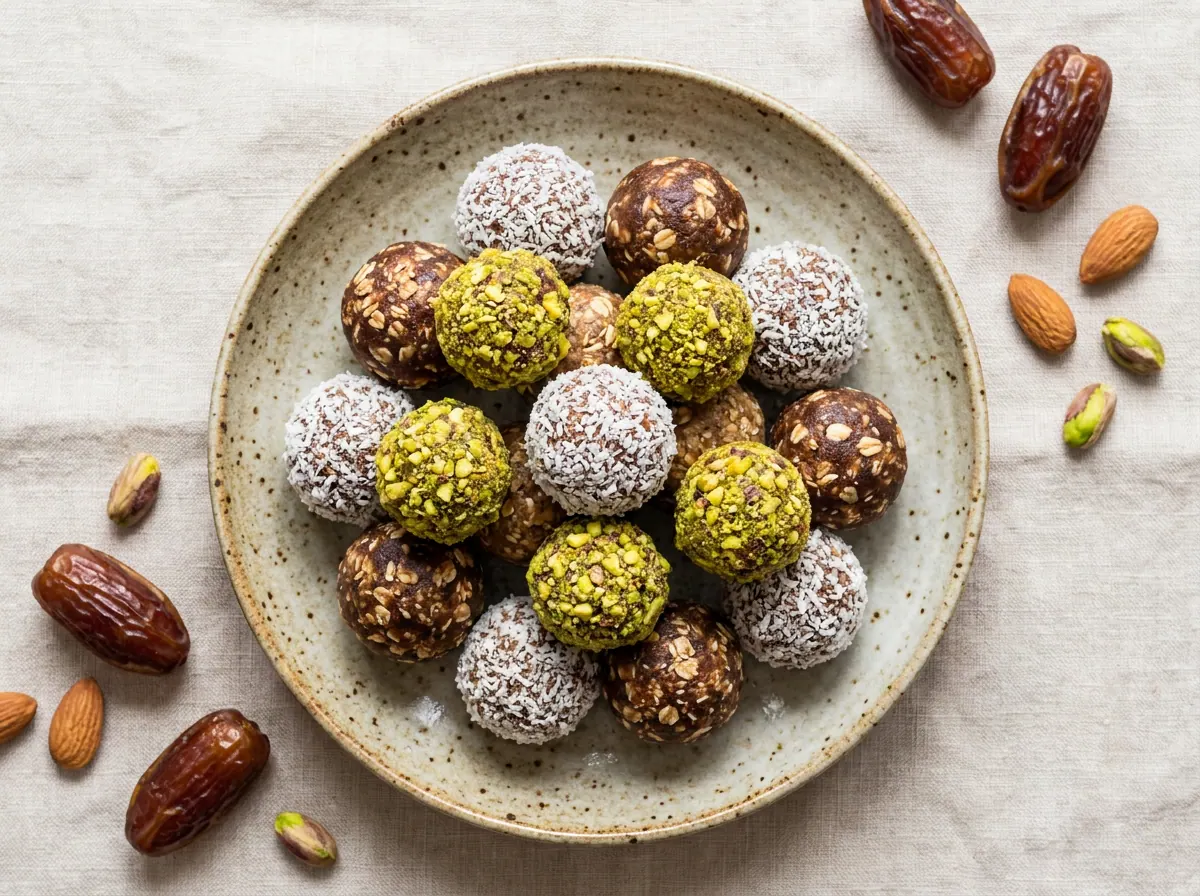
Date energy balls are an old idea made new: the Arab traveller's provision was a handful of dates and a handful of nuts — this recipe combines them into a single, easy-to-carry piece. All sweetness comes from the dates, with no added sugar, honey, or syrup.
The nutritional secret lies in the pairing: dates are concentrated natural sugar, but the fats, protein, and fibre in the almonds, walnuts, and seeds slow gastric emptying and soften the blood sugar spike. One or two balls means gentle energy between meals or before exercise.
Preparation Steps
Soften the dates
If the dates are dry, soak the pitted dates in warm water for five minutes until they soften, then drain well.
Grind the grains and nuts
Place the oats, almonds, and walnuts in a food processor and pulse coarsely — keep some small chunks for a cohesive texture.
Form the dough
Add the dates, cinnamon, and a pinch of salt, and run the processor until a sticky dough forms that holds together when pressed between your fingers.
Add the seeds
Add the chia seeds or flaxseed and shredded coconut, and pulse briefly to distribute them without fully grinding them in. Add a tablespoon of water if the dough is crumbly.
Shape
Dampen your hands slightly and shape the dough into walnut-sized balls (about 25 g each) — you will get about 16 balls.
Coat
Roll some of the balls in shredded coconut or sesame seeds for garnish if you like.
Chill
Arrange the balls on a plate and refrigerate for at least 30 minutes until firm before serving.
Blood Sugar Impact
The glycemic index (GI) measures how quickly a food raises blood sugar, while the glycemic load (GL) measures how much a full serving raises it. Together they give the complete picture.
Glycemic Index
GI
48Low
Low0–55Medium56–69High70+
A low value (≤55) means a gradual rise in blood sugar — the most suitable range for diabetes and insulin resistance.
Glycemic Load
GL
6Low
Low0–10Medium11–19High20+
Glycemic load reflects the impact of the full serving. To lower it: take half a serving, or pair the recipe with a source of protein and fiber.
Nutritional Information
Per ServingMakes 16 servings · one serving is about 25 g of raw ingredients
Calories102 kcal5%of Daily Value*
Protein3 g6%of Daily Value*
Carbohydrates15 g5%of Daily Value*
Fat4 g5%of Daily Value*
Fiber3 g11%of Daily Value*
Sodium301 mg13%of Daily Value*
* Percent Daily Values are based on a 2,000-calorie diet per FDA food-label reference values — your daily needs may be higher or lower. Values are derived from the recipe's ingredients via the USDA database.
Troubleshooting
The most common problems when preparing Date, Oat, and Nut Energy Balls, and how to fix them:
Dough is crumbly and will not hold together
The dates are dry or there are too few of them — no stickiness to bind the ingredients. Dates are the natural glue. To fix: add a tablespoon of warm water or two extra mashed dates and run the processor until the dough comes together when pressed between your fingers. Soft dates like Medjool bind better than dry dates.
Dough is too sticky and clings to the hands
Date ratio is high or there are too few nuts, adding excess moisture. Add two tablespoons of ground oats or a tablespoon of ground flaxseed to absorb the excess, and dampen your hands slightly when shaping so the dough does not stick.
Balls fall apart after chilling
The dough was not pressed firmly enough when shaping, or it did not have enough chilling time. Press each ball firmly between both palms until it holds, then refrigerate for at least 30 minutes. The cold firms up the nut and coconut fats and sets the ball.
Taste is too sweet
The dates are an intensely sweet variety like Medjool, or there are too many. To balance: add a tablespoon of extra chopped almond or walnut, an additional pinch of salt, and a quarter teaspoon of cinnamon. Salt and nuts break the intensity of the sweetness without adding a substitute sugar.
Dense, doughy texture with no crunch
The nuts were ground too finely and dissolved into the dough. Pulse the oats, almonds, and walnuts coarsely with short bursts and leave some small pieces. The crunch comes from keeping the nuts at a visible size, not grinding them to a powder.
Balls dry out and crack after two days
Stored uncovered and the moisture evaporated. Keep in an airtight container in the refrigerator. If they have dried a little, a light sprinkle of water and two minutes at room temperature will restore their softness before serving.
Storage and Make-Ahead
Refrigerator (4°C)
The finished balls keep for a full week in an airtight container. They firm up more as they chill and their texture stays stable. Separate layers with baking paper to stop the balls sticking to each other.
Freezer (-18°C)
Freezes perfectly. Arrange them individually on a tray until frozen, then transfer to a sealed bag. They keep for three months. Thaw for ten minutes at room temperature before eating.
Advance prep
Weekly batch: make the full quantity in fifteen minutes and keep them for the days ahead. The dough alone: can be kept in the refrigerator for two days before shaping — leave for a few minutes at room temperature to soften before rolling.
Serving
Serve cold from the refrigerator or after a few minutes at room temperature. One or two balls for energy between meals or before exercise. Do not leave them in high heat for long or the nut fats will soften.
Tested Ingredient Substitutions
Original Ingredient
Tested Substitute
Ratio
Flavor Difference
Almonds and walnuts
Sunflower or pumpkin seeds
Same weight
Free of tree nuts, lighter flavour, smoother texture
Rolled oats
Certified gluten-free oats
Same quantity
Free of gluten traces [5], nearly the same texture and flavour
Chia seeds or flaxseed
Toasted sesame seeds
Same quantity
More pronounced toasted flavour, sweetness unchanged
Shredded coconut
Raw unsweetened cocoa powder
1 tbsp
Darker colour and a chocolate flavour — needs a small extra splash of water
Cinnamon
Ground cardamom
Same quantity
A warm Gulf flavour in place of the cinnamon sweetness
How Much Does It Make? Scaling Guide
Number of balls
Date paste
Oats
Almonds and walnuts
Seeds
8 (small batch)
100 g
50 g
40 g
10 g
16 (base)
200 g
100 g
80 g
20 g
24 (entertaining)
300 g
150 g
120 g
30 g
32 (a month's supply)
400 g
200 g
160 g
40 g
EEINA Nutrition Tip
The portion is the key: these balls are healthy because they contain no added sugar, but their sweetness from dates is concentrated. One or two balls carry a low glycaemic load — but four or five add up and raise the calorie count. Keep them as a small energy reward, not a full meal.
Add This Recipe to Your Plan
The EEINA app saves your favorite recipes, calculates them from their real ingredients, and shows your daily numbers toward your goal. Try it free now.
One or two balls are appropriate because their glycaemic load is low and the fibre and fats slow sugar absorption. But dates are concentrated natural sugar — eating four or five balls will raise the load. Best to consult your doctor about the right portion for you.
Do they contain added sugar?
No — all sweetness comes from the dates, with no honey, syrup, or white sugar.
Can I make them gluten-free?
Yes — use oats labelled 'gluten-free'. Oats themselves are naturally gluten-free but susceptible to cross-contamination during processing.
How long do they keep?
A week in the refrigerator in an airtight container, and three months in the freezer. Thaw for a few minutes before eating.
Sources: USDA · University of Sydney · Gulf GSO · Our methodology · Updated on