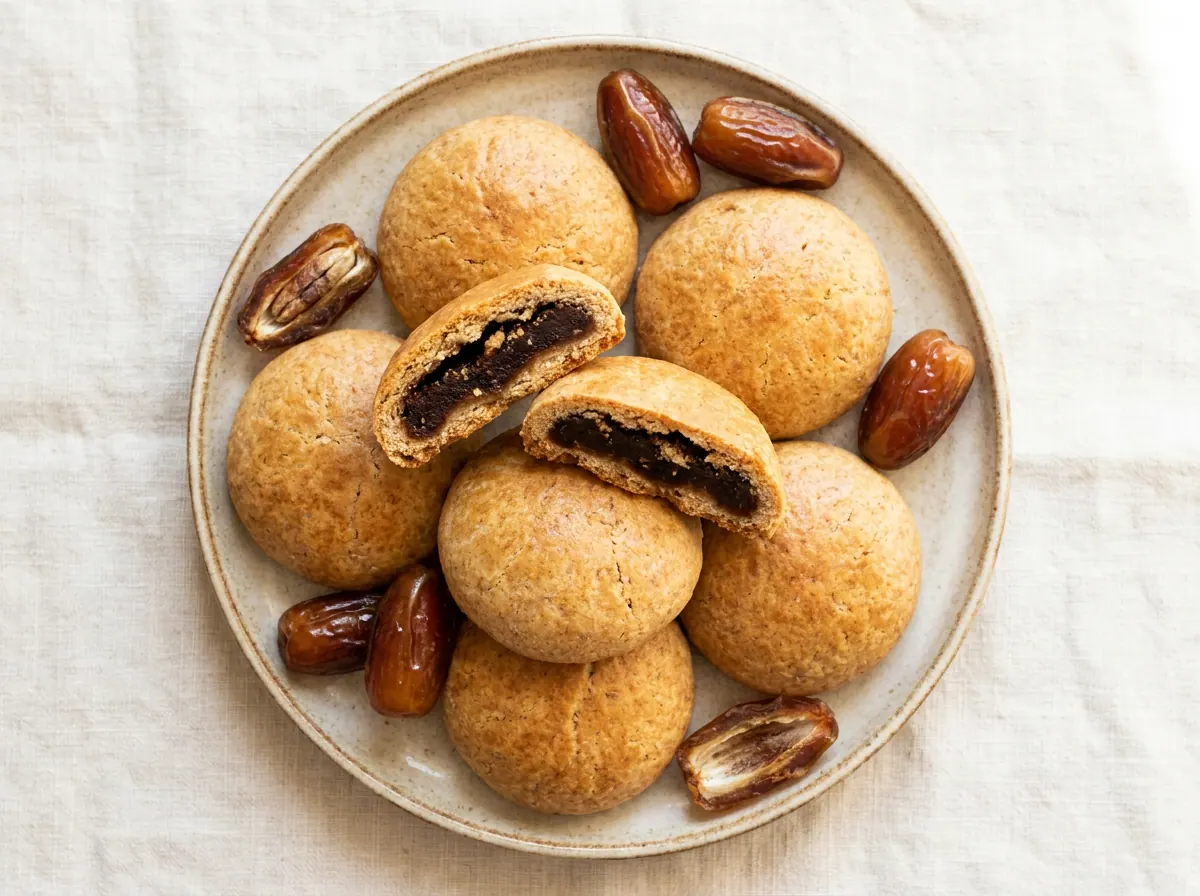
Kleeja with Date and cardamom (Qassimi Date Cookies)
Authentic Qassimi kleeja with a date, cardamom, and loomi (dried black lime) filling. A heritage celebration sweet with an estimated GI of 51 — serve in small portions of one or two pieces.
Kleeja is the foremost sweet of the Qassim region, inseparable from celebrations, coffee gatherings, and the return of travelers. It is a whole-wheat dough filled with date paste and perfumed with a blend of four aromatics — cardamom, cinnamon, ginger, and loomi (dried black lime) — then shaped in an engraved wooden mold that identifies each Qassimi household.
Its secret lies in the balance between dough and filling, and between the four spices. The dates give it natural sweetness along with potassium and magnesium, but it remains a rich sweet made with ghee and starchy dough, so its proper place is on a celebration plate in small portions, not as a daily staple.
Preparation Steps
Prepare the date filling
Heat a tablespoon of ghee and add the date paste along with the cardamom, cinnamon, ginger, and loomi (dried black lime). Stir over low heat until the dates soften and everything comes together, then leave to cool.
Rub the dry ingredients with the ghee
Combine the flour, powdered milk, cardamom, and ginger with the ghee, then rub the mixture between your palms until it resembles coarse, damp sand.
Knead and rest
Add warm water gradually and knead until a soft, non-sticky dough comes together. Cover and leave to rest for half an hour.
Divide into balls
Roll the dough into small balls of about thirty grams each and leave them to rest for another half hour so they are easier to shape.
Fill and shape
Flatten each ball and place about eight grams of date filling in the center. Fold the dough over the filling and press the edges closed, then shape with the engraved Qassimi wooden mold.
Glaze
Brush the surface with a mixture of egg yolk and turmeric for a golden color.
Bake
Bake in an oven preheated to 180–200°C for six to fifteen minutes until the surface turns golden, keeping a close eye to prevent drying out.
Serve
When taken out of the oven, turn the pieces gently so the date molasses distributes inside, then serve in small portions of one or two pieces as a celebration sweet.
Blood Sugar Impact
The glycemic index (GI) measures how quickly a food raises blood sugar, while the glycemic load (GL) measures how much a full serving raises it. Together they give the complete picture.
Glycemic Index
GI
51Low
Low0–55Medium56–69High70+
A low value (≤55) means a gradual rise in blood sugar — the most suitable range for diabetes and insulin resistance.
Glycemic Load
GL
11Medium
Low0–10Medium11–19High20+
Glycemic load reflects the impact of the full serving. To lower it: take half a serving, or pair the recipe with a source of protein and fiber.
Nutritional Information
Per ServingMakes 18 servings · one serving is about 45 g of raw ingredients
Calories209 kcal10%of Daily Value*
Protein4 g8%of Daily Value*
Carbohydrates24 g9%of Daily Value*
Fat11 g14%of Daily Value*
Fiber3 g11%of Daily Value*
Sodium11 mg0%of Daily Value*
* Percent Daily Values are based on a 2,000-calorie diet per FDA food-label reference values — your daily needs may be higher or lower. Values are derived from the recipe's ingredients via the USDA database.
Troubleshooting
The most common problems when preparing Kleeja with Date and cardamom (Qassimi Date Cookies), and how to fix them:
Filling leaks out during baking
The dough was rolled too thin, too much filling was used, or the edges were not sealed firmly. Use about eight grams of filling per thirty grams of dough, press the edges closed with your finger, then shape with the mold. Slightly cooled dough is easier to handle than warm dough.
Kleeja is dry and hard after cooling
Overbaked or oven temperature too high — the dough dried out before the center cooked through. Watch the surface from the sixth minute and remove as soon as it turns golden without browning. A little extra ghee or a spoonful of date molasses in the filling keeps them moist, and gently turning the pieces after removing from the oven distributes the date moisture inside.
Dough crumbles and won't hold together
Too little water or the ghee was added cold and lumpy. The ghee should be soft, not solid, when rubbed into the flour, then add warm water gradually until the dough just comes together without sticking. If still crumbly: add two tablespoons of warm water and knead for a minute — do not add all the water at once or it will become sticky.
Surface is pale with no golden color
Glaze was too thin, turmeric was absent, or the oven rack was too low. Mix egg yolk with a pinch of turmeric and brush an even layer just before baking, and place the tray on the middle rack. In the last two minutes, move it to the upper rack so the surface colors without the inside drying out.
Spice flavor is flat or overpowering
Cardamom and loomi (dried black lime) lose their aroma when old, or too much cinnamon masked the others. The balance from practice: one teaspoon each of cardamom, ginger, cinnamon, and loomi for this full quantity. Grind the cardamom and loomi fresh before use, and bloom the spices in the hot filling rather than in the dough so the aroma spreads.
Bottom burned before the surface colored
The tray is too close to the oven floor or the metal is thin and conducts heat too fast. Use a thick tray or double it up with another tray underneath, and place it on the middle rack, not the lower one. If it continues: lower the temperature by ten degrees and extend the time slightly so the top and bottom color together.
Storage and Make-Ahead
Room temperature
Baked kleeja: one to ten days in a sealed container away from moisture and heat, like other dry date pastries. Separate layers with parchment paper to prevent sticking.
Refrigerator (4°C)
Two weeks in a sealed container for those who prefer a firmer texture. Remove half an hour before serving to let them return to room temperature.
Freezer (-18°C)
Freezes well for three months in a sealed bag. Thaw at room temperature and pass through a warm oven for two minutes to restore the crispness.
Advance preparation
Filling: prepare two days ahead and refrigerate in a sealed container. Dough: knead, wrap, and refrigerate overnight; leave at room temperature for half an hour before shaping.
Tested Ingredient Substitutions
Original Ingredient
Tested Substitute
Ratio
Flavor Difference
Sheep ghee or clarified butter
Vegetable oil or butter
Same amount
Less saturated fat with oil, and a lighter flavor than animal ghee
Powdered milk
Plant-based powdered milk
Same amount
Dairy-free, slightly more neutral in flavor
Egg yolk glaze
Date molasses diluted with water
A thin layer
Egg-free, gives a darker and shinier color
Added date molasses
Rely on the mashed dates alone for sweetness
Omit the added molasses
Less sweetness and a lighter glycemic load [2]
Whole-wheat flour
Half whole-wheat, half white flour
Half and half
Smoother texture, less fiber, and a slightly higher glycemic index
How Much Does It Make? Scaling Guide
Number of pieces
Flour
Ghee
Mashed dates
Molasses
12 (small batch)
1.5 cups
0.12 cup
0.5 cup
1.5 tbsp
24 (base)
3 cups
0.75 cup
1 cup
3 tbsp
48 (celebration)
6 cups
1.5 cups
2 cups
6 tbsp
72 (large gift batch)
9 cups
2.25 cups
3 cups
9 tbsp
EEINA Nutrition Tip
Kleeja is a celebration sweet, not a daily food: its sweetness and richness place it in the medium-to-high blood-sugar range. Limit yourself to one or two pieces, pair it with plain Arabic coffee or a handful of nuts to slow absorption, and avoid the extra date molasses if you are watching your blood sugar or weight.
Add This Recipe to Your Plan
The EEINA app saves your favorite recipes, calculates them from their real ingredients, and shows your daily numbers toward your goal. Try it free now.
Only in a small portion. Its estimated index of 60 and glycemic load of 11 place it in the medium range — one piece with a balanced meal is acceptable, but it is not an everyday open option.
What is the difference between date molasses and mashed dates in the filling?
Mashed dates are the body and the base sweetness of the filling; the molasses adds softness, gloss, and extra sweetness. To reduce the glycemic load, rely on the mashed dates and omit the added molasses.
Can it be made without animal ghee?
Yes — substitute the ghee with vegetable oil or butter in the same amount. Oil reduces saturated fat, and the flavor will be lighter than traditional animal ghee.
How long does kleeja keep?
One to ten days at room temperature in a sealed container, two weeks in the fridge, and three months in the freezer — like other dry date pastries.
Sources: USDA · University of Sydney · Gulf GSO · Our methodology · Updated on