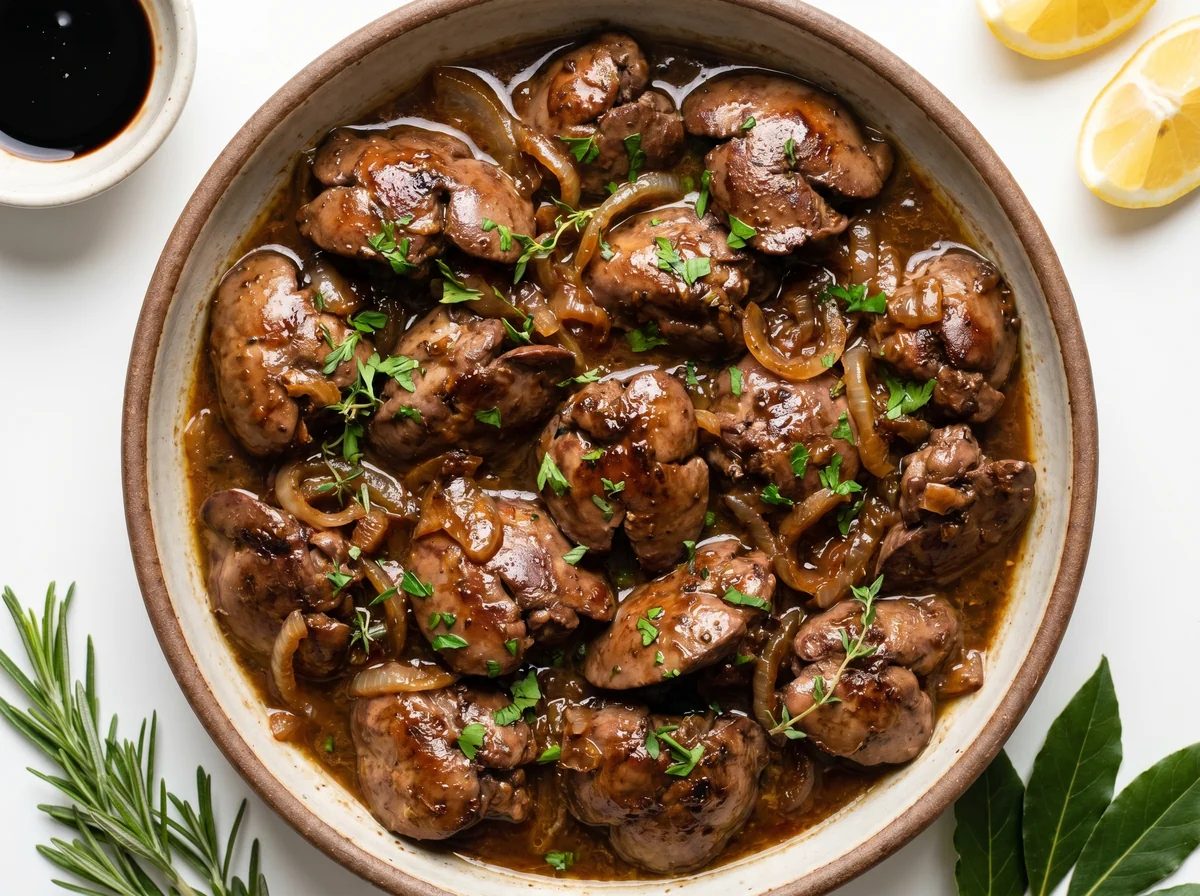
A quick Levantine dish rich in iron — chicken livers quickly pan-fried with onion, garlic, sumac (tart purple spice), and lemon until tender with a browned exterior. Eeina's version uses olive oil and a fast cook, making it high in protein and very low in carbs.
Chicken liver with onions is a quick and beloved Levantine-Lebanese dish, served as a warm starter or a light main.
The secret is a fast sear over high heat with onion and garlic, and the acidity of sumac (tart purple spice) and lemon that balances the richness of the liver and sets it apart. Eeina's version uses olive oil and a quick cook that preserves the tenderness of the liver, delivering a dish that is high in protein and iron, very low in carbs, and gentle on blood sugar.
Preparation Steps
Clean and dry the liver
Clean the chicken livers by removing membranes and veins. Rinse and pat thoroughly dry with paper towels. Drying is essential so the livers brown instead of steaming in their own moisture during frying.
Brown the onion
Heat the olive oil in a wide pan over medium heat. Add the chopped onion and stir until softened and golden, then add the garlic and green chili and stir until fragrant.
Fry the liver
Raise the heat to high and add the dry chicken livers in a single layer without crowding. Leave undisturbed for 2 minutes to brown the surface. High heat and no crowding brown the livers quickly and prevent them from steaming.
Season
Add the baharat (Gulf spice blend), sumac (tart purple spice), and a pinch of salt. Toss the livers for 3 to 4 minutes until cooked through — browned on the outside with a faint pink centre, without drying out. Liver cooks quickly; overdoing it makes it tough and rubbery.
Add the lemon
Pour the lemon juice over the liver and toss for one second on the heat, then turn it off. The lemon and sumac (tart purple spice) add the acidity that balances the richness of the liver and defines the Levantine character of the dish.
Serve
Serve the chicken livers immediately, hot, with bread or a green salad and a garnish of chopped parsley. Excellent as a light main or a warm starter on the table.
Blood Sugar Impact
The glycemic index (GI) measures how quickly a food raises blood sugar, while the glycemic load (GL) measures how much a full serving raises it. Together they give the complete picture.
Glycemic Index
GI
8Low
Low0–55Medium56–69High70+
A low value (≤55) means a gradual rise in blood sugar — the most suitable range for diabetes and insulin resistance.
Glycemic Load
GL
0Low
Low0–10Medium11–19High20+
Glycemic load reflects the impact of the full serving. To lower it: take half a serving, or pair the recipe with a source of protein and fiber.
Nutritional Information
Per ServingMakes 4 servings · one serving is about 205 g of raw ingredients
Calories243 kcal12%of Daily Value*
Protein22 g44%of Daily Value*
Carbohydrates8 g3%of Daily Value*
Fat13 g17%of Daily Value*
Fiber2 g7%of Daily Value*
Sodium480 mg21%of Daily Value*
* Percent Daily Values are based on a 2,000-calorie diet per FDA food-label reference values — your daily needs may be higher or lower. Values are derived from the recipe's ingredients via the USDA database.
Troubleshooting
The most common problems when preparing Chicken Liver with Onions and Sumac, and how to fix them:
Liver is tough and rubbery
Overcooked. Liver is done in 5 to 7 minutes total — keep it faintly pink in the centre and pull it off the heat immediately, as overcooking is what makes it tough.
Liver steamed instead of browning
Not dried, crowded, or the heat was too low. Pat dry well, spread in a single layer without crowding over high heat, and fry in batches if needed.
Strong liver smell
Not cleaned or not soaked. Remove the membranes and veins, then soak in milk or lemon water for 15 minutes before frying to mellow the smell.
Slight bitter flavour
Remnants of the gallbladder not removed. Carefully cut away any green piece (the bile duct) when cleaning — this is the source of bitterness.
Flavour is flat
Not enough sumac or lemon. The acidity from sumac (tart purple spice) and lemon is what balances the richness of the liver and defines the dish — do not reduce it.
Storage and Make-Ahead
Refrigerator (4°C)
Two days in an airtight container. Cooked liver has a shorter shelf life — reheat gently once only.
Freezer (-18°C)
Raw cleaned liver for one month. Thaw in the refrigerator before cooking. Freezing already-cooked liver is not recommended.
Prep ahead
Clean the liver and chop the onion in advance, then fry fresh at serving time — liver is best straight from the pan.
Reheating
Over low heat quickly until just warm, without prolonged heating so it does not toughen. Do not leave cooked food out of the refrigerator for more than two hours [2].
Tested Ingredient Substitutions
Original Ingredient
Tested Substitute
Ratio
Flavor Difference
Chicken liver
Lamb or beef liver
Same weight
Stronger, more intense flavour — needs the same clean-and-quick-fry approach
sumac (tart purple spice)
Pomegranate molasses
1 tsp
A gentle sweet-and-sour alternative — also a classic Levantine ingredient
Green chili
Black pepper only
A pinch
For those who do not like heat — a milder, gentler flavour
Olive oil
ghee
Same quantity
A richer flavour in the traditional style — higher saturated fat
Lemon juice
Apple cider vinegar
Half the quantity
Alternative acidity to balance the richness of the liver
How Much Does It Make? Scaling Guide
Servings
Liver
Onion
Lemon
Pan
2 (single × 2)
250 g
1 piece
1 spoon
small pan
4 (base)
500 g
2 pieces
2 spoons
large pan
6 (family)
750 g
3 pieces
3 tablespoons
large pan
8 (hosting)
1 kg
4 pieces
4 tablespoons
2 pans
EEINA Nutrition Tip
Chicken liver is one of the richest foods in iron, vitamin A, and protein, and is very low in carbs — excellent for anyone with anaemia, weight management goals, or blood sugar monitoring. However, it is high in cholesterol and vitamin A, so enjoy it in moderation (once a week) and avoid it during pregnancy due to elevated vitamin A levels.
Add This Recipe to Your Plan
The EEINA app saves your favorite recipes, calculates them from their real ingredients, and shows your daily numbers toward your goal. Try it free now.
Clean it well by removing the membranes and veins, then soak in milk or water with lemon for 15 minutes before frying. Good drying and frying over high heat also reduce the smell.
How do I know when the liver is cooked without going tough?
It turns brown on the outside and faintly pink in the centre, and stays tender. Five to seven minutes over high heat is enough. If it turns grey and firm all the way through, it has been overcooked.
Is chicken liver suitable for people with diabetes?
Yes — it is high in protein and very low in carbs with a very low glycaemic index. Just be mindful of its high cholesterol content: enjoy it in moderation and serve with a green salad.
Who should avoid chicken liver?
Pregnant women are advised to avoid it due to high vitamin A levels, and anyone monitoring their cholesterol should keep it to once a week. For everyone else, it is an excellent source of iron and protein in moderation.
What goes well with chicken liver?
Serve hot with bread or a green salad or Fatteh, as a light main or a warm starter. A squeeze of extra lemon at serving brightens the flavour.
Sources: USDA · University of Sydney · Our methodology · Updated on