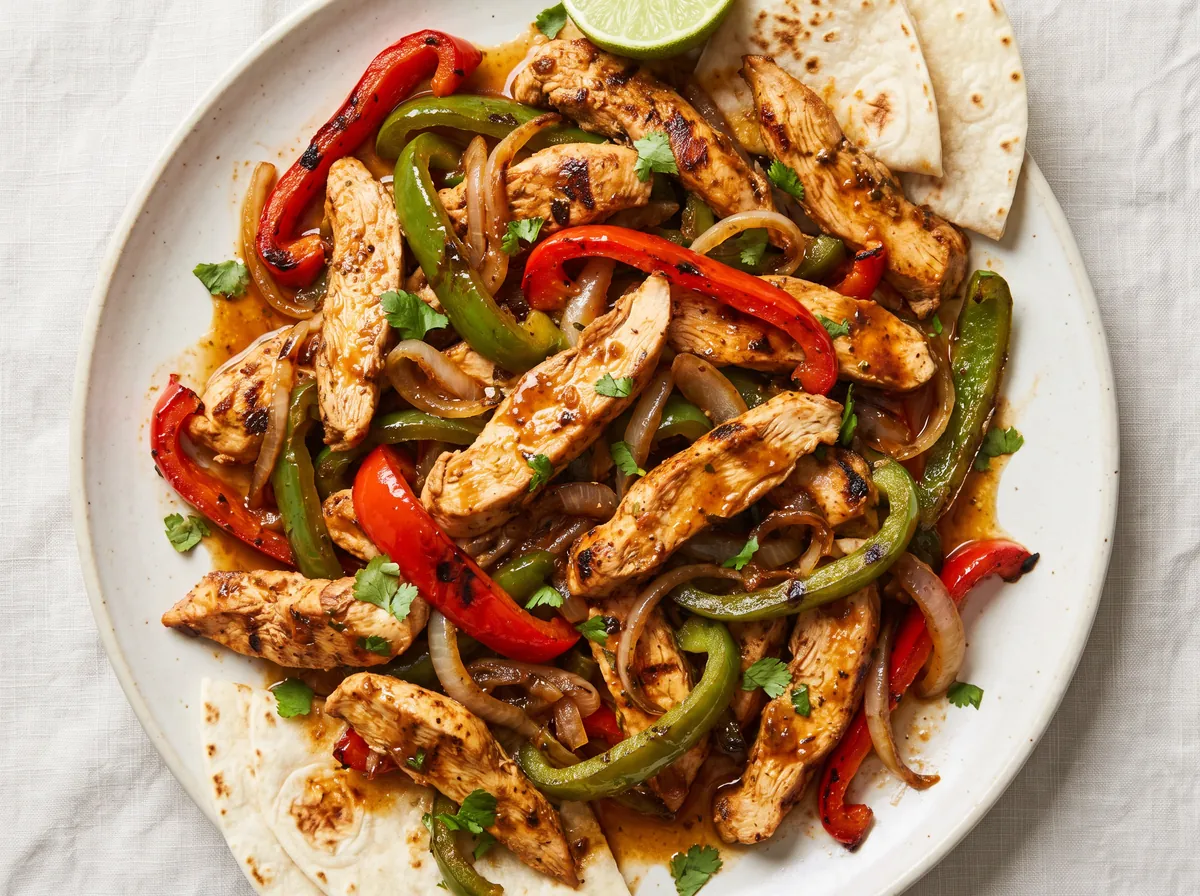
Chicken cut into strips is marinated for two hours in lemon juice, soy sauce, and fajita seasoning, with bell pepper and onion also marinated, then sautéed over high heat and served in tortillas with tomato sauce, guacamole, sour cream, and cheese.
Fajita is a table dish, not a plate dish: the chicken and bell pepper in the middle, with the sauces and bread around them, and everyone builds their bread as they like.
Its secret is in the high heat and the wide pan, because the vegetables must brown on their edges and stay crunchy inside them, and if we crowd them in a narrow pan they will boil in their water and the whole dish will be lost.
Preparation Steps
Marinate the chicken
In a bowl, place the cut chicken and add to it the juice of one lemon, a tablespoon of olive oil, a tablespoon of soy sauce, and the fajita seasoning, and mix them well until every strip is coated with the marinade, and leave the chicken marinated for at least two hours.
Marinate the vegetables
Place the chopped bell pepper and onion in another bowl and mix them with a tablespoon of olive oil, a tablespoon of soy sauce, salt, and pepper, and leave them for two hours as well. Separating the vegetables from the chicken is intentional, as each has a different cooking time.
Prepare the sauces
Right before starting the cooking process, prepare the sauces, as they are eaten cold and fresh, and a long time wilts the tomato and blackens the avocado.
Prepare the tomato sauce
Remove the pulp of the tomato and chop it finely, and add over it the cilantro, a tablespoon of olive oil, and a teaspoon of lemon juice or more according to taste, then add the salt and pepper. Removing the pulp is what prevents the sauce from becoming watery in the bread.
Prepare the guacamole
Mash the avocado well with a fork and mix it with half a teaspoon of lemon juice, two tablespoons of the tomato sauce, with the salt and pepper; the lemon here is not only for flavor but prevents the avocado from blackening.
Stir the vegetables
In a wide pan on the heat, place the bell pepper and onion with the marinade and stir over high heat for two minutes until their edges soften and remain crunchy, then place the vegetables aside.
Cook the chicken
In the same pan, place the chicken with the marinade and stir over high heat until it is cooked and its surface browns and its liquid dries, then add the vegetables over it and stir for two minutes so the two flavors meet.
Assemble the sandwiches
Place the chicken in the middle of a loaf of bread and put beside it a little of the tomato sauce, guacamole, and sour cream, sprinkle the cheese over them, roll it up, and serve immediately while warm.
Blood Sugar Impact
The glycemic index (GI) measures how quickly a food raises blood sugar, while the glycemic load (GL) measures how much a full serving raises it. Together they give the complete picture.
Glycemic Index
GI
23Low
Low0–55Medium56–69High70+
A low value (≤55) means a gradual rise in blood sugar — the most suitable range for diabetes and insulin resistance.
Glycemic Load
GL
9Low
Low0–10Medium11–19High20+
Glycemic load reflects the impact of the full serving. To lower it: take half a serving, or pair the recipe with a source of protein and fiber.
Nutritional Information
Per ServingMakes 4 servings · one serving is about 535 g of raw ingredients
Calories778 kcal39%of Daily Value*
Protein44 g88%of Daily Value*
Carbohydrates53 g19%of Daily Value*
Fat44 g56%of Daily Value*
Fiber12 g43%of Daily Value*
Sodium1674 mg73%of Daily Value*
Potassium1238 mg26%of Daily Value*
Phosphorus486 mg39%of Daily Value*
* Percent Daily Values are based on a 2,000-calorie diet per FDA food-label reference values — your daily needs may be higher or lower. Values are derived from the recipe's ingredients via the USDA database.
Troubleshooting
The most common problems when preparing Chicken Fajita, and how to fix them:
The vegetables wilted and swam in water
The pan is narrow or the heat is not high enough, so the water of the vegetables came out and boiled them. We use a wide pan over high heat and stir for no more than two minutes.
The chicken came out dry
It was stirred for too long after being cooked. We lift it as soon as its surface browns and its liquid stops, as it finishes cooking with its remaining heat.
The guacamole blackened
The avocado was exposed to air. We add a little more lemon juice and cover its surface with cling film in contact until serving time.
The bread tore when rolling
The bread is cold or the filling is too much. We heat the loaf for seconds on the griddle until it softens, and we reduce the filling and leave it on the edges.
Storage and Make-Ahead
Chicken and vegetables in the refrigerator
In a sealed container for three days, and heated in a pan over high heat not in the microwave.
Sauces
Tomato sauce two days in the refrigerator, and guacamole one day with cling film in contact with its surface.
Pre-marination
The chicken and vegetables are marinated and kept in the refrigerator for up to one full day; longer marination increases the flavor.
Freezing
The chicken is frozen marinated and raw for up to two months, and the guacamole and sour cream are not frozen.
Tested Ingredient Substitutions
Original Ingredient
Tested Substitute
Ratio
Flavor Difference
Chicken
Thin slices of beef
500 g
The famous beef fajita, and it needs higher heat and a shorter time.
Sour cream
Greek yogurt
120 g
Less fat and higher protein, and the acidity is closer than people think.
Tortilla bread
Romaine lettuce in large leaves
5 leaves
Lowers the carbohydrates a lot and gives cold crunchy wraps.
Fajita seasoning
Paprika, cumin, garlic powder, and oregano
30 g total
A homemade mix for those who did not find the ready packet, and you adjust the salt yourself.
How Much Does It Make? Scaling Guide
Servings
Chicken
Bell pepper
Tortilla
Avocado
Two servings (half quantity)
250 g
120 g
119 g
200 g
4 servings (base)
500 g
240 g
238 g
400 g
8 servings (double)
1000 g
480 g
476 g
800 g
EEINA Nutrition Tip
We stir the vegetables first, then lift them and cook the chicken in the same pan; this is the source order and it is the correct one: the vegetables need two minutes and the chicken needs more, and cooking them together means wilted vegetables or raw chicken. And the wide pan is more important than the strength of the heat.
Add This Recipe to Your Plan
The EEINA app saves your favorite recipes, calculates them from their real ingredients, and shows your daily numbers toward your goal. Try it free now.
The source says 'packet' of fajita seasoning, so what is its weight?
We identified the actual product from the market: a packet of fajita seasoning weighing 30 grams per its label, and we wrote the weight based on that. The source mentions 'a packet' with no weight, and we did not estimate it from ourselves.
And what is the weight of a tortilla loaf?
47.5 grams per loaf, calculated from the label of an actual product in the Saudi market: a large plain tortilla pack of 12 loaves at 570 grams net weight. So the five loaves are 238 grams.
What is the difference between it and our air-fryer fajita?
That one is chicken, bell pepper, seasoning, and oil cooked in the air fryer for fifteen minutes without bread or sauces. This one is marinated for two hours in soy sauce and lemon and sautéed in the pan, and comes with tortilla, tomato sauce, guacamole, sour cream, and cheese. The ingredients and method differ, so they are two recipes.
Why soy sauce in a Mexican dish?
That is what the source says, and it is a common touch in Arab kitchens that gives the marinade a savory depth. Whoever wants the original Mexican version can replace it with salt and green lemon juice.
Why is its sodium high?
From the soy sauce, the seasoning packet, the cheese, and the added salt combined. Reducing the soy sauce to one tablespoon lowers it noticeably with no noticeable effect on the taste.
Sources: USDA · University of Sydney · Our methodology · Updated on