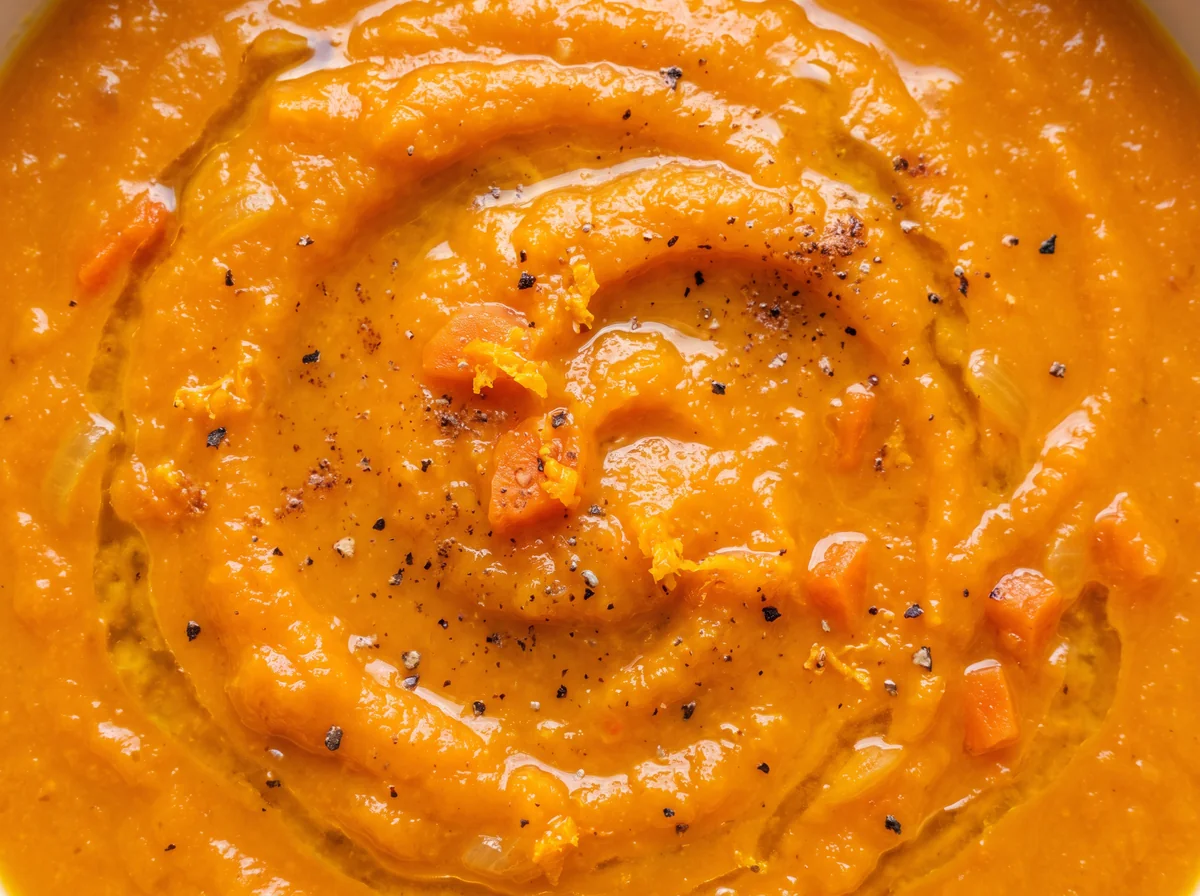
A pureed carrot soup lifted by orange zest and juice, whose citrusy freshness balances the carrots' sweetness, finished with a warm pinch of nutmeg. Its velvety body comes from the carrots alone with no cream, keeping it light on calories and suited to anyone watching their weight.
Carrot and orange are a classic orange-hued pairing in international soups, and this version comes from Sayidaty Kitchen.
We adapted it for weight management and declared every change: we removed the cream and butter entirely and kept only olive oil, increased the carrots beyond the original's two so the puree builds a thick body that makes up for the missing cream, and raised the orange juice to 2 tablespoons so its flavor stays present.
Preparation Steps
Soften the onion
Heat the olive oil in a pot over medium heat, add the onion, and stir for about 5 minutes until it softens and turns translucent without browning.
Add the carrots and orange
Add the carrot rounds, orange juice, orange zest, salt, and black pepper, and stir for 2 minutes so the flavors coat the carrots.
Cook until tender
Pour in the stock and cover the pot. Let the soup simmer over low heat for 20 to 25 minutes until the carrots are completely tender and mash under a fork with no resistance.
Puree the soup
Take the pot off the heat and let it settle for 2 minutes, then puree the mixture with an immersion blender until smooth and velvety. The generous amount of carrots creates the creamy body on its own, no cream needed.
Season with nutmeg and serve
Return the pot to low heat for 2 minutes, add the nutmeg and stir, then taste and adjust the salt. Serve hot, garnished with extra orange zest if you like.
Blood Sugar Impact
The glycemic index (GI) measures how quickly a food raises blood sugar, while the glycemic load (GL) measures how much a full serving raises it. Together they give the complete picture.
Glycemic Index
GI
30Low
Low0–55Medium56–69High70+
A low value (≤55) means a gradual rise in blood sugar — the most suitable range for diabetes and insulin resistance.
Glycemic Load
GL
4Low
Low0–10Medium11–19High20+
Glycemic load reflects the impact of the full serving. To lower it: take half a serving, or pair the recipe with a source of protein and fiber.
Nutritional Information
Per ServingMakes 4 servings · one serving is about 355 g of raw ingredients
Calories106 kcal5%of Daily Value*
Protein2 g4%of Daily Value*
Carbohydrates18 g7%of Daily Value*
Fat4 g5%of Daily Value*
Fiber4 g14%of Daily Value*
Sodium934 mg41%of Daily Value*
Potassium492 mg10%of Daily Value*
Phosphorus59 mg5%of Daily Value*
* Percent Daily Values are based on a 2,000-calorie diet per FDA food-label reference values — your daily needs may be higher or lower. Values are derived from the recipe's ingredients via the USDA database.
Troubleshooting
The most common problems when preparing Carrot and Orange Soup, and how to fix them:
The orange flavor is faint and barely there
Cooked juice loses some of its edge. Add an extra tablespoon of fresh juice after blending along with a pinch of zest — citrus added at the end reads more clearly than citrus cooked for long.
A bitter note in the background
Usually zest that reached the white pith of the peel. Grate only the thin colored layer; if bitterness happens, balance it with an extra splash of orange juice and a few more minutes of cooking.
The texture is thin and watery
Too much stock for the amount of carrots. Let it simmer gently uncovered for 10 minutes to concentrate, or next time start with 2 1/2 cups of stock and add more only at blending if needed.
The texture is heavy like a paste
The carrots absorbed the liquid during a long cook. Add hot stock a tablespoon at a time while stirring until you reach the velvety texture you want.
The sweetness is more than palatable
Carrots are naturally sweet and the orange adds to it. Balance with a squeeze of lemon juice or a small increase in black pepper — acidity and gentle heat cut the sense of excess sweetness.
Storage and Make-Ahead
Refrigerator (4°C)
Keep in an airtight container for up to 3 days after cooling completely. Reheat over low heat while stirring, and add a pinch of fresh orange zest at serving to refresh the flavor. Never leave it at room temperature for more than 2 hours.
Freezer (-18°C)
Freezes well for up to 3 months since it contains no dairy — use individual containers with room for expansion. Thaw overnight in the refrigerator, then heat to a gentle simmer and add a splash of fresh orange juice after reheating.
Reheating
Over low heat with constant stirring, or in the microwave for 2 minutes, stirring halfway through. Add a splash of water or stock if it thickens in storage, and do not reheat the same portion more than once.
Tested Ingredient Substitutions
Original Ingredient
Tested Substitute
Ratio
Flavor Difference
Orange juice and zest
Mandarin juice and zest
Same amount
A sweeter, lighter citrus flavor, and the soup keeps its orange character.
Nutmeg
Ground cumin or grated ginger
1/2 teaspoon cumin or 1 teaspoon ginger
Cumin brings it back to a familiar Arabic character, while ginger moves it toward the classic carrot-ginger soup.
Vegetable stock
Water and a low-sodium stock cube
3 cups of water and 1 cube
Simpler and cheaper — just mind the cube's salt and taste before adding any more.
Carrots alone
Carrots with a piece of sweet potato
Four-fifths carrots and one-fifth sweet potato
A thicker body and deeper sweetness, with a slight rise in carbohydrates and calories.
How Much Does It Make? Scaling Guide
Servings
Carrots
Stock
Orange juice
Orange zest
2 servings
250 g
1 1/2 cups (375 ml)
1 tablespoon
1/2 teaspoon
4 servings
500 g
3 cups (750 ml)
2 tablespoons
1 teaspoon
6 servings
750 g
4 1/2 cups (1125 ml)
3 tablespoons
1 1/2 teaspoons
EEINA Nutrition Tip
Add the orange zest before cooking so the carrots soak up its aroma, and hold back a small pinch of zest for garnish at serving time — fresh zest is more fragrant than cooked. Grate only the colored outer layer of the peel, not the white pith beneath it, which is bitter and spoils the flavor.
Add This Recipe to Your Plan
The EEINA app saves your favorite recipes, calculates them from their real ingredients, and shows your daily numbers toward your goal. Try it free now.
The generous ratio of carrots to stock is the secret: well-cooked carrots puree into a thick, smooth body through their natural starch and fiber. The original relies on cream for this — we compensated by increasing the carrots and stated it openly.
Does the orange juice raise the sugar in the soup?
The amount is 2 tablespoons across four servings — less than a teaspoon of juice per serving — so its effect on the carbohydrates is minimal. Most of the soup's sweetness comes from the carrots themselves, not the juice.
How is it different from carrot-ginger soup?
The base is nearly the same; the difference is in the aromatics. That one leans on ginger, garlic, and cumin for a spicy warmth, while this one leans on orange and nutmeg for a sweet citrusy freshness — each suits a different mood.
Can it be served cold?
Yes — it is pleasant chilled in summer, in the style of cold vegetable soups, after cooling completely in the refrigerator. Adjust the salt and acidity after chilling, since cold mutes the perception of flavor.