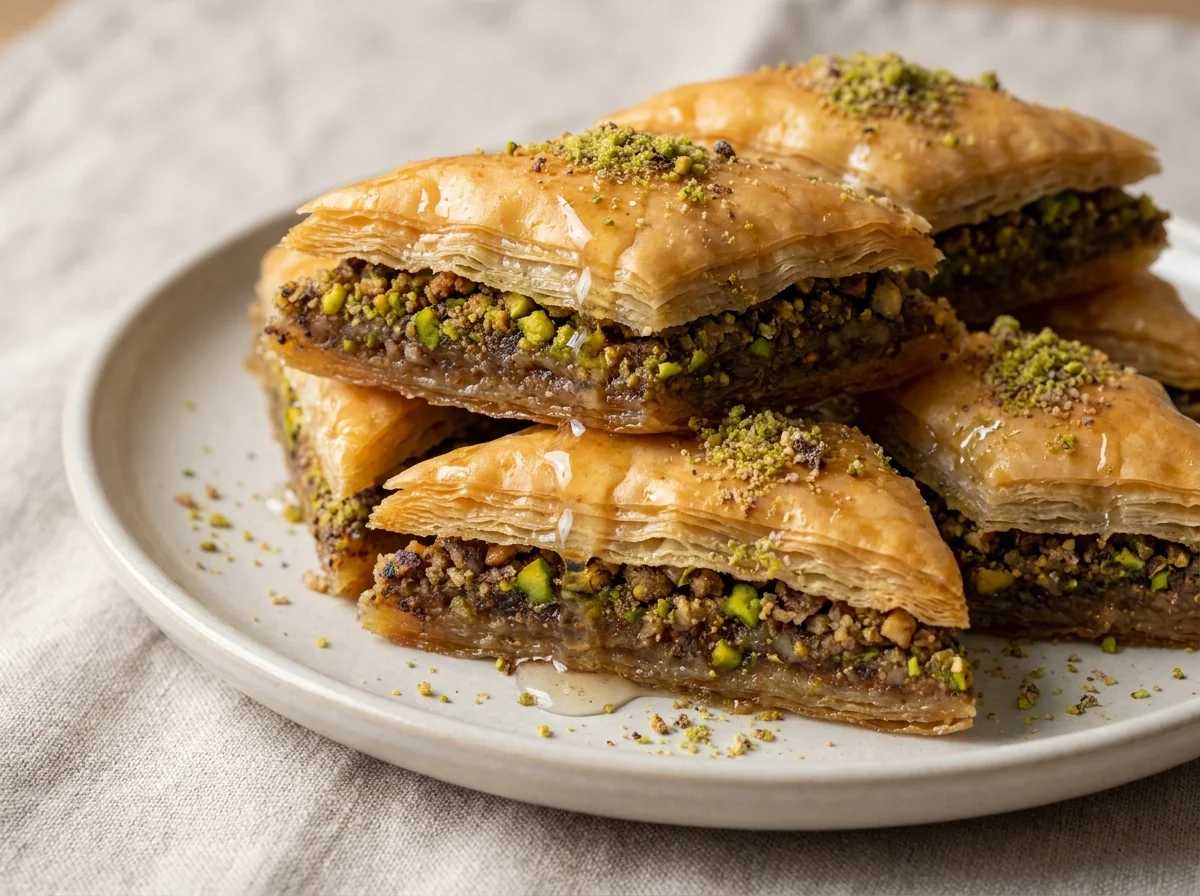
We make baklava the way it is made in the pastry shops of the Levant, layers of thin phyllo dough interleaved with a pistachio and walnut filling, then drenched in rose-water-scented syrup.
It is the sweet of feasts and celebrations, served in small dishes with coffee, and the households of Damascus, Aleppo, and Beirut have passed it down generation after generation.
Preparation Steps
Preparing the syrup
We boil the sugar with the water and lemon juice until the sugar dissolves and it thickens slightly, about ten minutes, then we turn off the heat, add the honey and rose water, and leave it to cool completely, for cold syrup on hot baklava is the secret to its crispness.
Preparing the filling
We grind the pistachios and walnuts coarsely rather than finely, then mix them with the caster sugar, cinnamon, and cardamom until the flavor is evenly distributed.
Lining the tray
We grease a tray with ghee and lay down half the phyllo sheets one by one, brushing each sheet with ghee before placing the next, and cover the remaining sheets with a damp towel so they do not dry out.
Filling
We spread the nut mixture evenly over the first layer, then cover it with the remaining phyllo sheets, each brushed with ghee one after another.
Cutting
We cut the baklava with a sharp knife into diamonds or squares before baking, for this opens a path through which the syrup will later seep into every piece.
Baking
We bake in an oven preheated to 175 degrees Celsius for about forty minutes until the layers turn golden and puff up and the surface becomes golden.
Pouring the syrup and serving
We take out the tray and pour the cold syrup directly over the hot baklava along the cutting lines, then sprinkle ground pistachios and leave it to cool and absorb before serving.
Blood Sugar Impact
The glycemic index (GI) measures how quickly a food raises blood sugar, while the glycemic load (GL) measures how much a full serving raises it. Together they give the complete picture.
Glycemic Index
GI
62Medium
Low0–55Medium56–69High70+
A low value (≤55) means a gradual rise in blood sugar — the most suitable range for diabetes and insulin resistance.
Glycemic Load
GL
31High
Low0–10Medium11–19High20+
Glycemic load reflects the impact of the full serving. To lower it: take half a serving, or pair the recipe with a source of protein and fiber.
Nutritional Information
Per ServingMakes 12 servings · one serving is about 115 g of raw ingredients
Calories475 kcal24%of Daily Value*
Protein7 g14%of Daily Value*
Carbohydrates53 g19%of Daily Value*
Fat27 g35%of Daily Value*
Fiber3 g11%of Daily Value*
Sodium161 mg7%of Daily Value*
Potassium236 mg5%of Daily Value*
Phosphorus136 mg11%of Daily Value*
* Percent Daily Values are based on a 2,000-calorie diet per FDA food-label reference values — your daily needs may be higher or lower. Values are derived from the recipe's ingredients via the USDA database.
Troubleshooting
The most common problems when preparing Pistachio and Walnut Baklava (Baklawa), and how to fix them:
The baklava is soft and not crisp
We make sure the syrup is cold and the baklava hot when pouring, and we do not drown it in more syrup than it needs.
The layers dry out and crack
We brush every phyllo sheet with ghee and do not leave the dough exposed, covering it with a damp towel while working.
The syrup does not seep into the pieces
We cut the baklava before baking so the cutting lines open a path for the syrup into every piece.
Storage and Make-Ahead
Room temperature
We keep it in an airtight container at room temperature for up to five days, and the tight seal preserves its crispness.
Freezing
It can be frozen before pouring the syrup for up to a month, then baked and topped with fresh syrup when needed.
Tested Ingredient Substitutions
Original Ingredient
Tested Substitute
Ratio
Flavor Difference
ghee
butter
same weight, 150 g
Butter is lighter in flavor and ghee is closer to the traditional taste
walnuts
ground almonds
same weight, 100 g
Almonds are a common substitute in some Levantine households
rose water
orange blossom water
same amount, 10 ml
Orange blossom water gives a different aroma but is authentic too
Aleppo pistachios
cashews
same weight, 200 g
The flavor differs and pistachios remain the finest
How Much Does It Make? Scaling Guide
Ingredient
Half the quantity
The quantity (base)
Double
phyllo dough
200 g
400 g
800 g
Ground Aleppo pistachios
100 g
200 g
400 g
ground walnuts
50 g
100 g
200 g
melted ghee
75 g
150 g
300 g
sugar for the syrup
150 g
300 g
600 g
honey
15 g
30 g
60 g
EEINA Nutrition Tip
The golden rule is that one must be cold and the other hot, so we pour the cold syrup over the hot baklava the moment it comes out of the oven so it stays crisp and does not soften.
Add This Recipe to Your Plan
The EEINA app saves your favorite recipes, calculates them from their real ingredients, and shows your daily numbers toward your goal. Try it free now.