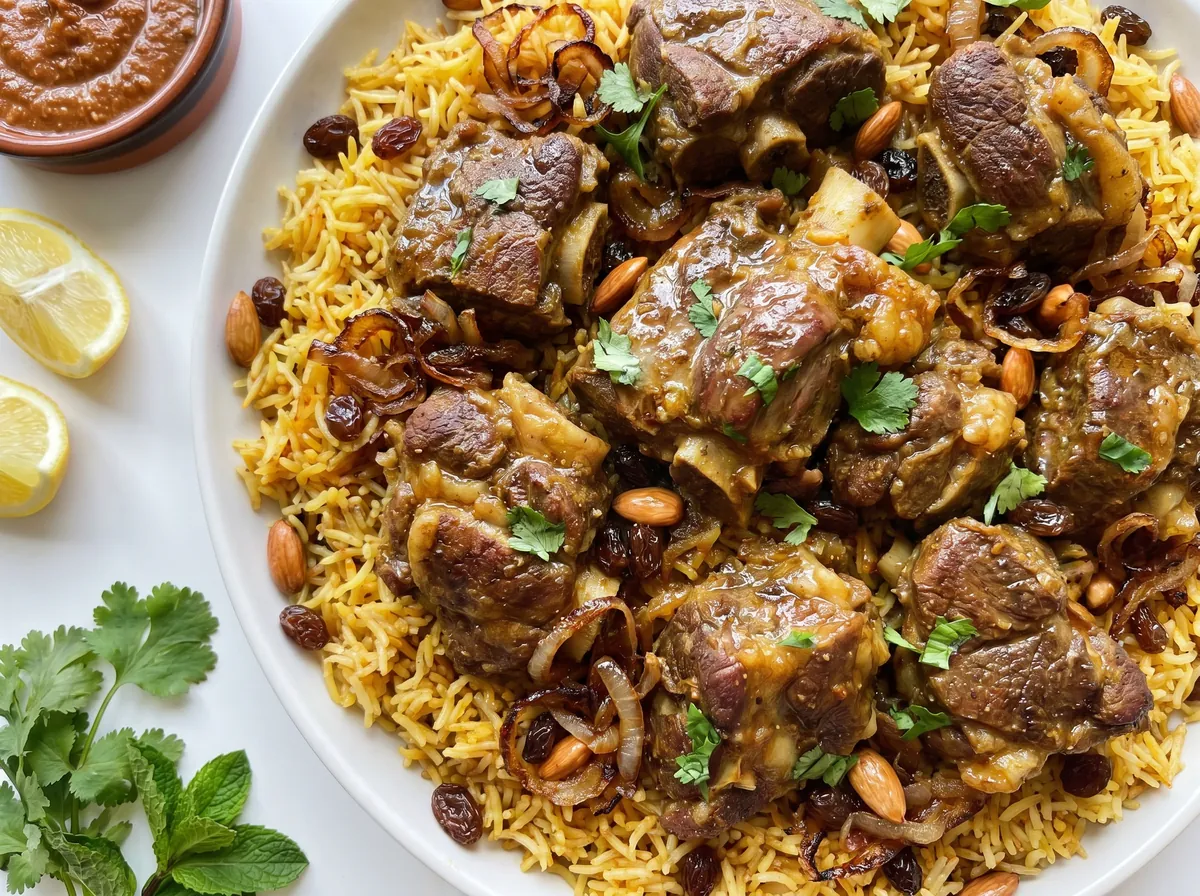
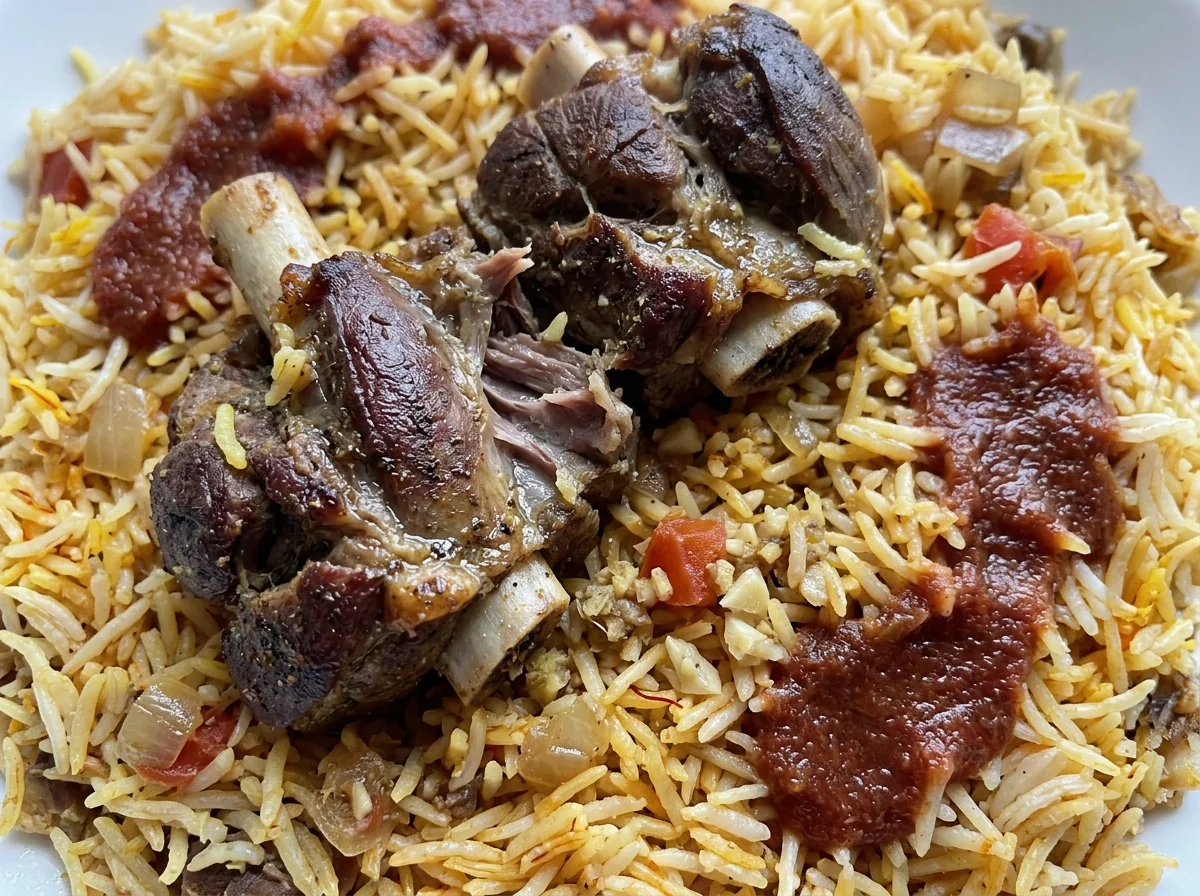
Yemen's biryani — basmati rice, lamb, and potatoes cooked in layers with yogurt, baharat (Gulf spice blend), and saffron, so the rice absorbs every flavour. High glycemic load from the rice and potatoes, rich in protein, and contains dairy (yogurt marinade).
Zurbian is a celebratory Yemeni rice dish from the biryani family, beloved across Yemen, southern Saudi Arabia, and the Gulf. What sets it apart from Kabsa (Saudi spiced rice dish) and Mandi (Yemeni-Saudi smoked meat and rice) is the yogurt marinade for the meat, the addition of potatoes, the dum layering technique, and the saffron — the rice comes out fragrant, coloured, and with grains that have absorbed layers of flavour.
It is the dish of weddings, Eids, and Ramadan feasts, always prepared in large quantities for gatherings. Its origins reflect the historic sea trade between Yemen and India, carrying the fingerprint of biryani in a distinctly Yemeni voice.
Preparation Steps
Marinate the lamb
Mix the lamb with the yogurt, garlic-ginger paste, half the spice blend, turmeric, lemon juice, and a pinch of salt. Leave to marinate for at least half an hour. The yogurt tenderises the meat and carries the spices deep into the flesh — this marinade is what sets Zurbian apart from Kabsa (Saudi spiced rice dish).
Caramelise the onion and fry the potatoes
Fry the sliced onion in the oil until golden, then set half aside for garnish. Fry the potato quarters in the same oil until lightly coloured on the outside, then set aside. Caramelised onion and lightly fried potatoes are two of the essential flavours in Zurbian.
Cook the lamb
Add the grated tomatoes and remaining spice blend to the pot and stir, then add the marinated lamb with its marinade liquid and enough water to cover. Cover and cook on a gentle simmer for about an hour until the lamb is fully tender. Strain and reserve the cooking broth.
Parboil the rice
Bring a pot of salted water to the boil with cardamom and bay leaves, then add the soaked rice. Parboil for 5 to 7 minutes until the outside is tender but the centre is still firm, then drain immediately. Rice parboiled to half-done finishes cooking in the steam, keeping the grains separate.
Build the layers
In a heavy-bottomed pot, spread a layer of lamb and potatoes, then a layer of rice, and repeat. Between the layers, drizzle the saffron-steeped milk, the caramelised onion, and a splash of the lamb broth. Cover tightly — placing a cloth under the lid — and cook on the lowest possible heat for 15 to 20 minutes (the dum).
Rest and serve
Remove the pot from the heat and leave covered for 5 minutes, then gently fold the layers together. Tip the Zurbian onto a large serving platter and garnish with the reserved caramelised onion. Serve with salad and yogurt. This is the dish of weddings, Eid, and Ramadan tables in Yemen — defined by its yogurt marinade, potatoes, and saffron.
Blood Sugar Impact
The glycemic index (GI) measures how quickly a food raises blood sugar, while the glycemic load (GL) measures how much a full serving raises it. Together they give the complete picture.
Glycemic Index
GI
71High
Low0–55Medium56–69High70+
A low value (≤55) means a gradual rise in blood sugar — the most suitable range for diabetes and insulin resistance.
Glycemic Load
GL
62High
Low0–10Medium11–19High20+
Glycemic load reflects the impact of the full serving. To lower it: take half a serving, or pair the recipe with a source of protein and fiber.
Nutritional Information
Per ServingMakes 6 servings · one serving is about 390 g of raw ingredients
Calories727 kcal36%of Daily Value*
Protein29 g58%of Daily Value*
Carbohydrates91 g33%of Daily Value*
Fat27 g35%of Daily Value*
Fiber3 g11%of Daily Value*
Sodium91 mg4%of Daily Value*
Potassium874 mg19%of Daily Value*
Phosphorus383 mg31%of Daily Value*
* Percent Daily Values are based on a 2,000-calorie diet per FDA food-label reference values — your daily needs may be higher or lower. Values are derived from the recipe's ingredients via the USDA database.
Troubleshooting
The most common problems when preparing Zurbian Lamb, and how to fix them:
The rice is gummy and doughy
It was fully cooked (or cooked with too much liquid) before layering. Parboil for only 5 to 7 minutes and drain immediately — it finishes in the steam. Fully cooked rice turns doughy during the dum.
The meat is tough
It was not cooked long enough. Bone-in lamb needs about an hour on a gentle simmer until truly tender. The yogurt marinade helps, but time is key.
The bottom of the Zurbian burned
The heat was too high or the pot too thin. Use a heavy-bottomed pot for the dum and cook on the absolute lowest flame — place a folded cloth under the lid. A lightly golden crust on the bottom is desirable; a charred one is not.
The flavour is dull
Not enough yogurt marinade time or saffron. Allow the lamb to marinate properly, distribute the saffron between the layers, and caramelise the onion deeply for flavour.
The potatoes are undercooked
They were not fried or parboiled before layering. Fry the potato quarters in oil until the outside colours before assembling, and they will finish cooking in the steam alongside the rice and lamb.
Storage and Make-Ahead
Refrigerator (4°)
Keeps in an airtight container for three days. Reheat with a splash of water on a gentle flame or in steam to keep the rice moist.
Freezer (-18°)
Freeze in portioned containers for up to one month. Thaw in the fridge and reheat in steam. The rice may soften slightly after thawing.
Make-ahead
Marinate the lamb overnight for deeper flavour. Caramelise the onion and fry the potatoes in advance. Assemble the layers and cook the dum fresh just before serving.
Food safety
Cook the lamb until fully tender throughout, and do not leave cooked rice outside refrigeration for more than two hours.
Tested Ingredient Substitutions
Original Ingredient
Tested Substitute
Ratio
Flavor Difference
White basmati rice
Brown basmati rice
Same quantity, more water, longer parboil
Higher fibre and lower glycemic load for the whole dish
Lamb
Chicken or beef
Same weight
Chicken is lighter and cooks faster (Zurbian chicken is popular); lamb is the authentic choice
Ghee for cooking
Vegetable oil
Same quantity
Lower in saturated fat; ghee is closer to the traditional flavour
How Much Does It Make? Scaling Guide
Servings
Rice
Meat
Potatoes
Yogurt
3 (half recipe)
1 1/2 cups
400 g
1 1/2 pieces
1/2 cup
6 (base)
3 cups
800 g
3 pieces
1 cup
12 (large family)
6 cups
1600 g
6 pieces
2 cups
EEINA Nutrition Tip
Zurbian is a high glycemic-load dish because both rice and potatoes are its starchy base. That said, the yogurt and lamb contribute solid protein. To moderate: keep the rice portion to a fist-sized serving and pile on the lamb, trim some of the visible fat, and always serve alongside a generous green salad and yogurt. Replacing one-third of the white rice with brown rice raises the fibre. Best enjoyed as an occasional treat, not an everyday dish.
Add This Recipe to Your Plan
The EEINA app saves your favorite recipes, calculates them from their real ingredients, and shows your daily numbers toward your goal. Try it free now.
What is the difference between Zurbian, Kabsa (Saudi spiced rice dish), and Mandi (Yemeni-Saudi smoked meat and rice)?
Zurbian is defined by the yogurt marinade for the meat, the addition of potatoes, and dum layering with saffron — closer in method to biryani. Kabsa (Saudi spiced rice dish) cooks the rice directly in the broth. Mandi (Yemeni-Saudi smoked meat and rice) uses a slow-smoked cooking method in a pit. Zurbian is Yemeni in origin.
Why marinate the lamb in yogurt?
The yogurt's acidity tenderises the meat and carries the spices deep into it, giving Zurbian its distinctive deep flavour. This is what sets it apart from other Gulf rice dishes.
Is Zurbian suitable for people with diabetes?
With caution — it is a rice-and-potato dish with a high glycemic load. With a small rice portion, plenty of lamb, and a salad at a special occasion, it can be enjoyed. Swap some rice for brown rice and consult your doctor.
What are the potatoes for, and why are they added?
The fried potatoes are a defining element of Yemeni Zurbian — layered in between, they absorb the flavour and contribute body and richness. They are one of the markers that distinguish Zurbian from all other rice dishes.