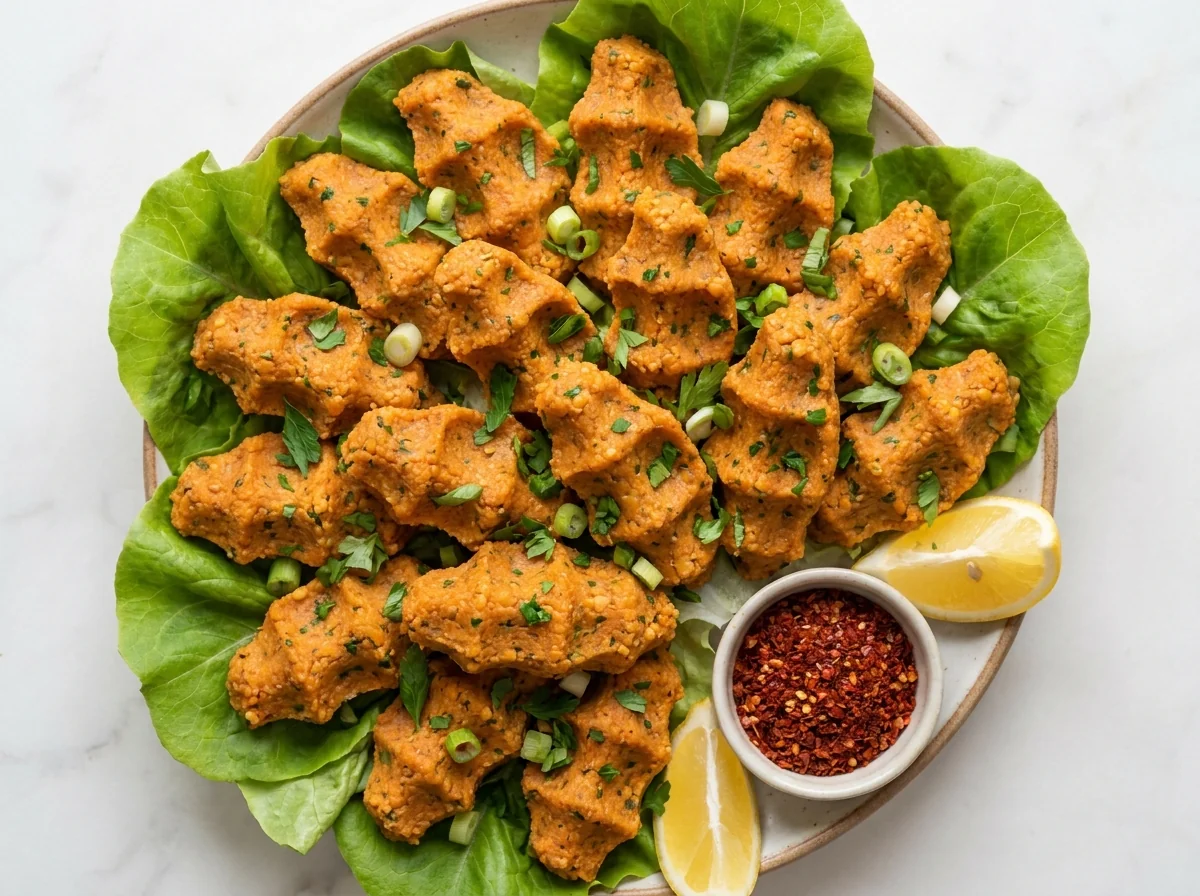
Mercimek koftesi, lentil kofta, is one of the most famous appetizers of Turkish tables and tea gatherings: dissolved red lentils embracing bulgur that cooks in their latent heat alone, then kneaded with a red saute and shaped by hand.
A cold vegetarian kofta wrapped in lettuce, with meat absent and unmissed.
Preparation Steps
Cook the red lentils until they dissolve
The lentils with the water for twenty minutes until they dissolve into a thick puree that drinks up all its water. Red dissolves by nature and that is exactly what is wanted here.
The fine bulgur cooks in its heat. No flame
The bulgur is stirred into the hot puree and the pot is covered for a quarter of an hour, off the heat. The bulgur swells from the lentils' latent heat alone: cooking with no flame is the signature of mercimek koftesi.
Sauté the onion with the two pastes
The onion in olive oil until it softens, then the tomato and pepper pastes caramelize. A Turkish red saute kneaded into the mixture.
Knead by hand and taste boldly
The cumin, salt, chili, green onion, and parsley kneaded by hand until uniform, and a bold taste: a cold mass to come needs bolder seasoning.
Shape with a fist and serve on lettuce
Fistfuls pressed so the imprint of the fingers is stamped. The distinctive traditional shape of mercimek koftesi, arranged on lettuce leaves with lemon: wrapped in a bite and eaten cold: the appetizer of Turkey's tables and tea gatherings.
Blood Sugar Impact
The glycemic index (GI) measures how quickly a food raises blood sugar, while the glycemic load (GL) measures how much a full serving raises it. Together they give the complete picture.
Glycemic Index
GI
35Low
Low0–55Medium56–69High70+
A low value (≤55) means a gradual rise in blood sugar — the most suitable range for diabetes and insulin resistance.
Glycemic Load
GL
14Medium
Low0–10Medium11–19High20+
Glycemic load reflects the impact of the full serving. To lower it: take half a serving, or pair the recipe with a source of protein and fiber.
Nutritional Information
Per ServingMakes 6 servings · one serving is about 315 g of raw ingredients
Calories338 kcal17%of Daily Value*
Protein15 g30%of Daily Value*
Carbohydrates52 g19%of Daily Value*
Fat9 g12%of Daily Value*
Fiber12 g43%of Daily Value*
Sodium322 mg14%of Daily Value*
Potassium766 mg16%of Daily Value*
Phosphorus241 mg19%of Daily Value*
* Percent Daily Values are based on a 2,000-calorie diet per FDA food-label reference values — your daily needs may be higher or lower. Values are derived from the recipe's ingredients via the USDA database.
Troubleshooting
The most common problems when preparing Turkish Cold Lentil Kofta (Mercimek Koftesi), and how to fix them:
The mixture is loose and won't hold into fistfuls
Water overflowed or bulgur was short. The precise six hundred ml, and two extra spoonfuls of bulgur with another quarter hour rescue the loose.
The bulgur stayed gritty
Coarse was used or heat escaped. Fine only and a tight lid. Coarse is for tabbouleh, not here.
Faint when cold
Seasoned for hot. Cold mutes. The same oily-dish lesson: bold seasoning then adjust after cooling.
It cracked while shaping
Kneaded before it cooled a little. Lukewarm, it is kneaded and gripped. Hot, it cracks and cold, it crumbles.
Storage and Make-Ahead
At room temperature or cold
Its original station. An appetizer, not a hot dish.
In the refrigerator
Three days in a container, growing firmer and more flavorful.
Not freezable
The soaked bulgur's texture rebels.
Tested Ingredient Substitutions
Original Ingredient
Tested Substitute
Ratio
Flavor Difference
Sweet pepper paste
Paprika with an extra spoonful of tomato paste
~
The substitute when the Turkish one is absent
Lettuce
Tender cabbage leaves or flatbread
~
The wraps multiply
A pomegranate touch
Pomegranate molasses, a few drops in the kneading
10 ml
The Gaziantep school
Its companion
Our lentil soup or a salad. A complete vegetarian lunch
~
Lentils in both their forms
How Much Does It Make? Scaling Guide
Ingredient
~18 handfuls (6 servings)
9 handfuls
36 handfuls
Red lentils
250 g
125 g
500 g
Fine bulgur
150 g
75 g
300 g
Olive oil
50 ml
25 ml
100 ml
EEINA Nutrition Tip
Let the bulgur cook in the lentils' latent heat, not over the flame. This is the engineering genius of mercimek koftesi: fine bulgur needs only heat and liquid, and the hot puree owns both; cooking over a direct flame turns the mixture into a sticky porridge that loses the kofta's hold. The covered, switched-off pot for a quarter of an hour cooks the bulgur grain by grain and keeps the shapeable texture: patience here does the cooking.
Add This Recipe to Your Plan
The EEINA app saves your favorite recipes, calculates them from their real ingredients, and shows your daily numbers toward your goal. Try it free now.
Kofta with no meat. Will it convince a meat-eater?
In Turkey it is served on the very tables of meat and often runs out before it. The red saute and the cumin build a surprising "meaty" depth: try it before you judge.
How is it counted and how much does it cost?
Three fistfuls with their lettuce ~315 calories with complete plant protein (lentils and wheat bulgur). For a couple of riyals: a full hospitality dish for the price of a bag of chips.
How is it different from our mujaddara?
Mujaddara is a hot dish that is scooped; mercimek koftesi is a cold appetizer that is gripped and wrapped. Lentils and wheat are one duo with two functions.
For afternoon tea hospitality?
It was born for it. A tray of fistfuls on lettuce with lemon befits any gathering: an appetizer prepared in the morning that grows tastier by the afternoon.