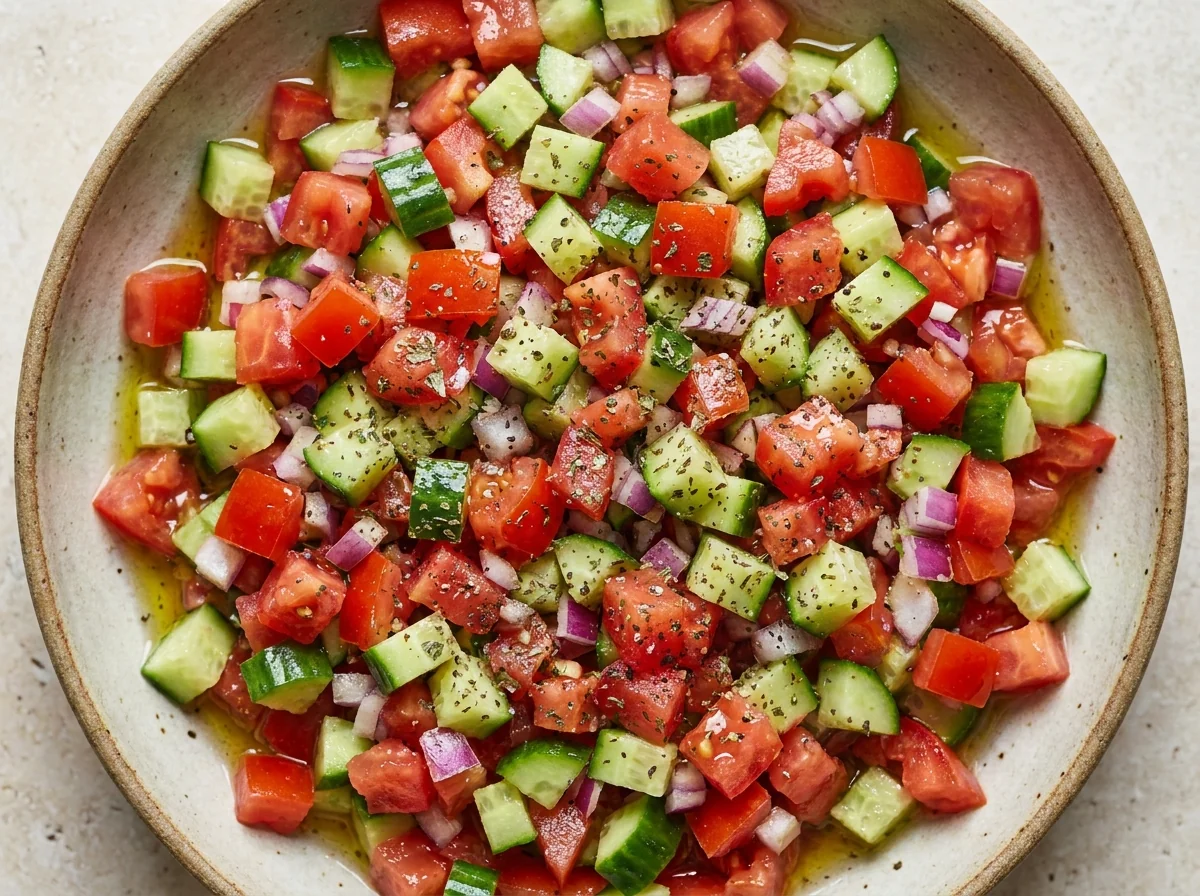
Shirazi salad is named after the city of Shiraz in southern Iran, and it is one of the simplest and most widespread dishes on the Persian table.
Its secret lies in the very fine cut that lets the cucumber and tomato juices blend with the lemon, so it becomes a refreshing dip as much as it is a salad, and it is served alongside rice and grilled dishes.
Preparation Steps
The cucumber
Cut the cucumber into very small cubes, because the fine cut mixes the vegetable juices and gives the salad its cohesive texture.
The tomatoes
Cut the tomatoes to the same size and leave them with their skin, as it holds their shape and keeps them from falling apart.
The onion
Cut the red onion very finely, as the small pieces soften its sharpness in the dish.
The mint
Rub the dried mint between your palms before adding it, as rubbing releases its aromatic oils and strengthens its flavor.
The dressing
Mix the lemon juice, oil, salt, and pepper in a small bowl, as mixing them beforehand distributes the flavor evenly.
Serving
Pour the dressing over the vegetables, toss gently, and serve immediately, as serving right away keeps the crunch before it wilts.
Blood Sugar Impact
The glycemic index (GI) measures how quickly a food raises blood sugar, while the glycemic load (GL) measures how much a full serving raises it. Together they give the complete picture.
Glycemic Index
GI
15Low
Low0–55Medium56–69High70+
A low value (≤55) means a gradual rise in blood sugar — the most suitable range for diabetes and insulin resistance.
Glycemic Load
GL
1Low
Low0–10Medium11–19High20+
Glycemic load reflects the impact of the full serving. To lower it: take half a serving, or pair the recipe with a source of protein and fiber.
Nutritional Information
Per ServingMakes 4 servings · one serving is about 160 g of raw ingredients
Calories90 kcal4%of Daily Value*
Protein1 g2%of Daily Value*
Carbohydrates7 g3%of Daily Value*
Fat7 g9%of Daily Value*
Fiber2 g7%of Daily Value*
Sodium199 mg9%of Daily Value*
Potassium255 mg5%of Daily Value*
Phosphorus38 mg3%of Daily Value*
* Percent Daily Values are based on a 2,000-calorie diet per FDA food-label reference values — your daily needs may be higher or lower. Values are derived from the recipe's ingredients via the USDA database.
Troubleshooting
The most common problems when preparing Shirazi Salad (Cucumber, Tomato, and Onion), and how to fix them:
The salad turned watery
Strain the tomato seeds before cutting, and add the dressing only at serving time, not before.
The onion is too sharp
Soak the cut onion in cold water for ten minutes, then drain it before mixing.
The flavor is bland
Add a little more rubbed mint and salt, and make sure the tomatoes are ripe and not firm.
The salad has wilted
Prepare the vegetables ahead and keep them in the refrigerator without dressing, and toss them with the dressing right before serving.
Storage and Make-Ahead
Vegetables without dressing
Keep them in the refrigerator in an airtight container for up to four hours.
Salad after dressing
Eat it right away, as it loses its crunch within an hour.
Tested Ingredient Substitutions
Original Ingredient
Tested Substitute
Ratio
Flavor Difference
red onion
green onion
same weight, 60 g
Milder in sharpness and gentler in color.
lemon juice
verjuice (unripe grape juice)
same volume, 45 ml
It is the traditional sour element in Shiraz and more tart.
dried mint
chopped fresh mint
about 5 g
A softer, less concentrated flavor.
olive oil
grapeseed oil
same volume, 30 ml
A neutral taste that lets the vegetable flavor stand out.
How Much Does It Make? Scaling Guide
Ingredient
2 servings
4 servings (base)
8 servings
cucumber
125 g
250 g
500 g
ripe tomatoes
125 g
250 g
500 g
red onion
30 g
60 g
120 g
fresh lemon juice
22 ml
45 ml
90 ml
EEINA Nutrition Tip
Cut all the ingredients as small as possible, as this is the difference between a real Shirazi salad and any ordinary cucumber and tomato salad.
Add This Recipe to Your Plan
The EEINA app saves your favorite recipes, calculates them from their real ingredients, and shows your daily numbers toward your goal. Try it free now.