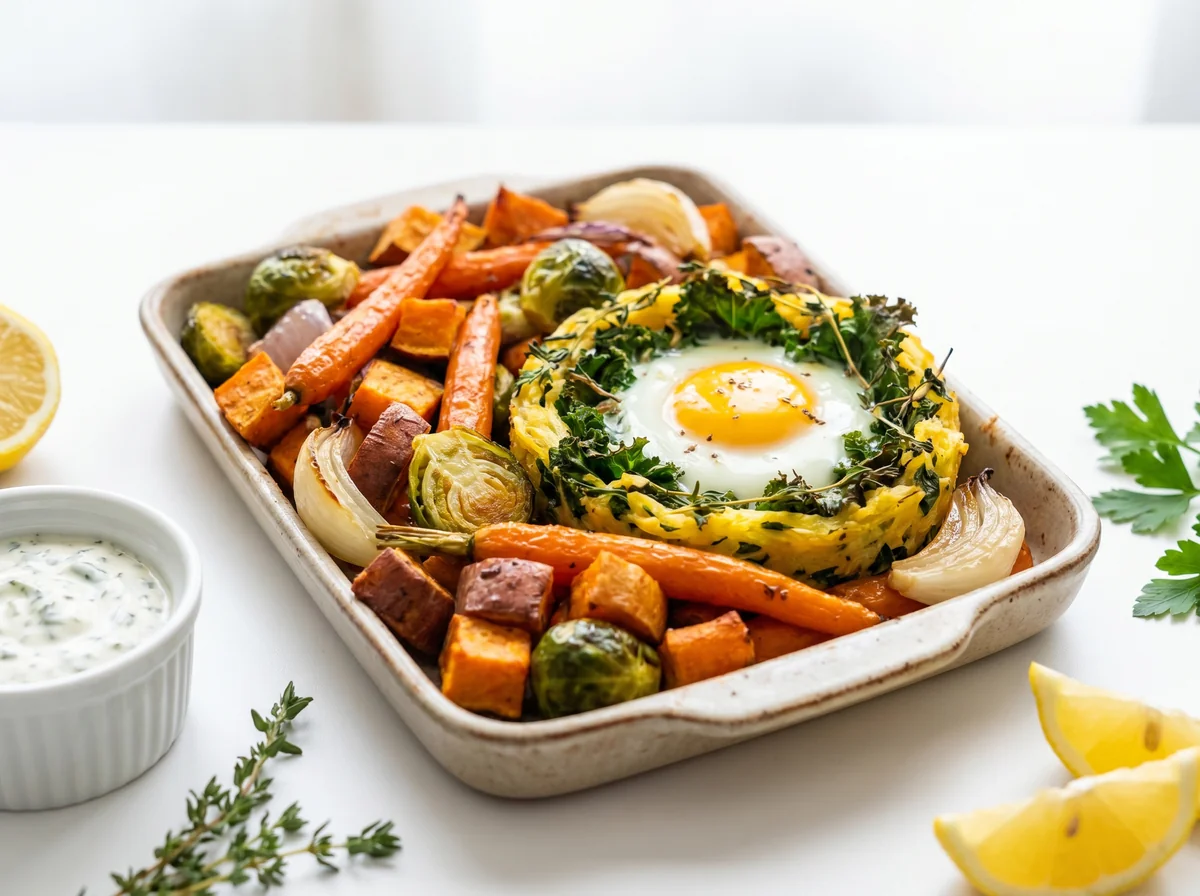
In the rush of midday, one person does not need a large pot or multiple dishes — just enough for one, with nothing to throw away or store. This small tray was born from that simple need: vegetables chopped quickly and roasted until their edges caramelise, then a single egg nestled into a hollow in the roasted vegetables, setting around a warm, runny yolk.
It is not a frittata to be flipped nor a Shakshuka (eggs poached in spiced tomato) simmered on the hob, but rather the idea of an oven-roasted nest: the vegetables are both the vessel and the meal, and the egg is their warm heart. A complete single-serving dish out of one tray and onto one plate, with minimal washing up and honest flavour.
Preparation Steps
Preheat the oven
Preheat the oven to 200 °C with top and bottom heat. The sign of readiness is a stable temperature indicator; consistent heat ensures the vegetables roast rather than steam in their own moisture.
Dice the vegetables
Cut the courgette, bell pepper and onion into even cubes about 1.5 cm. Even sizing is the key to success — smaller pieces burn before larger ones soften.
Season the vegetables
Toss the cubes in a small tray with the olive oil, cumin, black pepper and a pinch of salt until every piece glistens. Even oil coating — visible as a light sheen — conducts heat and prevents drying.
First roast
Spread the vegetables in a single layer without crowding and roast for 15 minutes until they wilt and the edges begin to colour. A single layer is the mark of success — crowding traps moisture and prevents browning.
Shape the nest
Remove the tray and use a spoon to push a well in the centre of the vegetables, exposing the base. A clear well — visible base — cradles the egg and stops it spreading to the edges.
Crack the egg
Crack the egg into a small cup first, then gently slide it into the nest. Cracking into a cup first is the safety step — it keeps the yolk intact and lets you remove any shell before it reaches the vegetables.
Final roast
Return the tray to the oven for 6 to 8 minutes, until the white is completely set and the yolk is still runny, and the egg's internal temperature reaches 71 °C. Fully set, matte-white egg white is the sign of safe doneness.
Serve
Scatter the chopped parsley over the nest and serve immediately, straight from the tray. Serve promptly — the residual heat of the tray continues cooking the egg if it sits too long.
Blood Sugar Impact
The glycemic index (GI) measures how quickly a food raises blood sugar, while the glycemic load (GL) measures how much a full serving raises it. Together they give the complete picture.
Glycemic Index
GI
12Low
Low0–55Medium56–69High70+
A low value (≤55) means a gradual rise in blood sugar — the most suitable range for diabetes and insulin resistance.
Glycemic Load
GL
1Low
Low0–10Medium11–19High20+
Glycemic load reflects the impact of the full serving. To lower it: take half a serving, or pair the recipe with a source of protein and fiber.
Nutritional Information
Per ServingMakes 1 servings · one serving is about 290 g of raw ingredients
Calories256 kcal13%of Daily Value*
Protein9 g18%of Daily Value*
Carbohydrates13 g5%of Daily Value*
Fat19 g24%of Daily Value*
Fiber4 g14%of Daily Value*
Sodium474 mg21%of Daily Value*
Potassium508 mg11%of Daily Value*
Phosphorus163 mg13%of Daily Value*
* Percent Daily Values are based on a 2,000-calorie diet per FDA food-label reference values — your daily needs may be higher or lower. Values are derived from the recipe's ingredients via the USDA database.
Troubleshooting
The most common problems when preparing Roasted Vegetable Egg Nest Tray for One, and how to fix them:
White not setting while the vegetables are burning
The vegetables were too soft before the egg was added, so the egg needed too long. Roast the vegetables for the full time first until they wilt, then add the egg only in the final 6 to 8 minutes.
Egg spread to the edges of the tray instead of staying in the nest
The well was too shallow. Push a well that reaches the base of the tray and move the vegetables firmly to the sides to form a wall that holds the egg.
Vegetables came out soft and watery instead of roasted
They were crowded or the tray was too full. Spread in a single layer with gaps between pieces — crowding traps steam and boils them rather than roasting them.
Yolk set completely and lost its runniness
The egg stayed in the oven longer than needed, or the residual heat of the tray continued cooking it. Remove as soon as the white is set and serve immediately.
Flat, bland flavour
The vegetables were under-roasted, or the seasoning was insufficient. Let the edges colour well and add the cumin and black pepper before roasting so they bloom in the heat. A pinch of salt at serving time as needed.
Storage and Make-Ahead
Prep ahead for one
Dice the courgette, bell pepper and onion the evening before and store in an airtight container in the fridge for up to two days. In the morning, season and roast straight away — prep time drops to minutes.
Refrigerator
Store the cooked dish in an airtight container in the fridge for up to two days. Keep in mind the egg yolk will set firm after chilling and lose its runniness.
Reheating
Reheat in a small oven at 160 °C until warmed through — better than a microwave, which can dry out the white and make it rubbery.
Avoid freezing
Freezing the cooked egg in the nest is not recommended; the white becomes watery after thawing. Freeze the roasted vegetables alone if desired.
Tested Ingredient Substitutions
Original Ingredient
Tested Substitute
Ratio
Flavor Difference
Courgette
Aubergine, diced
100 g for 100 g
Aubergine absorbs more oil, so watch the quantity and extend the roasting time slightly until it softens.
Chicken egg
2 egg whites
1 whole egg for 2 egg whites
Lower in saturated fat and cholesterol with similar protein, but without the richness of the runny yolk.
Olive oil
Avocado oil
15 ml for 15 ml
Avocado oil has a neutral flavour and a higher smoke point, with the same predominance of monounsaturated fats.
Bell pepper
Cherry tomatoes
80 g for 80 g
Adds a gentle acidity but releases more water, so shorten the first roasting stage slightly to avoid a wet base.
Parsley
Fresh coriander, chopped
5 g for 5 g
Slightly sharper flavour — add at serving time rather than before roasting to keep it fresh.
How Much Does It Make? Scaling Guide
Ingredient
1 serving
2 servings
4 servings
Courgette
100 g
200 g
400 g
Mixed bell peppers, diced
80 g
160 g
320 g
Onion
40 g
80 g
160 g
Egg
1
2
4
Extra-virgin olive oil
15 ml
30 ml
60 ml
Parsley, chopped
5 g
10 g
20 g
EEINA Nutrition Tip
Keep the yolk slightly runny for people with diabetes — the dish has a very low glycaemic load, and the protein and fibre support satiety and slow the absorption of whatever simple carbohydrates it contains. Keep salt to a minimum if you are monitoring your blood pressure.
Add This Recipe to Your Plan
The EEINA app saves your favorite recipes, calculates them from their real ingredients, and shows your daily numbers toward your goal. Try it free now.
Do I need a special tray or will a regular baking tray work?
Any tray or small baking dish that allows you to spread the vegetables in a single layer will work. The key is that the vegetables are not crowded so they brown rather than steam. For one person, a small tray minimises empty space around the food.
How do I know the egg is safely cooked?
The white is completely set and has turned from translucent to matte white, and the egg's internal temperature has reached 71 °C. If you want a runny yolk, remove it as soon as the white is fully set; for a fully cooked yolk, extend by two minutes.
Can this work as a dinner or breakfast too?
Yes — it is light and balanced and works at any time of day. It was designed here as a light solo lunch, but it makes an equally good filling breakfast or early dinner.
Can it be made without an oven?
The recipe is built around oven roasting to colour the vegetables and form the nest. You can approximate the idea in a deep lidded pan over a low flame until the white sets, but the caramelised edges and roasted flavour of the vegetables will not be fully replicated.
Is this dish suitable for people with diabetes?
Its glycaemic load is very low because it relies on non-starchy vegetables, an egg and olive oil — this supports stable blood sugar after the meal. It remains food that supports rather than treats, and a specialist should be consulted before making any dietary changes.