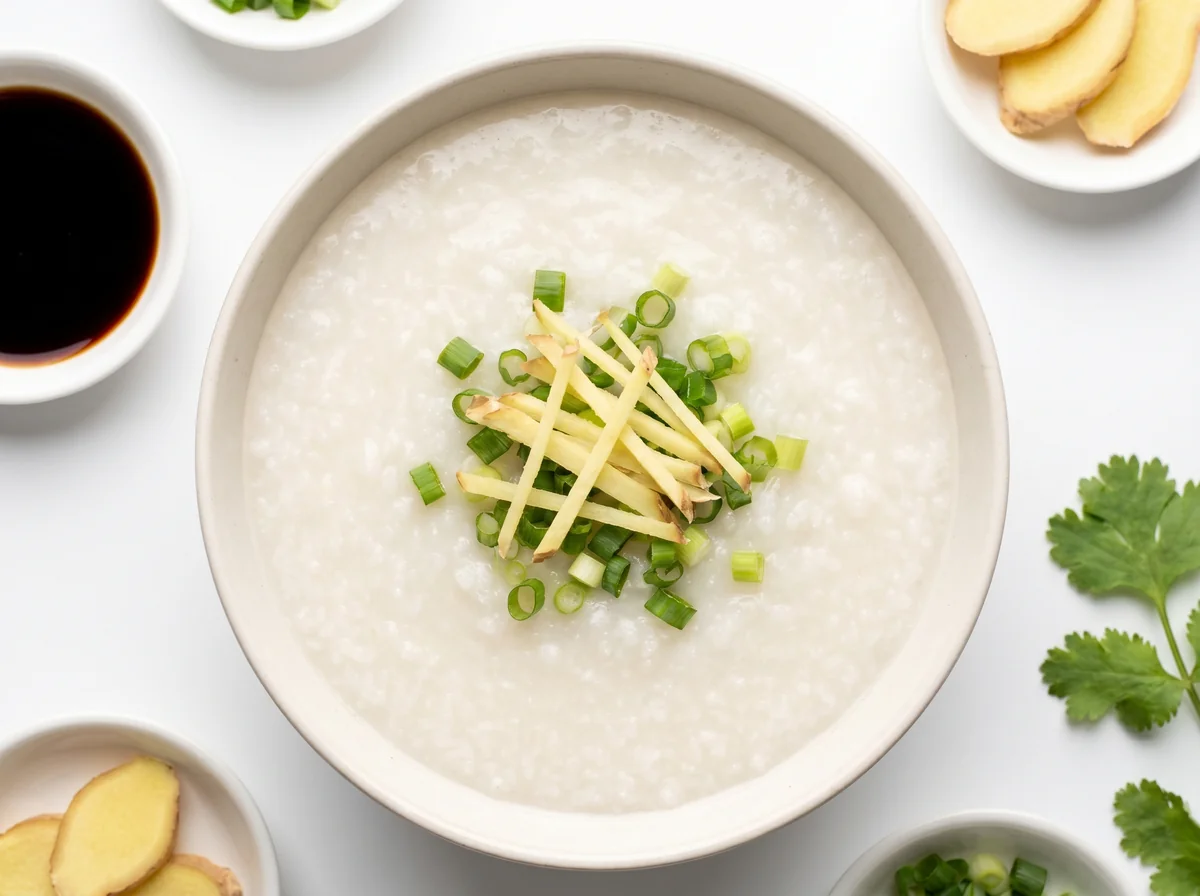
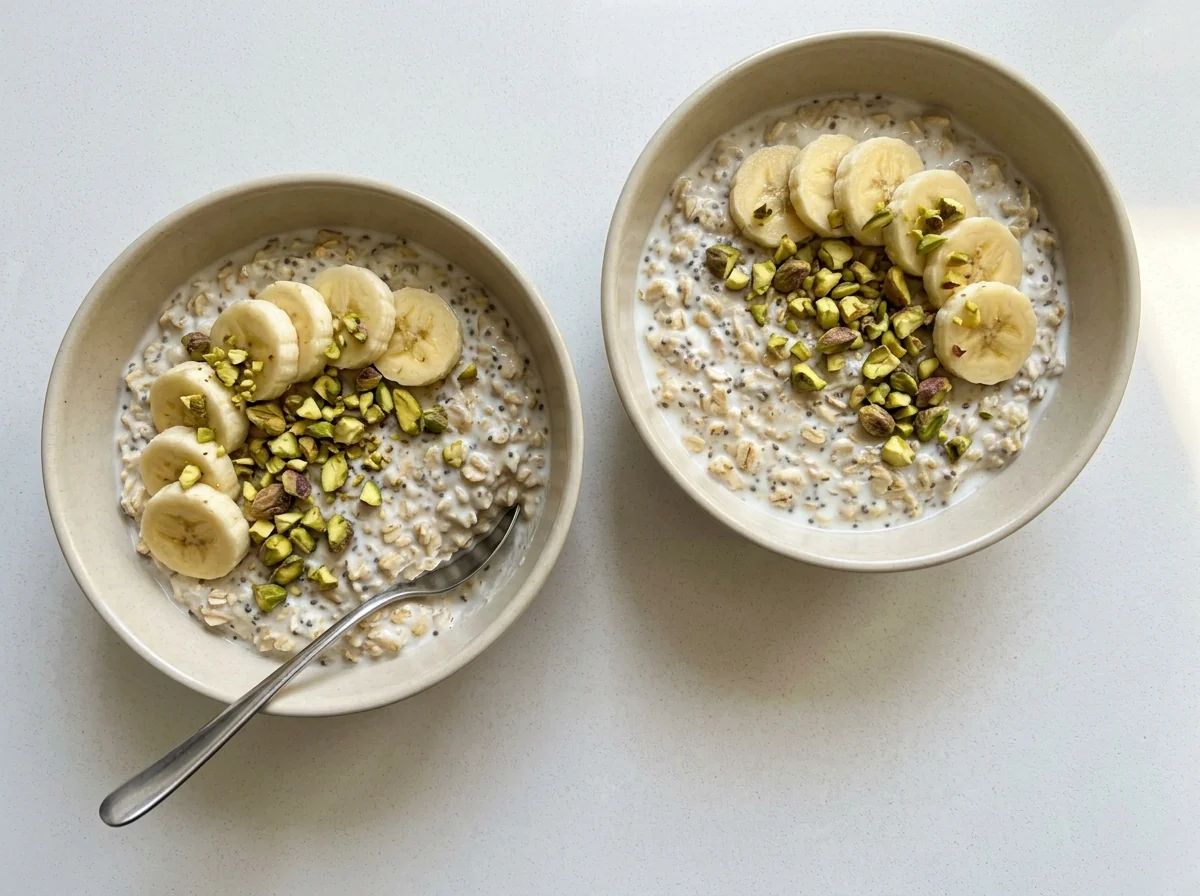
Congee is an ancient East Asian rice porridge served as a warm breakfast in China, Japan, Korea, and across Southeast Asia. It differs from Arabic asida in its fluid, creamy consistency and its savoury seasoning — ginger and soy — rather than sweet flavours.
Its heart is simple: rice simmered in plenty of liquid until the grains break down and the texture becomes smooth like a thick soup. This version cuts the long stovetop cooking down to a single mug in the microwave ready in minutes, using rice left over from yesterday, making it a warm, comforting individual meal on a busy morning — perfect for cold weather or a stomach craving something light and easy to digest.
Preparation Steps
Prepare the mug
Place the pre-cooked rice and the water or broth in a large microwave-safe mug with a capacity of at least 500 ml, leaving the top third of the mug empty so the liquid does not overflow when boiling. Choosing a wide mug gives the liquid room to bubble and reduces spillage.
First cook
Microwave on high for three minutes until the liquid begins to boil and bubbles appear on the surface. The active boiling is what gradually breaks down the rice grains and transforms the texture into something creamy.
Stir and continue cooking
Carefully remove the mug — it is hot — and stir well to loosen the rice, then return it for two more minutes on high until the consistency thickens to a creamy porridge. Stirring distributes the heat and prevents the bottom from sticking.
Add the egg
Beat the egg in a small bowl then pour it over the hot congee with rapid stirring, and return the mug for one minute on high until the egg is fully set and any egg mixture reaches 71°C with no liquid visible. Fully cooking the egg ensures food safety.
Season
Stir in the grated ginger and low-sodium soy sauce, taste, then add salt if needed. Adding the ginger at the end preserves its sharp, aromatic flavour before it fades with prolonged heat.
Serve
Pour the congee into a serving bowl and garnish with the chopped spring onion and a few drops of sesame oil, then serve warm immediately. The consistency thickens quickly as it cools, so serving right away preserves its smoothness.
Blood Sugar Impact
The glycemic index (GI) measures how quickly a food raises blood sugar, while the glycemic load (GL) measures how much a full serving raises it. Together they give the complete picture.
Glycemic Index
GI
64Medium
Low0–55Medium56–69High70+
A low value (≤55) means a gradual rise in blood sugar — the most suitable range for diabetes and insulin resistance.
Glycemic Load
GL
12Medium
Low0–10Medium11–19High20+
Glycemic load reflects the impact of the full serving. To lower it: take half a serving, or pair the recipe with a source of protein and fiber.
Nutritional Information
Per ServingMakes 1 servings · one serving is about 435 g of raw ingredients
Calories178 kcal9%of Daily Value*
Protein9 g18%of Daily Value*
Carbohydrates20 g7%of Daily Value*
Fat7 g9%of Daily Value*
Fiber1 g4%of Daily Value*
Sodium348 mg15%of Daily Value*
* Percent Daily Values are based on a 2,000-calorie diet per FDA food-label reference values — your daily needs may be higher or lower. Values are derived from the recipe's ingredients via the USDA database.
Troubleshooting
The most common problems when preparing Asian Rice Congee for One — Microwave Mug, and how to fix them:
Liquid overflowed from the mug during cooking
Use a larger mug and leave the top third empty. Reduce the power to medium after boiling begins — the bubbling settles as the heat eases.
The texture stayed watery and did not become creamy
Return it for one or two extra minutes with stirring in between — congee needs enough boiling for the rice grains to break down and release their starch.
The texture became too thick like dough
Add hot water a tablespoon at a time with stirring until it flows again — it thickens naturally as it cools.
The egg clumped into separate pieces instead of dissolving into the congee
Beat the egg well and pour it in slowly with continuous rapid stirring into the very hot congee — stirring distributes it into fine threads.
Bland flavour with no depth
Add the ginger and soy sauce at the end and increase the sesame oil drop — late seasoning keeps the flavour alive, and broth instead of water deepens the taste.
Storage and Make-Ahead
Refrigerator
Store in an airtight container for up to two days — it thickens considerably when cold, so thin it with hot water when reheating.
Reheating
Microwave for one minute with two tablespoons of water, stirring halfway through, until fully hot and the consistency flows again.
Advance preparation for one
Keep cooked rice in the refrigerator or freeze 120 g portions — congee breakfast is then ready to boil instantly on any morning with no prior cooking.
Tested Ingredient Substitutions
Original Ingredient
Tested Substitute
Ratio
Flavor Difference
Pre-cooked white rice
Pre-cooked brown rice
1:1
Adds fibre but the texture stays slightly coarser and needs more liquid and stirring to soften.
Low-sodium chicken broth
Water with half a vegetable stock cube
300 ml water and half a cube
A vegetarian alternative — note the sodium in the cube and reduce added salt accordingly.
Egg
Shredded poached chicken breast · 40 g
1 egg = 40 g chicken
An egg-free protein alternative — add at the end with stirring until heated through.
Soy sauce
Gluten-free tamari sauce
1:1
A suitable substitute for gluten sensitivity with the same savoury flavour.
Sesame oil
Olive oil
1:1
For those avoiding sesame — it changes the flavour slightly but maintains the oily finish.
How Much Does It Make? Scaling Guide
Ingredient
1 serving
2 servings
4 servings
Cooked rice
120 g
240 g
480 g
Water or broth
300 ml
600 ml
1200 ml
Grated ginger
5 g
10 g
20 g
Spring onion
15 g
30 g
60 g
Eggs
1
2
4
EEINA Nutrition Tip
Start with more liquid than you think you need — cooked rice absorbs water quickly in the microwave and thickens further after removing. If it is too thick, add two tablespoons of hot water and stir; good congee has a flowing consistency, not a set one.
Add This Recipe to Your Plan
The EEINA app saves your favorite recipes, calculates them from their real ingredients, and shows your daily numbers toward your goal. Try it free now.
This version is designed for pre-cooked rice because it softens quickly in the microwave. Raw rice needs much more liquid, longer cooking time, and repeated stirring — it does not suit the quick mug method.
What is the difference between congee and Arabic asida?
Arabic asida is a firm dough-like porridge typically served with date molasses or honey, while congee is a fluid, creamy rice porridge seasoned with savoury flavours such as ginger and soy, eaten as a warm breakfast.
Is congee suitable for someone with indigestion?
Its smooth, warm consistency is easy to eat, but whether it suits a specific digestive condition depends on the individual. For general information only — consult a specialist for any health condition.
How do I make the texture creamier?
Stir during cooking and extend the boiling a little so the rice breaks down and releases its starch, and start with plenty of liquid. Frequent stirring is the secret to a smooth texture.
Can it be made without egg?
Yes — substitute with shredded poached chicken or leave it fully plant-based. Congee is delicious with just ginger and spring onion and a drizzle of soy sauce.