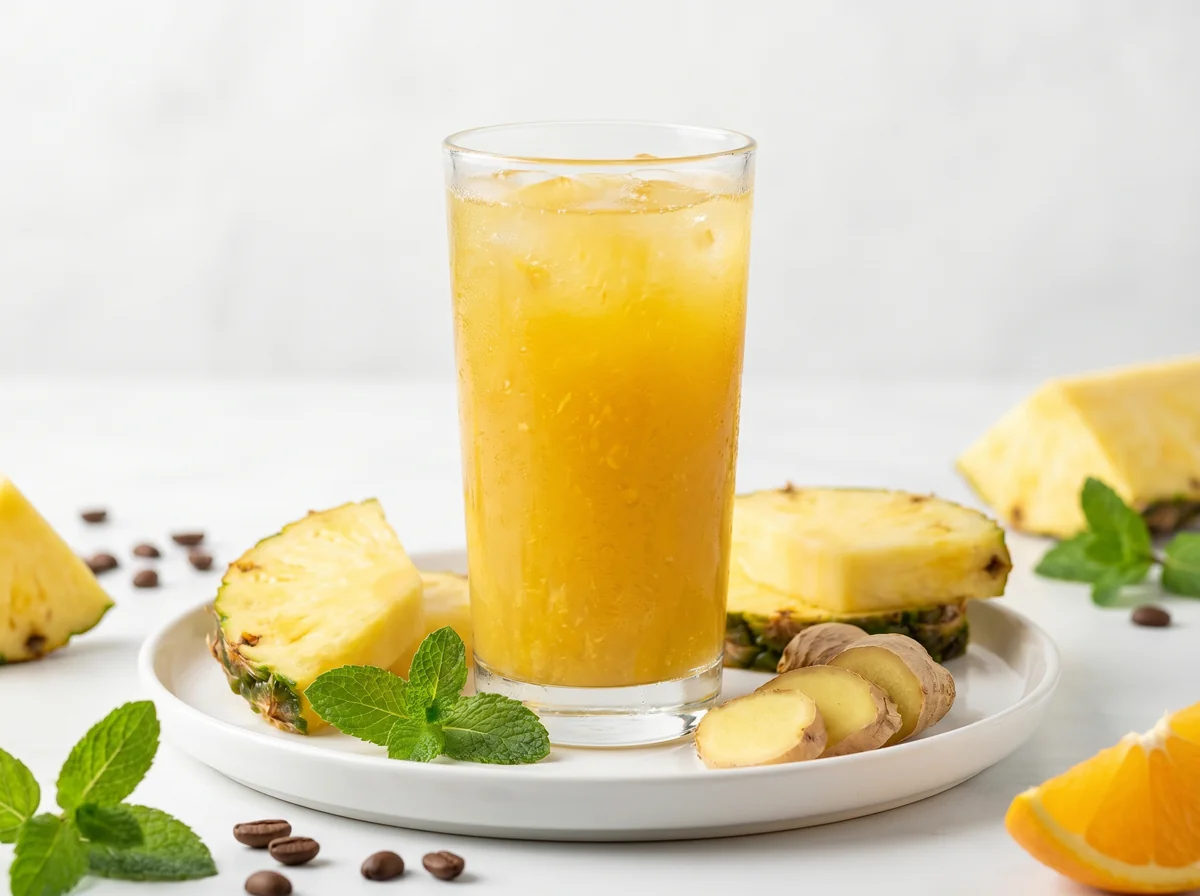
On hot summer days when everything feels heavy, a cold glass of pineapple and ginger has the power to wake the senses with a sharp tartness and a gentle warmth all at once. Pineapple is an adopted guest on Gulf tables, but it settled in quickly in cafe and home juices for its sunny sweetness — and when it meets a piece of fresh ginger and a squeeze of lemon, it transforms from purely sweet into a balanced drink that has a beginning and an end on the tongue.
We wanted it here with no added sugar, fresh from the fruit alone, as a clean alternative to the overly sweetened canned juices. Make it a few minutes before serving — it is at its peak when the ginger is still sharp and the ice still crackles.
Preparation Steps
Prepare the pineapple
Peel the pineapple and remove the tough fibrous core in the centre, then cut it into small cubes until you have 400 g. The tough core is hard on the blender and gives a coarse texture — removing it produces a smoother juice.
Prepare the ginger and lemon
Scrape the ginger skin off with the edge of a spoon, then slice it thin to help the blender process it. Squeeze the fresh lemon and reserve 15 ml. The lemon balances the sweetness of the pineapple and stabilises the golden colour so it does not quickly turn brown.
Blend
Place the pineapple, ginger, lemon juice, and cold water in a blender and blend on high for a full minute until the mixture is smooth and uniform with no visible chunks. A full minute is enough to break down the ginger fibres.
Strain if desired
For a clear texture, pass the juice through a medium-mesh sieve over a pitcher, pressing the pulp with the back of a spoon. Skip this step if you want to keep the fibre for a thicker texture and a longer sense of fullness.
Serve
Divide the ice cubes between two glasses, pour the juice over them, and garnish each glass with two mint leaves. Serve immediately — the freshness of the ginger and the vitamin C fade gradually after blending, and the flavour is at its brightest in the first few minutes.
Blood Sugar Impact
The glycemic index (GI) measures how quickly a food raises blood sugar, while the glycemic load (GL) measures how much a full serving raises it. Together they give the complete picture.
Glycemic Index
GI
57Medium
Low0–55Medium56–69High70+
A low value (≤55) means a gradual rise in blood sugar — the most suitable range for diabetes and insulin resistance.
Glycemic Load
GL
14Medium
Low0–10Medium11–19High20+
Glycemic load reflects the impact of the full serving. To lower it: take half a serving, or pair the recipe with a source of protein and fiber.
Nutritional Information
Per ServingMakes 2 servings · one serving is about 270 g of raw ingredients
Calories105 kcal5%of Daily Value*
Protein2 g4%of Daily Value*
Carbohydrates27 g10%of Daily Value*
Fat0 g0%of Daily Value*
Fiber2 g7%of Daily Value*
Sodium3 mg0%of Daily Value*
* Percent Daily Values are based on a 2,000-calorie diet per FDA food-label reference values — your daily needs may be higher or lower. Values are derived from the recipe's ingredients via the USDA database.
Troubleshooting
The most common problems when preparing Pineapple Ginger Juice, and how to fix them:
Juice is too bitter
Too much ginger or too large a piece. Start with 5 g and increase gradually, tasting before straining. Adding a teaspoon of honey or an extra slice of pineapple balances the sharpness.
Colour turns brown quickly
This is natural oxidation. Lemon juice slows it down — do not skip the squeeze. Serve immediately after blending; if storage is needed, add double the lemon juice and keep in a full, tightly sealed glass container to minimise air contact.
Texture is coarse with tough fibres
Usually the fibrous core was not removed or the ginger was not blended enough. Remove the hard core, blend on high for a full minute, then pass through a medium-mesh sieve.
Juice is excessively sweet and flat-tasting
The pineapple was very ripe. Increase the lemon juice and add a small piece of ginger to introduce acidity and sharpness, and add cold water or extra ice to dilute the concentration.
Mixture separates into two layers quickly
Normal in fresh juices without emulsifiers. Stir with a spoon before each sip, or keep the fibre by not straining — it holds the consistency together for longer.
Storage and Make-Ahead
Serve immediately
Best within 15 minutes of blending, when the ginger is still sharp and the vitamin C is at its peak before oxidising.
Refrigerator
Keep in a full, tightly sealed glass container (to minimise air) for up to 24 hours. Stir well before drinking and add a squeeze of lemon to refresh the colour.
Freezing
Pour into ice-cube trays and freeze for up to two weeks; use the cubes later in smoothies or flavoured water. The texture after thawing will be less smooth — blend again.
Tested Ingredient Substitutions
Original Ingredient
Tested Substitute
Ratio
Flavor Difference
Fresh pineapple
Frozen pineapple
1:1 by weight
Thaw slightly before blending. Frozen pineapple chills the juice so reduce the ice. Avoid canned in sweet syrup to avoid adding sugar.
Fresh ginger
Dried ground ginger
8 g fresh ≈ quarter teaspoon ground
The flavour is milder and more earthy. Add gradually and taste — ground ginger is concentrated and will not give the same fresh sharpness.
Lemon juice
Lime juice
1:1
Gives a more floral acidity that suits pineapple. Start with slightly less as lime is sharper.
Cold water
Unsweetened coconut water
1:1
Adds a mild sweetness and potassium. Note that it slightly raises the sugar content, so those managing blood sugar may prefer plain water.
Ice cubes
Frozen pineapple cubes
4 ice cubes ≈ 60 g frozen pineapple
Chills without diluting the flavour as the ice melts, and gives a thicker, smoothie-like texture.
How Much Does It Make? Scaling Guide
Ingredient
2 cups (2 servings)
4 cups
Pitcher (6 cups)
Fresh pineapple, cubed
400 g
800 g
1.2 kg
Fresh peeled ginger
8 g
16 g
24 g
Lemon juice
15 ml
30 ml
45 ml
Cold water
120 ml
240 ml
360 ml
Ice cubes
4
8
12
EEINA Nutrition Tip
If your goal is managing blood sugar, keep the pineapple fibre and do not strain the juice — drink it with a handful of nuts or as part of a meal, not on an empty stomach. Fibre slows sugar absorption, and one serving at a time is enough. The whole fruit will always be the better choice for blood sugar compared to any juice.
Add This Recipe to Your Plan
The EEINA app saves your favorite recipes, calculates them from their real ingredients, and shows your daily numbers toward your goal. Try it free now.
Does pineapple ginger juice burn fat or cause weight loss?
No. No single food or drink burns fat on its own. Fresh juice with no added sugar may be a cleaner alternative to sweetened drinks, but it remains a source of natural sugars. Weight loss depends on overall calorie balance and lifestyle, not on one particular drink.
Does the bromelain in pineapple improve digestion?
Bromelain is a protein-digesting enzyme, and there are preliminary and limited studies (weak evidence) exploring possible digestive and anti-inflammatory roles, but the evidence is not sufficient to confirm it as a therapeutic benefit. Think of it as a delicious refreshing drink, not a medicine.
Which is better for blood sugar — the juice or the whole pineapple?
The whole fruit is always better. Blending it into juice, especially after straining, reduces fibre and concentrates the free sugars so blood sugar rises faster. If you do drink it, keep the fibre by not straining, and stick to one serving with a meal.
Is it suitable for people with kidney disease?
We advise people with kidney disease to exercise caution and consult a specialist. Pineapple is relatively high in potassium, and kidney patients often need to manage their potassium intake, so we do not classify this drink as suitable for them without medical supervision.
When should I drink it to get it at its best?
Within the first 15 minutes of blending. The freshness of the ginger and the vitamin C fade gradually with air exposure, and the colour starts to turn brown. Make it just before serving for the brightest flavour and colour.
Does it interact with any medications?
Bromelain may theoretically interact with blood thinners and some antibiotics. If you are taking regular medications, consult your doctor or pharmacist before making it a daily habit, especially in large quantities.