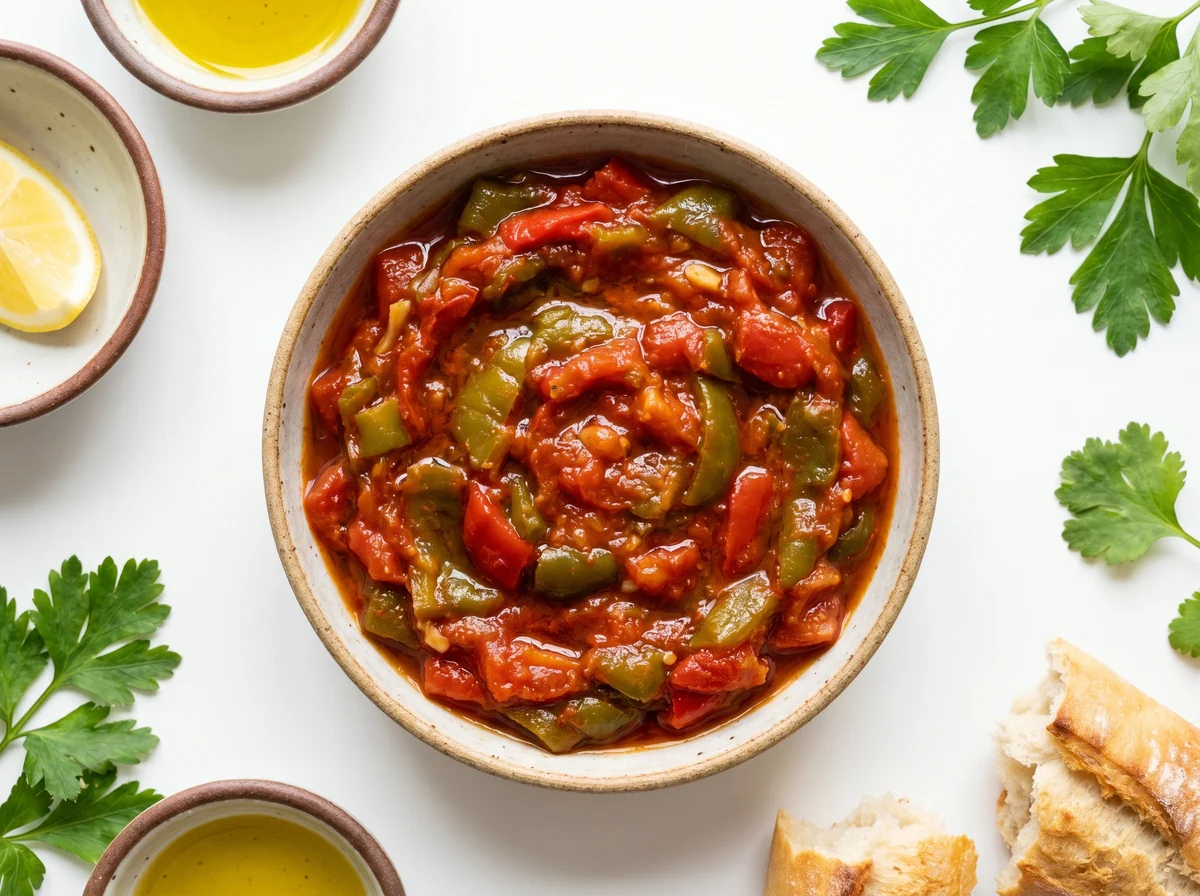
A Moroccan cooked salad -- roasted green peppers and tomatoes slow-cooked with garlic, cumin, and paprika to a soft, smoky spread scooped with bread; light, low glycemic load, free from common allergens.
Taktouka is a famous and beloved Moroccan cooked salad, from the family of Moroccan cooked salads (like zaalouk and carrot salad) served as starters before the main course. It consists primarily of roasted green peppers and tomatoes cooked with garlic, cumin, and paprika to a fragrant, soft, roughly mashed spread.
It differs from zaalouk (which is eggplant-based) by using pepper. Eaten warm or at room temperature, scooped with bread. Its smoky flavour from roasting the peppers and its richness with tomatoes and spices has made it one of the most beloved Moroccan starters, reflecting the art of the Moroccan kitchen in creating flavour-rich, healthy cooked salads.
Preparation Steps
Roast the peppers
Roast the green peppers over a direct flame, on a grill, or in a hot oven until the skin is charred and the flesh is soft. Place in a bag for a few minutes (this makes peeling easier), then peel, remove the seeds, and chop. Roasting the peppers gives a smoky flavour that defines taktouka.
Cook the tomatoes
In a pan, saute the garlic in olive oil, then add the grated tomatoes, cumin, paprika, chilli, and salt and cook until thickened. The spiced tomatoes are the base of taktouka.
Add the peppers
Add the chopped roasted peppers to the tomatoes, stir, and cook together until they meld and the mixture thickens and the olive oil separates, about fifteen minutes. The roasted peppers and tomatoes merge into a soft spread.
Cook until thick
Let the taktouka cook on low heat until the mixture thickens to a soft, roughly mashed consistency (not watery), mashing it lightly with a spoon. Cooking until thick concentrates the flavour and gives the characteristic texture (between a salad and a dip).
Final seasoning
Add the chopped coriander and parsley and a squeeze of lemon juice at the end and stir. Taste and adjust the salt, cumin, and lemon. Fresh herbs and acidity refresh the taktouka and balance its richness.
Serve
Spread the taktouka on a plate, drizzle a little olive oil over it, and serve warm or at room temperature with Moroccan bread (for scooping) as a starter or side dish. It is a famous Moroccan cooked salad (from the family of cooked salads like zaalouk), its smoky flavour from roasted peppers and tomatoes with cumin is a delight, a beloved vegetarian dish on the Moroccan table.
Blood Sugar Impact
The glycemic index (GI) measures how quickly a food raises blood sugar, while the glycemic load (GL) measures how much a full serving raises it. Together they give the complete picture.
Glycemic Index
GI
14Low
Low0–55Medium56–69High70+
A low value (≤55) means a gradual rise in blood sugar — the most suitable range for diabetes and insulin resistance.
Glycemic Load
GL
1Low
Low0–10Medium11–19High20+
Glycemic load reflects the impact of the full serving. To lower it: take half a serving, or pair the recipe with a source of protein and fiber.
Nutritional Information
Per ServingMakes 4 servings · one serving is about 245 g of raw ingredients
Calories63 kcal3%of Daily Value*
Protein3 g6%of Daily Value*
Carbohydrates13 g5%of Daily Value*
Fat0 g0%of Daily Value*
Fiber4 g14%of Daily Value*
Sodium11 mg0%of Daily Value*
Potassium453 mg10%of Daily Value*
Phosphorus58 mg5%of Daily Value*
* Percent Daily Values are based on a 2,000-calorie diet per FDA food-label reference values — your daily needs may be higher or lower. Values are derived from the recipe's ingredients via the USDA database.
Troubleshooting
The most common problems when preparing Moroccan Taktouka, and how to fix them:
Taktouka is watery
Has not thickened. Let the peppers and tomatoes cook until the water evaporates and the mixture thickens and the oil separates; taktouka should have a soft, cohesive consistency, not watery. Sufficient cooking concentrates the flavour.
Lacks the smoky flavour
Peppers were not roasted. Roast the peppers until the skin is charred (this gives the distinctive smoky flavour) then peel; raw or boiled peppers lose the dish its character. Roasting is essential.
Flavour is flat
Not enough garlic, cumin, paprika, or salt. Be generous with garlic, cumin, and paprika (Moroccan flavour); lemon juice and fresh herbs added at the end refresh it. Good seasoning is the foundation of taktouka.
Bitterness from charred skin
Peppers not fully peeled. Peel the roasted pepper completely of the charred skin (it comes off easily after bagging); traces of charred skin give bitterness. Full peeling gives a clean flavour.
Texture is a smooth paste
Mashed too much. Mash the taktouka lightly with a spoon to a soft, coarse consistency (not a smooth paste); the texture is between a salad and a dip. Leave some chunks for the characteristic texture.
Storage and Make-Ahead
Refrigerator (4 degrees C)
Taktouka keeps in an airtight container in the refrigerator for 3 to 4 days and its flavour improves (garlic and spices develop). Eat warm or at room temperature; ideal for advance preparation. Add olive oil at serving.
Advance preparation
An excellent salad for advance preparation; prepare it and refrigerate, and its flavour improves, ready as a starter over several days. Practical as part of a Moroccan mezze or a healthy side.
Freezer
Taktouka can be frozen for two to three months in an airtight container (it tolerates freezing as it is a cooked, concentrated preparation). Thaw and reheat or serve at room temperature; add fresh lemon and herbs.
Food safety
Roast the peppers and cook the tomatoes thoroughly; keep the taktouka refrigerated (it contains garlic); do not leave it out of refrigeration for more than two hours. Use clean utensils.
Tested Ingredient Substitutions
Original Ingredient
Tested Substitute
Ratio
Flavor Difference
Green peppers
Coloured peppers (red/yellow)
Same amount
Coloured peppers are sweeter, give a beautiful colour, and are even higher in vitamin C; green is traditional with a slightly stronger flavour
Roasting the peppers over flame
Roasting in the oven (grill/broil)
--
A practical alternative; roast the peppers under a hot oven grill until the skin is charred; direct flame gives a stronger smoky flavour
Peppers only
Add eggplant (becomes zaalouk)
As desired
Adding eggplant turns it into zaalouk (a closely related Moroccan salad), or keep it as peppers and tomatoes only (classic taktouka)
How Much Does It Make? Scaling Guide
Servings
Peppers
Tomatoes
Olive oil
2 (half recipe)
2 peppers
2 tomatoes
2 spoons
4 (base)
4 peppers
4 tomatoes
3 tbsp
8 (gathering)
8 peppers
8 tomatoes
6 tbsp
EEINA Nutrition Tip
Taktouka is one of the healthiest starters: green pepper is very rich in vitamin C (higher than orange) and antioxidants; tomatoes provide lycopene (which improves with cooking); garlic and spices are beneficial; olive oil is a healthy fat; and its glycemic load and calorie count are very low. Excellent for heart health and weight. Its only challenge is the quantity of olive oil, which should be moderated (roasting reduces the need for oil). A nourishing, delicious vegetarian starter.
Add This Recipe to Your Plan
The EEINA app saves your favorite recipes, calculates them from their real ingredients, and shows your daily numbers toward your goal. Try it free now.
A Moroccan cooked salad of roasted green peppers and tomatoes cooked with garlic, cumin, and paprika to a fragrant, soft, roughly mashed spread, eaten warm by scooping with bread. One of the famous Moroccan cooked mezze salads (like zaalouk), vegetarian and healthy.
What is the difference between taktouka and zaalouk?
Taktouka is based on roasted green peppers and tomatoes, while zaalouk is based on eggplant and tomatoes. Both are Moroccan cooked salads with garlic, cumin, and paprika, but the main vegetable differs (pepper versus eggplant), and each has its own character.
Is taktouka healthy?
Yes, one of the healthiest starters: peppers are very rich in vitamin C and antioxidants; tomatoes provide lycopene; olive oil is a healthy fat; and its load and calorie count are very low. Excellent for heart health and weight. Just moderate the oil (roasting reduces the need). A nourishing vegetarian starter.
Why are the peppers roasted?
Roasting the peppers until the skin chars gives them a deep, distinctive smoky flavour (the soul of taktouka), softens the flesh, and makes them easy to peel. This smoky flavour differentiates taktouka from ordinary pepper-and-tomato sauce; roasting is an essential step, not to be skipped.