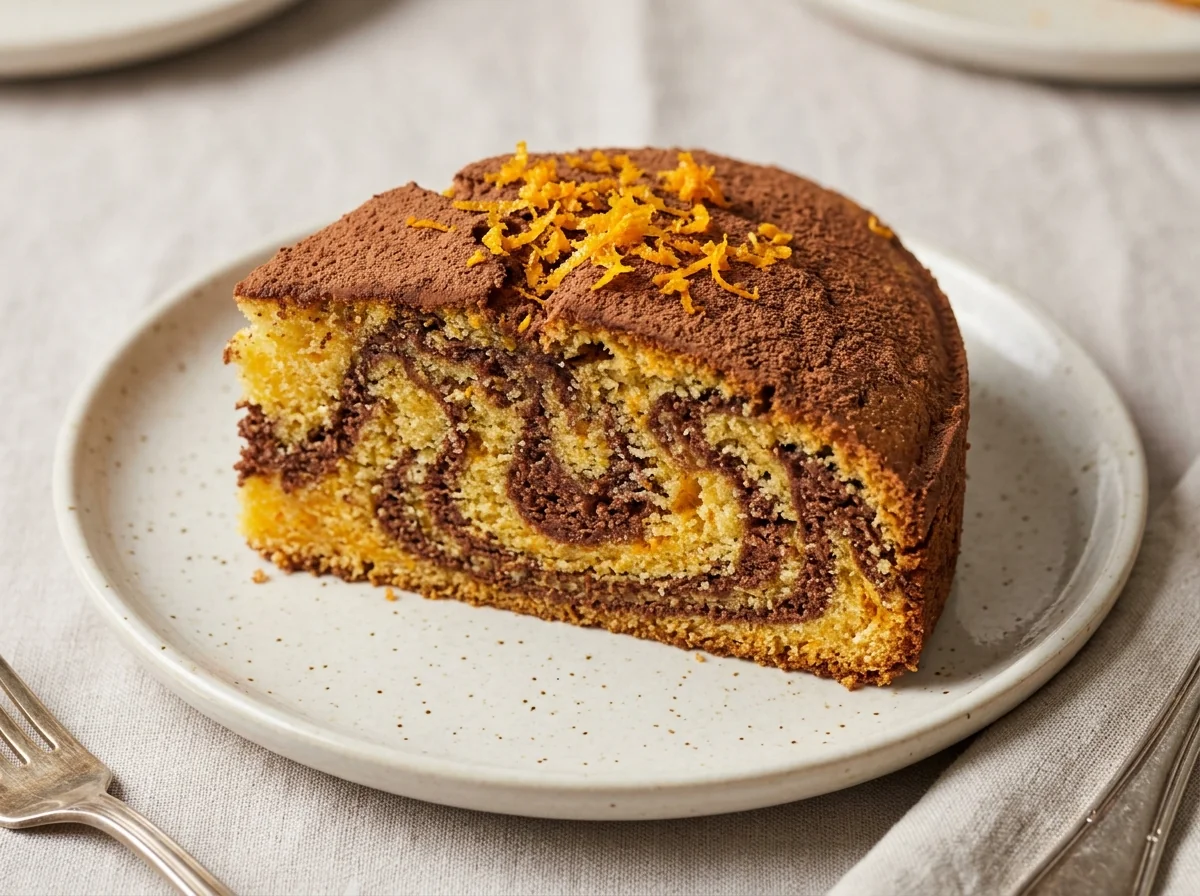
A marble cake that combines fresh orange flavor with cocoa. It is baked in a single pan and takes shape with a marble pattern by running a fork between the two layers. The crumb is tender on the inside thanks to vegetable oil, and the taste balances the tang of orange against the bitterness of cocoa. Suitable for celebrations and family occasions.
The marble cake is among the classic desserts that originated in European kitchens in the 19th century, then were adopted by Arab kitchens with local touches.
This version carries the flavor of fresh orange, a popular Levantine touch in suhoor cakes and family occasions. Drawing the marble with a fork is a visual tradition that sets this cake apart from others and makes each slice a surprise for everyone at the table.
Preparation Steps
Beat the Oil and Sugar
Start by pouring the vegetable oil into the bowl of an electric mixer and add the cup of sugar. Beat on medium speed for 3 minutes until the mixture turns light white and becomes tender in texture. This step is the foundation of the cake's tenderness, so do not shorten it to less than 3 minutes.
Add the Eggs and Flavors
Lower the mixer speed and add the first egg, and beat until it is fully incorporated into the mixture. Add the second egg and repeat the beating for 3 minutes until the texture becomes creamy. Add one teaspoon of vanilla and two tablespoons of orange zest, and beat once more on slow speed just to combine.
Add the Liquid Ingredients
Add a quarter cup of fresh orange juice while beating on slow speed, then half a cup of liquid milk the same way. Beat for only 30 seconds, since over-beating after adding liquids makes the cake tough. Stop beating as soon as the ingredients are combined.
Fold in the Flour
In a separate bowl, mix the sifted flour with baking powder and a quarter teaspoon of salt. Add the flour mixture to the wet mixture in three batches, beating on the slowest speed after each batch. Stop as soon as the flour is fully incorporated, since further mixing makes the cake rubbery. Transfer three-quarters of the batter to a second bowl.
Form the Marble
To the remaining quarter of the batter, add 3 tablespoons of sifted cocoa powder and stir with a silicone spatula until fully combined. Grease a round cake pan (24 cm diameter) with oil and sprinkle the flour carefully, then pour the orange batter (three-quarters) into it and spread evenly. Pour the cocoa batter over it in scattered dots, then pass a fork from the edge to the middle with a single circular motion to draw the marble pattern. Avoid passing the fork more than twice so the pattern does not disappear.
Bake the Cake
Place the pan in an oven preheated to 180 °C on the middle rack. Bake for 35 to 40 minutes and test for doneness with a wooden skewer in the middle of the cake: if it comes out clean, the cake is ready. Remove the pan and leave it for 10 minutes in the tin, then flip the cake onto a cooling rack and leave it to cool completely before slicing.
Blood Sugar Impact
The glycemic index (GI) measures how quickly a food raises blood sugar, while the glycemic load (GL) measures how much a full serving raises it. Together they give the complete picture.
Glycemic Index
GI
66Medium
Low0–55Medium56–69High70+
A low value (≤55) means a gradual rise in blood sugar — the most suitable range for diabetes and insulin resistance.
Glycemic Load
GL
27High
Low0–10Medium11–19High20+
Glycemic load reflects the impact of the full serving. To lower it: take half a serving, or pair the recipe with a source of protein and fiber.
Nutritional Information
Per ServingMakes 10 servings · one serving is about 95 g of raw ingredients
Calories344 kcal17%of Daily Value*
Protein5 g10%of Daily Value*
Carbohydrates43 g16%of Daily Value*
Fat18 g23%of Daily Value*
Fiber2 g7%of Daily Value*
Sodium144 mg6%of Daily Value*
* Percent Daily Values are based on a 2,000-calorie diet per FDA food-label reference values — your daily needs may be higher or lower. Values are derived from the recipe's ingredients via the USDA database.
Troubleshooting
The most common problems when preparing Marble Cake with Orange and Cocoa, and how to fix them:
The cake is dry even though the steps were followed
Lower the oven temperature by 10 degrees and add an extra tablespoon of milk. Test for doneness with a wooden skewer before removing the cake, since over-baking dries it out. Sifted flour is essential, because lumpy flour needs more liquids.
The marble pattern did not appear clearly
Pour the cocoa layer immediately over the orange layer before the latter absorbs it, and draw with the fork only once with a circular motion from the edge to the middle. Excessive passes merge the two layers and hide the marble.
The crust has large cracks on top
Lower the oven temperature by 20 degrees and reduce the beating after adding the flour. Large cracks indicate the oven is too hot or over-beating introduced more air bubbles than the dough can hold. Test with a wooden skewer two minutes ahead of schedule.
Storage and Make-Ahead
Room temperature
In an airtight container, it stays fresh for 3 days. Cut the cake only at serving time so the surface does not dry out.
Refrigerator (4°)
In an airtight container for a full week. Take the cake out half an hour before serving so it reaches room temperature and the orange flavor comes through.
Tested Ingredient Substitutions
Original Ingredient
Tested Substitute
Ratio
Flavor Difference
orange juice
lemon juice
quarter cup
Different flavor and higher acidity, so add an extra tablespoon of sugar to balance the acidity.
cocoa powder
instant coffee
2 tablespoons
For flavor only, the color will be lighter. Reduce the flour by one tablespoon because coffee absorbs liquids.
liquid milk
coconut milk
same quantity
Distinct tropical flavor that pairs well with orange. Reduce the sugar by one tablespoon because coconut milk has natural sweetness.
How Much Does It Make? Scaling Guide
Ingredient
Half amount
Original amount
Double amount
Flour
1 cup (130 g)
2 cups (260 g)
4 cups (520 g)
Sugar
1/2 cup (100 g)
1 cup (200 g)
2 cups (400 g)
Eggs
1 egg
2 eggs
4 eggs
Milk
1/4 cup
1/2 cup
1 full cup
EEINA Nutrition Tip
Beat the oil with the sugar long enough (at least 3 minutes) for the mixture to become light in texture, since this step is the foundation of the cake's tenderness. Grease the pan with oil and sprinkle flour instead of using parchment paper, because parchment paper prevents the marble from clinging to the sides. Place the cake on the middle rack of the oven so it bakes evenly.
Add This Recipe to Your Plan
The EEINA app saves your favorite recipes, calculates them from their real ingredients, and shows your daily numbers toward your goal. Try it free now.
Why don't we use butter as in the traditional cake?
Vegetable oil makes the cake more tender and keeps it moist longer, a common technique in light Arab cakes. Butter gives a richer flavor but a drier texture. For an everyday cake, oil is a practical and tasty choice.
How do we get a clear marble pattern?
Pour the cocoa mixture directly over the orange mixture as soon as it is ready, and draw a single circular motion with the fork from the edge to the middle. Avoid over-stirring which would merge the two layers and hide the marble. A freshly baked cake shows the pattern clearly when sliced.
Can I use lemon zest instead of orange?
Yes, but reduce the quantity to one tablespoon since lemon flavor is stronger than orange. Add an extra tablespoon of orange juice to prevent dryness. Lemon-flavored coffee is a modern invention.
Why didn't the cake rise like a sponge cake?
Because this is an oil-based cake rather than a butter-based one, its texture is naturally dense and heavy. This texture makes it suitable for serving with tea and coffee without crumbling. For a lighter texture, reduce the flour by 2 tablespoons and increase the eggs to 3 pieces.
Sources: USDA · University of Sydney · Our methodology · Updated on