The manousheh is a pillar of the morning bakeries of the Levant, and its name comes from 'naqsh,' the dimpling of the dough with the fingers before baking.
We have had za'atar manousheh for a long time, and this is its older sister with cheese. The star of Suhoor (pre-dawn Ramadan meal) in front of Ramadan's nightly bakeries.
Preparation Steps
Activate the Lebanese dough
Dissolve the yeast and sugar in the warm water until it foams, then knead it with the flour, salt, and oil for eight minutes into a soft, glossy dough. Cover it and let it proof for forty minutes until it doubles.
Tame the saltiness of the Akkawi
Soak the Akkawi cheese in cold water changed twice over half an hour, then crumble and dry it. The saltiness runs off and the cheese becomes pliable and melts well.
Roll the discs and top them
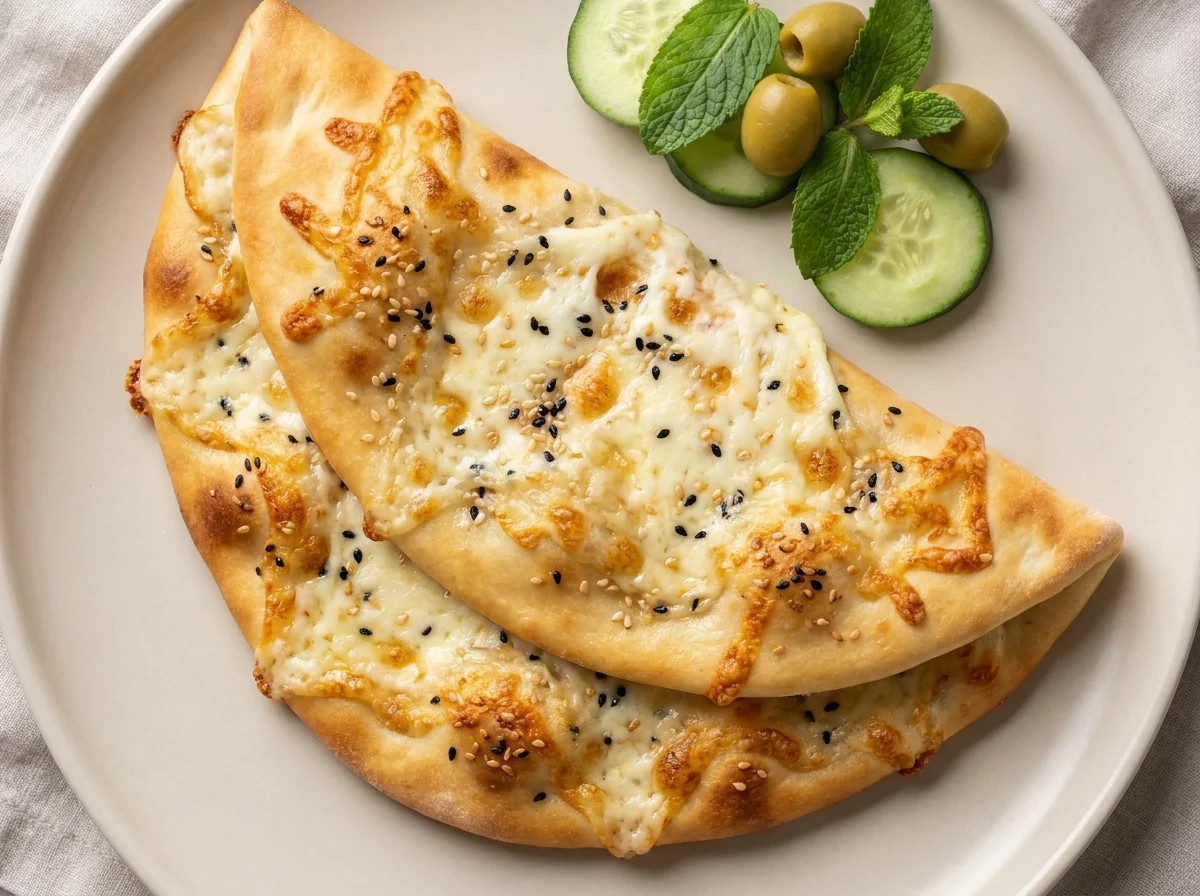
Divide the dough into four balls and roll each into a disc half a centimeter thick, dimple it with your fingertips to keep it from puffing up, spread the cheese leaving a thin border, and scatter the nigella seeds and sesame.
Bake on a hot stone
An oven preheated to its maximum (240 degrees) with an inverted tray or a baking stone waiting. The manousheh slides onto it for ten minutes until the cheese melts into golden pools and the edges blush.
Folded and eaten hot
It is folded in half as in the bakeries of Beirut and eaten by hand, with cucumber, olives, and mint on the side in the Levantine custom.
Blood Sugar Impact
The glycemic index (GI) measures how quickly a food raises blood sugar, while the glycemic load (GL) measures how much a full serving raises it. Together they give the complete picture.
Glycemic Index
GI
72High
Low0–55Medium56–69High70+
A low value (≤55) means a gradual rise in blood sugar — the most suitable range for diabetes and insulin resistance.
Glycemic Load
GL
49High
Low0–10Medium11–19High20+
Glycemic load reflects the impact of the full serving. To lower it: take half a serving, or pair the recipe with a source of protein and fiber.
Nutritional Information
Per ServingMakes 4 servings · one serving is about 225 g of raw ingredients
Calories601 kcal30%of Daily Value*
Protein26 g52%of Daily Value*
Carbohydrates71 g26%of Daily Value*
Fat23 g29%of Daily Value*
Fiber3 g11%of Daily Value*
Sodium841 mg37%of Daily Value*
* Percent Daily Values are based on a 2,000-calorie diet per FDA food-label reference values — your daily needs may be higher or lower. Values are derived from the recipe's ingredients via the USDA database.
Troubleshooting
The most common problems when preparing Oven-Baked Cheese Manousheh, and how to fix them:
The cheese wept oil and its fat separated
A lukewarm oven kept it in too long. Maximum heat and ten minutes only.
The bottom is doughy and the top is cooked
We baked on a cold tray. An inverted hot tray or the stone is the condition for a crisp bottom.
The saltiness won despite the soaking
Difficult Akkawi. Raise the mozzarella ratio in the mix to half.
It puffed like bread and pushed out the cheese
We forgot the finger dimples. The dimpling is a function, not a decoration.
Storage and Make-Ahead
Hot from the oven
Its glory is in its first ten minutes.
In the fridge
Two days, and revived in a hot oven for five minutes, not the microwave.
In the freezer
Frozen baked for a month, and from the freezer straight to the oven.
Tested Ingredient Substitutions
Original Ingredient
Tested Substitute
Ratio
Flavor Difference
The Akkawi
Grated halloumi with mozzarella
1:1
Available in every Saudi supermarket
Half the white flour
Whole-wheat flour
1:1 for the half
A rustic manousheh with higher fiber
The nigella seeds
A pinch of dried za'atar
~
A bridge between it and its za'atar sister
The oven
A covered saj over low heat
~
A rustic saj manousheh
How Much Does It Make? Scaling Guide
Ingredient
4 manousheh
2 manousheh
8 manousheh
Flour
350 g
175 g
700 g
Cheese
300 g
150 g
600 g
Water
210 ml
105 ml
420 ml
EEINA Nutrition Tip
The oven's maximum heat with a preheated hot surface is the difference between a bakery and a home. A bottom that cooks fast before the top dries out, and cheese that melts without weeping oil.
Add This Recipe to Your Plan
The EEINA app saves your favorite recipes, calculates them from their real ingredients, and shows your daily numbers toward your goal. Try it free now.
The topping is melted cheese, not za'atar in oil. Higher in protein and satiety and a hotter oven method, a separate sibling dish.
Why does it appear at Ramadan Suhoor?
The bakeries of the Levant open their nights specially for it. Warm dough and cheese supply the fasting person with carbohydrates and protein that endure with them.
Make the dough the night before?
It is kneaded and chilled overnight and taken out half an hour before rolling. A cold proof adds flavor.
Can it be filled and closed like a pie?
It then becomes a closed 'cheese qallaya.' Delicious, but a different dish; the manousheh is always open-faced.