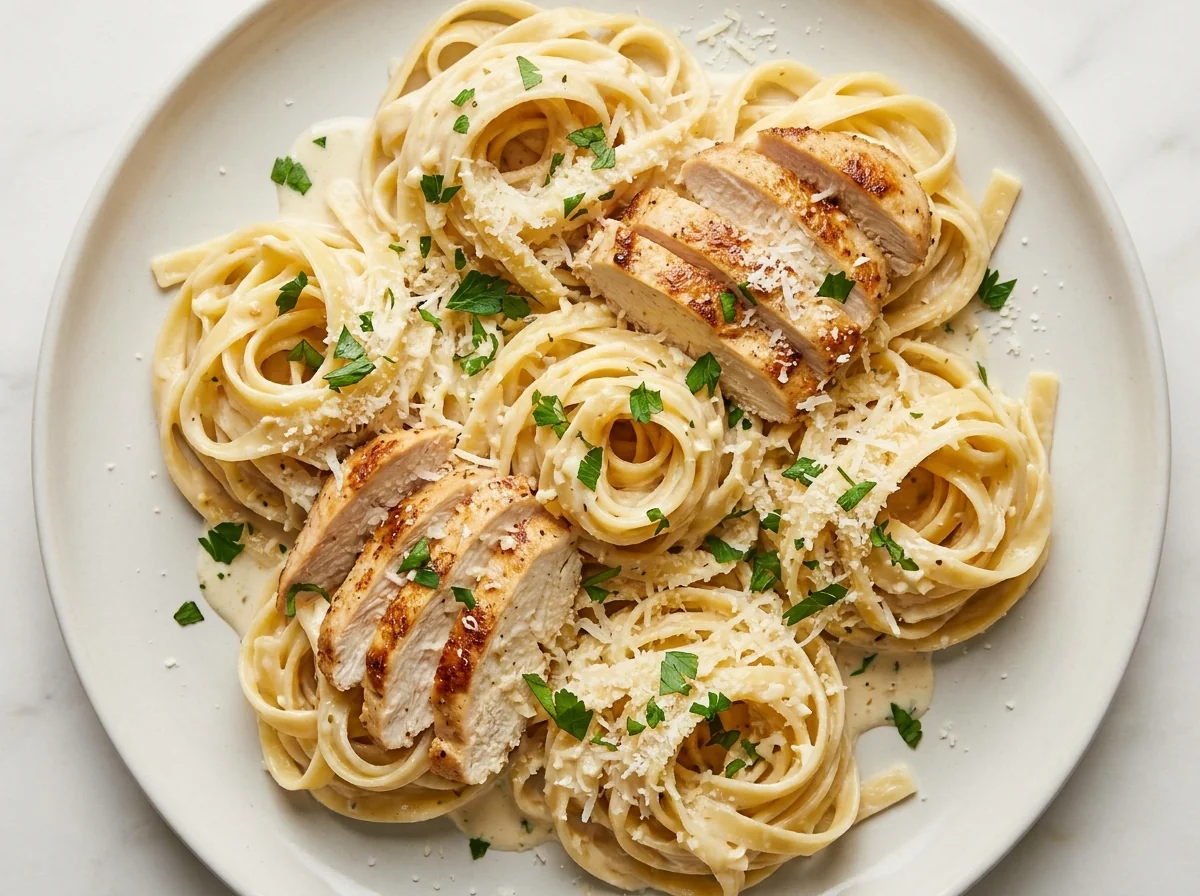
Fettuccine Alfredo is the most famous creamy pasta on the planet, born in Rome with butter and parmesan only, then amplified by America into heavy cream.
Our version brings it back toward balance: thickened milk carrying two-thirds, light cream, and real parmesan leading the flavor.
Preparation Steps
Brown the chicken slices
Salt and pepper the slices and brown them in the olive oil for three minutes per side until they turn golden and cook through, and lift them to rest: they will return as slices over the plate, not drowned in the sauce.
Build the smart milk sauce
In the same pan, melt the butter and fry the garlic for half a minute, add the flour and stir it for a minute, then the cold milk gradually with continuous whisking until a smooth sauce thickens. Milk thickened with a roux carries two-thirds of the sauce, so the heavy cream retires from its throne.
Enrich with the light cream and parmesan
Add the light cream and bring it to a gentle boil, then off the heat stir in the freshly grated parmesan and a pinch of nutmeg. Cheese off the heat is the eternal law of smoothness.
Marry the fettuccine to its sauce
Boil the fettuccine a minute short and transfer it with tongs to the sauce with a ladle of cooking water, and toss for a minute so it soaks up and clothes itself in silky ribbons.
Crown with the chicken and serve
The golden chicken slices over the nests, parsley, and a sprinkle of parmesan. The restaurants' alfredo that weighs down their plates, in a version where you taste its luxury and do not carry its heaviness.
Blood Sugar Impact
The glycemic index (GI) measures how quickly a food raises blood sugar, while the glycemic load (GL) measures how much a full serving raises it. Together they give the complete picture.
Glycemic Index
GI
49Low
Low0–55Medium56–69High70+
A low value (≤55) means a gradual rise in blood sugar — the most suitable range for diabetes and insulin resistance.
Glycemic Load
GL
42High
Low0–10Medium11–19High20+
Glycemic load reflects the impact of the full serving. To lower it: take half a serving, or pair the recipe with a source of protein and fiber.
Nutritional Information
Per ServingMakes 3 servings · one serving is about 410 g of raw ingredients
Calories831 kcal42%of Daily Value*
Protein49 g98%of Daily Value*
Carbohydrates88 g32%of Daily Value*
Fat31 g40%of Daily Value*
Fiber3 g11%of Daily Value*
Sodium502 mg22%of Daily Value*
* Percent Daily Values are based on a 2,000-calorie diet per FDA food-label reference values — your daily needs may be higher or lower. Values are derived from the recipe's ingredients via the USDA database.
Troubleshooting
The most common problems when preparing Lighter Chicken Fettuccine Alfredo, and how to fix them:
The sauce is gritty and grainy
Ready-grated parmesan with anti-caking agents or cheese over a live flame. The fresh block and off the heat. Two laws that are not broken.
It thickened until it set on the plate
Alfredo's eternal nature. Pour it looser with an extra ladle of cooking water, and eat it right after serving, not after a photo session.
Its taste is bland despite the cheese
Quiet salt. The parmesan carries its salt but the milk swallows it. Taste and correct after the cheese, not before.
The chicken dried out on top of it
Thin slices cooked too long. Three minutes per side and rest aside. It returns tender over the plate.
Storage and Make-Ahead
Immediately
Alfredo cannot be postponed. Its consistency sets in minutes.
In the refrigerator
One day. Loosen it with a sip of milk over low heat and it loses a little of its silk.
Not suitable for freezing
The cheese sauce separates.
Tested Ingredient Substitutions
Original Ingredient
Tested Substitute
Ratio
Flavor Difference
Light cream
Omit it and add more thickened milk
~
The lightest extreme. Loses a degree of richness
Fettuccine
Penne or whole wheat
1:1
All shapes wear the sauce
Chicken
Briefly fried shrimp or browned mushrooms
~
Sea or plant alfredo
A green addition
Briefly blanched broccoli tossed into it
150 g
Slipping vegetables into the beloved white
How Much Does It Make? Scaling Guide
Ingredient
3 servings
One and a half servings
6 servings
Fettuccine
300 g
150 g
600 g
Chicken
350 g
175 g
700 g
Milk and cream
450 ml
225 ml
900 ml
EEINA Nutrition Tip
Grate the parmesan fresh from its block and add it off the heat. The ready-grated kind is packed with anti-caking agents that prevent it from melting, so the sauce comes out gritty; the block grated in the moment melts into silk: the whole difference of alfredo is in this detail.
Add This Recipe to Your Plan
The EEINA app saves your favorite recipes, calculates them from their real ingredients, and shows your daily numbers toward your goal. Try it free now.
How much lighter is it than the restaurants' alfredo really?
The restaurants' plate is pure heavy cream with generous butter, and our plate is milk thickened by two-thirds: the fat drops toward half and the luxury stays in the real parmesan.
Was the original alfredo without cream at all?
Yes. Rome tosses it with butter, parmesan, and cooking water only: cream is a later American addition, and our version stands between the lean original and the American amplification.
What is its balanced portion?
A medium plate with its chicken alongside a green salad with sharp lemon. The acidity cuts the creaminess and closes the appetite fairly.
Why fettuccine specifically?
Its wide ribbons carry heavy sauces in a way thin spaghetti cannot bear. To each sauce its strand: Italy's first wisdom.