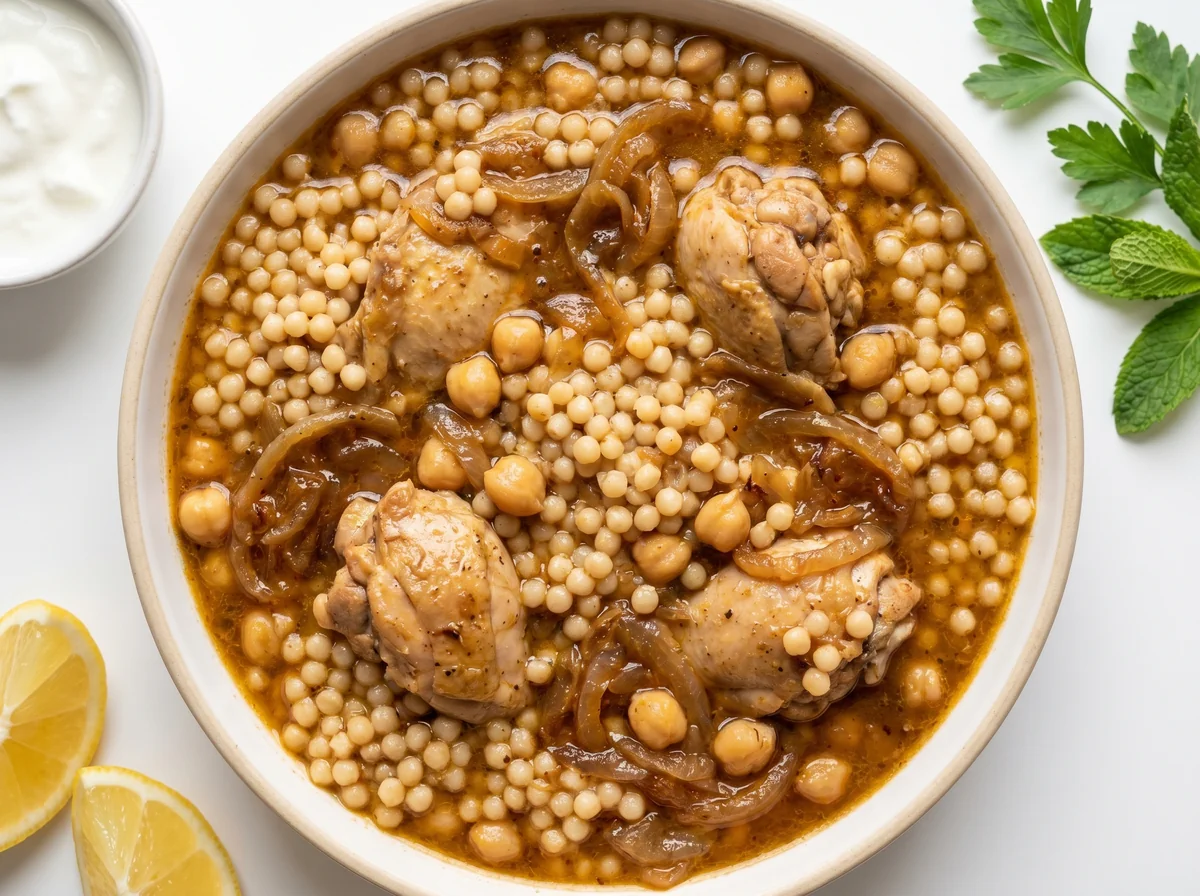
A Lebanese winter dish — large moghrabieh pearls (giant pearl couscous) cooked with chicken, chickpeas, and baby onions, seasoned with caraway and cinnamon. A warm, satisfying dish with moderate carbohydrates that contains gluten.
Moghrabieh is a beloved Lebanese winter dish, especially in Beirut, named for the moghrabieh pearl (giant pearl couscous — much larger than ordinary North African couscous, sometimes called maftoul in Palestinian cuisine). The pearls are cooked with chicken, chickpeas, and baby pearl onions, seasoned with caraway and cinnamon (its signature aroma).
Despite the name 'moghrabieh' (suggesting Moroccan origin), it is a Levantine Lebanese and Palestinian dish (its Palestinian counterpart is maftoul) — different from North African couscous. Moghrabieh is a family dish and a winter occasion staple, warm and filling. Its large, tender, caraway-scented pearls with chicken and chickpeas are a warming delight — a symbol of generous, authentic Lebanese winter cooking.
Preparation Steps
Cook the chicken and make the broth
Poach the chicken with an onion, whole spices, a cinnamon stick, and salt until fully cooked. Remove the chicken and reserve the broth. The aromatic broth is the foundation for cooking the moghrabieh (the pearls absorb it). The chicken can be lightly browned after poaching for color.
Cook the chickpeas and baby onions
Cook the soaked chickpeas until tender (in the broth or water), and sauté the baby onions in ghee until golden. Chickpeas and baby pearl onions are two essential components of Lebanese moghrabieh alongside the chicken.
Steam the moghrabieh pearls
Steam the moghrabieh (ready-to-cook) in a couscousière over steam until tender (or cook in broth depending on the variety), tossing with ghee to separate the pearls. Moghrabieh pearls are large (much bigger than ordinary couscous) — they need sufficient cooking time to become tender without clumping.
Season the broth
Season the broth with caraway seeds, cinnamon, baharat, pepper, and salt. Adjust to taste. Caraway and cinnamon are the warm, classic signature of Lebanese moghrabieh (distinguishing it from North African couscous).
Combine and simmer
Combine the cooked moghrabieh pearls with the chickpeas, baby onions, and chicken in the pot. Pour in the seasoned broth and leave over gentle heat for about fifteen minutes for everything to absorb the flavor and come together. The final absorption makes the pearls fragrant and delicious.
Serve
Serve the moghrabieh hot in a large dish: pearls on the bottom, topped with chicken, chickpeas, and baby onions, with broth ladled over. This is a Lebanese (and especially Beiruti) winter dish — warm, satisfying, and beloved for family gatherings and occasions. Its large, tender pearls perfumed with caraway and cinnamon alongside chicken and chickpeas are a warming pleasure — a symbol of authentic Lebanese winter cooking.
Blood Sugar Impact
The glycemic index (GI) measures how quickly a food raises blood sugar, while the glycemic load (GL) measures how much a full serving raises it. Together they give the complete picture.
Glycemic Index
GI
42Low
Low0–55Medium56–69High70+
A low value (≤55) means a gradual rise in blood sugar — the most suitable range for diabetes and insulin resistance.
Glycemic Load
GL
36High
Low0–10Medium11–19High20+
Glycemic load reflects the impact of the full serving. To lower it: take half a serving, or pair the recipe with a source of protein and fiber.
Nutritional Information
Per ServingMakes 5 servings · one serving is about 480 g of raw ingredients
Calories755 kcal38%of Daily Value*
Protein44 g88%of Daily Value*
Carbohydrates101 g37%of Daily Value*
Fat18 g23%of Daily Value*
Fiber16 g57%of Daily Value*
Sodium101 mg4%of Daily Value*
Potassium1119 mg24%of Daily Value*
Phosphorus483 mg39%of Daily Value*
* Percent Daily Values are based on a 2,000-calorie diet per FDA food-label reference values — your daily needs may be higher or lower. Values are derived from the recipe's ingredients via the USDA database.
Troubleshooting
The most common problems when preparing Lebanese Moghrabieh, and how to fix them:
The pearls are clumped and sticky
Not steamed or not tossed with oil. Steam the pearls and toss them with ghee to separate (as with couscous), or cook them in sufficient liquid without excess. Stirring and oil keep the pearls separate rather than clumped.
The pearls are hard
Too short cooking time or too little liquid. Moghrabieh pearls are large — they need longer cooking and enough liquid to become fully tender. Steam or cook for sufficient time with generous broth. Test for tenderness before serving.
The flavor is bland
Too little caraway, cinnamon, or broth. Caraway and cinnamon are the signature aroma of moghrabieh — be generous with them. Cook the pearls in aromatic chicken broth (not water) — the broth delivers the core flavor.
Dry and tight
Not enough broth. Moghrabieh is served moist in its broth (the pearls absorb it and dry out if it runs low). Reserve enough broth and ladle it over at serving, offering extra broth on the side. Broth is essential.
The chickpeas are hard
Not soaked long enough. Soak the chickpeas overnight (or use tinned), and cook until completely tender before combining. Hard chickpeas will not soften in the short final cooking time.
Storage and Make-Ahead
Refrigerator (4°C)
Moghrabieh keeps in a sealed container in the refrigerator for 3 days, and the flavor improves. The pearls absorb the broth and dry out on standing — reheat with a splash of hot broth or water to restore moisture. Reheat gently.
Freezer
Freeze the moghrabieh with chicken, chickpeas, and broth for two months in a sealed container. Thaw in the refrigerator and reheat with extra broth (the pearls absorb liquid). Practical for preparing a batch for winter occasions.
Advance preparation
Prepare the broth, chicken, and chickpeas the day before the occasion, then steam the pearls and assemble the dish at serving time. Or cook it fully (it improves overnight) and reheat with broth. Practical for winter gatherings.
Food safety
Cook the chicken until fully done (74°C internal), cool the moghrabieh quickly, do not leave unrefrigerated for more than two hours, and reheat thoroughly before serving.
Tested Ingredient Substitutions
Original Ingredient
Tested Substitute
Ratio
Flavor Difference
Moghrabieh pearls
Palestinian maftoul or giant pearl couscous
same amount
Palestinian maftoul is a close equivalent (large pearls). Any large pearl couscous approximates the texture if moghrabieh is unavailable.
Chicken
Lamb
same amount
Chicken is the lighter traditional choice; lamb gives a richer flavor. Both are cooked to make the broth that the pearls absorb.
Ghee
Olive oil
same amount
Lowers saturated fat. Ghee is the traditional flavor; olive oil is a healthier option with a pleasant Lebanese character.
How Much Does It Make? Scaling Guide
Number of servings
Moghrabieh
Chicken
chickpeas
3 (small)
1.5 cups
0.25 chicken
0.5 cup
5 (base)
2 cups
0.5 chicken
1 cup
10 (gathering)
4 cups
1 chicken
2 cups
EEINA Nutrition Tip
Moghrabieh is a balanced, nourishing dish: chicken provides protein, chickpeas add plant protein and fiber (which lowers the glycemic load), onion contributes antioxidants, and the pearls are complex carbohydrates. The challenges are the carbohydrates and moderate glycemic load (from the large pearls), fat (ghee), and sodium. For a better version: increase the chickpeas (fiber and protein), use skinless chicken, replace ghee with olive oil, control the salt, and balance with salad. A warm, satisfying winter dish whose balance comes from the fiber and protein — enjoy in moderation.
Add This Recipe to Your Plan
The EEINA app saves your favorite recipes, calculates them from their real ingredients, and shows your daily numbers toward your goal. Try it free now.
A Lebanese winter dish of moghrabieh pearls (giant pearl couscous) cooked with chicken, chickpeas, and baby pearl onions, seasoned with caraway and cinnamon. A warm, hearty family and occasion dish (especially Beiruti), whose large, tender, caraway-scented pearls with chicken and chickpeas are a winter pleasure.
Is moghrabieh a Moroccan dish?
No, despite the name. Moghrabieh is a Levantine Lebanese and Palestinian dish (its Palestinian counterpart is maftoul) — different from North African couscous. Its pearls are much larger than Moroccan couscous and its flavor (caraway and cinnamon) is distinctly Levantine. The name may reflect a distant origin, but the dish is quintessentially Lebanese.
What is the difference between moghrabieh and maftoul?
Very similar — both are large pearls cooked with chicken, chickpeas, and onion. Moghrabieh is the Lebanese version (seasoned with caraway and cinnamon) and maftoul is Palestinian. The pearl itself is virtually the same (called moghrabieh in Lebanon and maftoul in Palestine). Both are warm Levantine counterparts.
Is moghrabieh healthy?
A balanced, nourishing dish: chicken protein, chickpea protein and fiber, antioxidant onion, and complex-carbohydrate pearls. Challenges are carbohydrates (moderate load) and fat and sodium. Increase the chickpeas, use skinless chicken, replace ghee with olive oil, and control the portion. A satisfying winter dish balanced by fiber and protein.
Sources: University of Sydney · Gulf GSO · Our methodology · Updated on