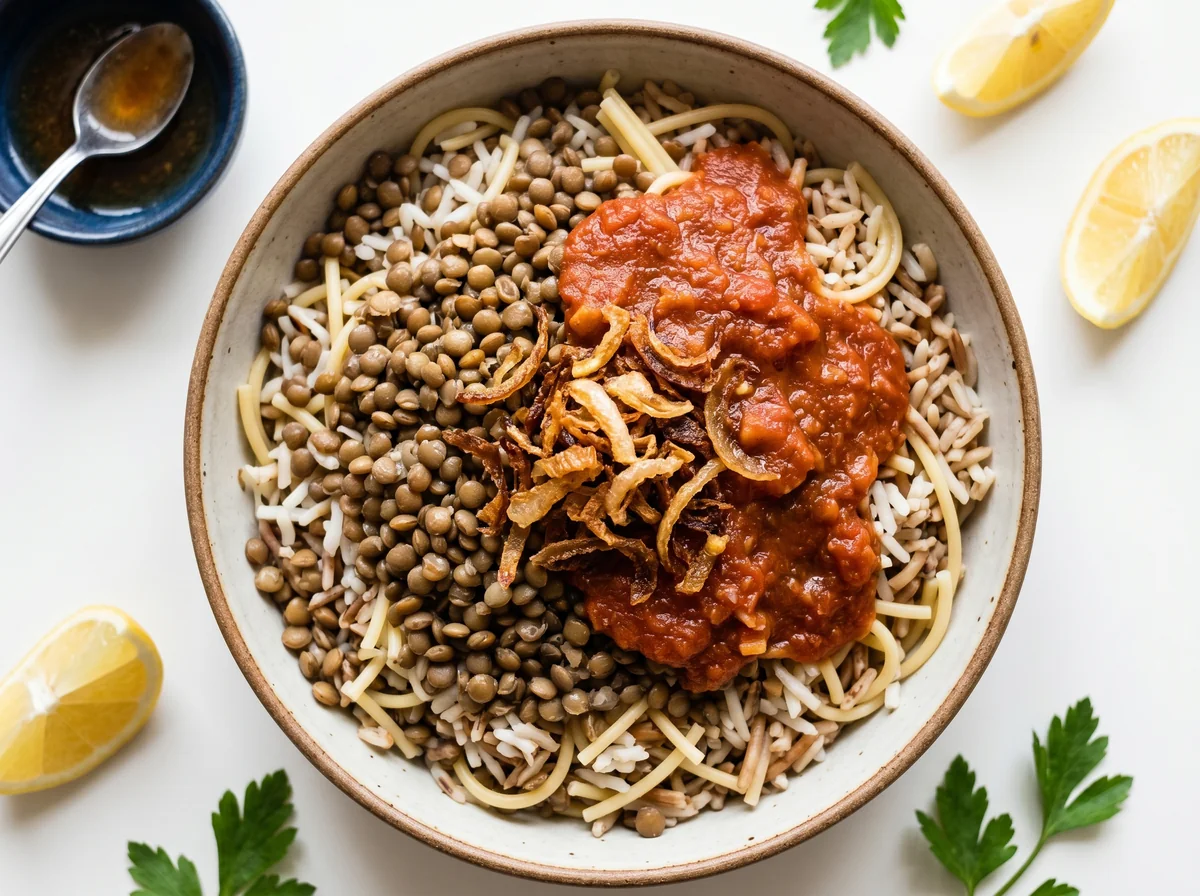
Egypt's number-one street dish — rice, lentils, pasta, and chickpeas with tomato sauce and crispy onions, a complete plant protein from combining lentils and grains, rich in fiber, with a high glycemic load because it is a starchy dish, so it is served in a moderate portion.
Koshari is Egypt's street dish without rival, born in the nineteenth century from a meeting of cultures: rice and lentils from ancient Egyptian cuisine, pasta from the Italians, and chickpeas from the Levant.
It brings together three starch and legume sources in one cheap, filling dish that became a symbol of Egyptian street food. Combining lentils with rice gives a plant protein complete in amino acids.
Preparation Steps
Boil the lentils
Wash the cup of brown lentils well under water and drain them, then put them in a pot with three cups of cold water without salt, as early salt toughens the lentil skin and slows its cooking. Leave it until it boils, and skim off the foam that floats on the surface with a spoon so the broth clears, then lower the heat and leave it to cook for fifteen minutes. The right sign is that the lentil grain softens and presses easily between two fingers while staying intact, not mushy. Drain it and keep half a cup of its cooking water aside, as we may need it to adjust the consistency later.
Cook the rice over the lentils
Wash a cup and a half of short-grain Egyptian rice with water several times until its water runs clear and it is rid of excess starch. In the same pot over the drained lentils, add the rice, two cups of hot water, half a teaspoon of salt, and a spoon of oil. Stir the mixture only once so the rice does not stick, then cover the pot tightly and cook over very low heat for eighteen minutes without lifting the lid or stirring. When done, the rice absorbs all the water and small steam holes appear on its surface. Take it off the heat and leave it covered for five minutes to rest, then fluff it gently with a fork until the grains separate.
Boil the pasta and heat the chickpeas
In a separate pot, boil water and salt it well, then add the cup of small pasta (ditalini or broken vermicelli). Boil it until it softens while its center stays slightly firm, about eight minutes depending on the type, then drain it and toss it with a splash of oil so it does not stick together. At the same time, heat the cup of boiled chickpeas (drained, rinsed canned or home-boiled) in lightly heated water for two minutes or in the microwave, as koshari is served with all its components hot.
Fry the onions until crispy
Koshari's number-one secret: peel two large onions and cut them into thin, even slices, then dry them completely with a kitchen towel, as any moisture prevents crispiness and burns the edges. Heat the oil over medium heat and add the onion, and stir it constantly until it turns gradually from translucent to golden then to dark golden brown, about ten to twelve minutes. Watch out, for if it darkens too fast, lower the heat a little so it does not burn and go bitter. Lift it out immediately onto absorbent paper while it is a touch lighter than the desired color, as it keeps cooking and darkening out of the oil and becomes crispy as it cools.
Prepare the tomato sauce
In two spoons of the same onion-frying oil, brown the four crushed garlic cloves for twenty seconds until their aroma rises without burning, then add two finely chopped onions and stir until they wilt and turn translucent. Add the four grated tomatoes, the teaspoon of cumin, the half spoon of hot chili (if you like heat), and a pinch of salt, and leave the mixture to boil uncovered for about fifteen minutes until its water evaporates, it thickens, and its color becomes a dark red that clings to the back of the spoon. Watch out, for if the sauce dries before it is done, add a little of the reserved lentil cooking water. Turn off the heat and add the two spoons of white vinegar and stir, as vinegar is koshari's distinctive flavor. Taste and adjust the salt and vinegar to taste.
Assemble the dish and serve
On a wide serving plate, spread the rice and lentil layer first, then distribute the pasta over it, then scatter the hot chickpeas. Pour the hot tomato sauce generously over everything, and crown the dish with a mound of crispy onion in the center. Serve the koshari immediately while it is hot, with the vinegar bottle and a dish of hot chili on the table so each person adds to taste. Immediate serving is essential so the onion's crispiness keeps itself before it wilts in the heat of the sauce.
Blood Sugar Impact
The glycemic index (GI) measures how quickly a food raises blood sugar, while the glycemic load (GL) measures how much a full serving raises it. Together they give the complete picture.
Glycemic Index
GI
50Low
Low0–55Medium56–69High70+
A low value (≤55) means a gradual rise in blood sugar — the most suitable range for diabetes and insulin resistance.
Glycemic Load
GL
39High
Low0–10Medium11–19High20+
Glycemic load reflects the impact of the full serving. To lower it: take half a serving, or pair the recipe with a source of protein and fiber.
Nutritional Information
Per ServingMakes 6 servings · one serving is about 305 g of raw ingredients
Calories508 kcal25%of Daily Value*
Protein18 g36%of Daily Value*
Carbohydrates88 g32%of Daily Value*
Fat9 g12%of Daily Value*
Fiber10 g36%of Daily Value*
Sodium412 mg18%of Daily Value*
* Percent Daily Values are based on a 2,000-calorie diet per FDA food-label reference values — your daily needs may be higher or lower. Values are derived from the recipe's ingredients via the USDA database.
Troubleshooting
The most common problems when preparing Egyptian Koshari, and how to fix them:
The onion burned and did not become crispy
The heat was too high, or the onion was not dried before frying. Moisture prevents crispiness and burns the edges before the inside dries. Dry the slices with a towel, and fry them over medium heat with constant stirring until they reach dark golden, then lift them immediately as they keep cooking out of the oil.
The rice and lentils are falling apart and pasty
You added more water than needed, or the lentils were overcooked before adding the rice. Boil the lentils only until they soften (15 minutes), not until they disintegrate, use two cups of water per cup and a half of rice, and do not stir the pot while the rice cooks.
The sauce is watery with no body
It was not left to thicken enough. Grated tomatoes need 15 minutes of uncovered boiling to evaporate their water. If it stays watery, raise the heat a little and leave it extra minutes until it thickens and clings to the back of the spoon.
The taste is bland
Lacking vinegar and cumin. White vinegar is koshari's distinctive flavor, added to the sauce at the end with its bottle served on the table. Cumin gives depth. Taste the sauce and adjust the salt and vinegar before serving.
The components are cold at serving
Koshari is assembled hot and served immediately. Heat the pasta and chickpeas before assembling, and keep the sauce over low heat. Assembling is the last step right before serving.
Storage and Make-Ahead
Refrigerator (4°)
Components separate: rice, lentils, and pasta keep in airtight containers for three days. The sauce for two days. The crispy onion in a dry container at room temperature for two days (do not refrigerate it or it loses its crispiness).
Freezer (-18°)
Rice, lentils, and sauce freeze for a month. The pasta does not freeze (it becomes pasty). The crispy onion does not freeze.
Make ahead
Prepare each component separately and store it, and assemble minutes before serving. This is better than full assembly in advance, as assembled koshari loses its texture and the onion's crispiness wilts.
Reheating
Heat each component separately (the rice with a splash of water, the sauce over low heat), then assemble and add fresh crispy onion. Avoid the microwave for the assembled dish as it becomes pasty.
Tested Ingredient Substitutions
Original Ingredient
Tested Substitute
Ratio
Flavor Difference
Regular pasta
Whole-wheat pasta
Same amount
Higher fiber and a slightly lower glycemic load, a more grainy flavor
White rice
Brown rice
Same amount with more water and a longer time
Higher fiber, lowers the glycemic load, a nutty flavor
Fried onion
Oven-roasted onion
Same amount
Much less fat, needs tossing in the oven until it browns
How Much Does It Make? Scaling Guide
Number of servings
Rice
Lentils
Pasta
Tomatoes
3 (half recipe)
3/4 cup
1/2 cup
1/2 cup
2 pieces
6 (base)
1.5 cups
1 cup
1 cup
4 pieces
12 (large family)
3 cups
2 cups
2 cups
8 pieces
EEINA Nutrition Tip
Koshari is a starchy dish with a high glycemic load despite its low index, because it combines three carbohydrates. For moderation: make your portion the size of a fist, and add a plate of green salad alongside it to slow sugar absorption. It is not a daily dish for diabetics, but a moderate occasion.
Add This Recipe to Your Plan
The EEINA app saves your favorite recipes, calculates them from their real ingredients, and shows your daily numbers toward your goal. Try it free now.
Rich in plant protein and fiber, but it is a starchy dish with a high glycemic load. It is healthy in a moderate portion with a salad, and not in a large amount daily.
Is it suitable for diabetics?
It is not a daily dish for them because of its high glycemic load (23). In a very small portion with a large green salad on a moderate occasion, it can work. Consult your doctor.
What is the secret to the crispy onion?
Drying the slices well, frying them over medium heat to dark golden, and lifting them immediately. It is the soul of koshari.
Is it vegan?
Yes, koshari is fully vegan and free of animal products.