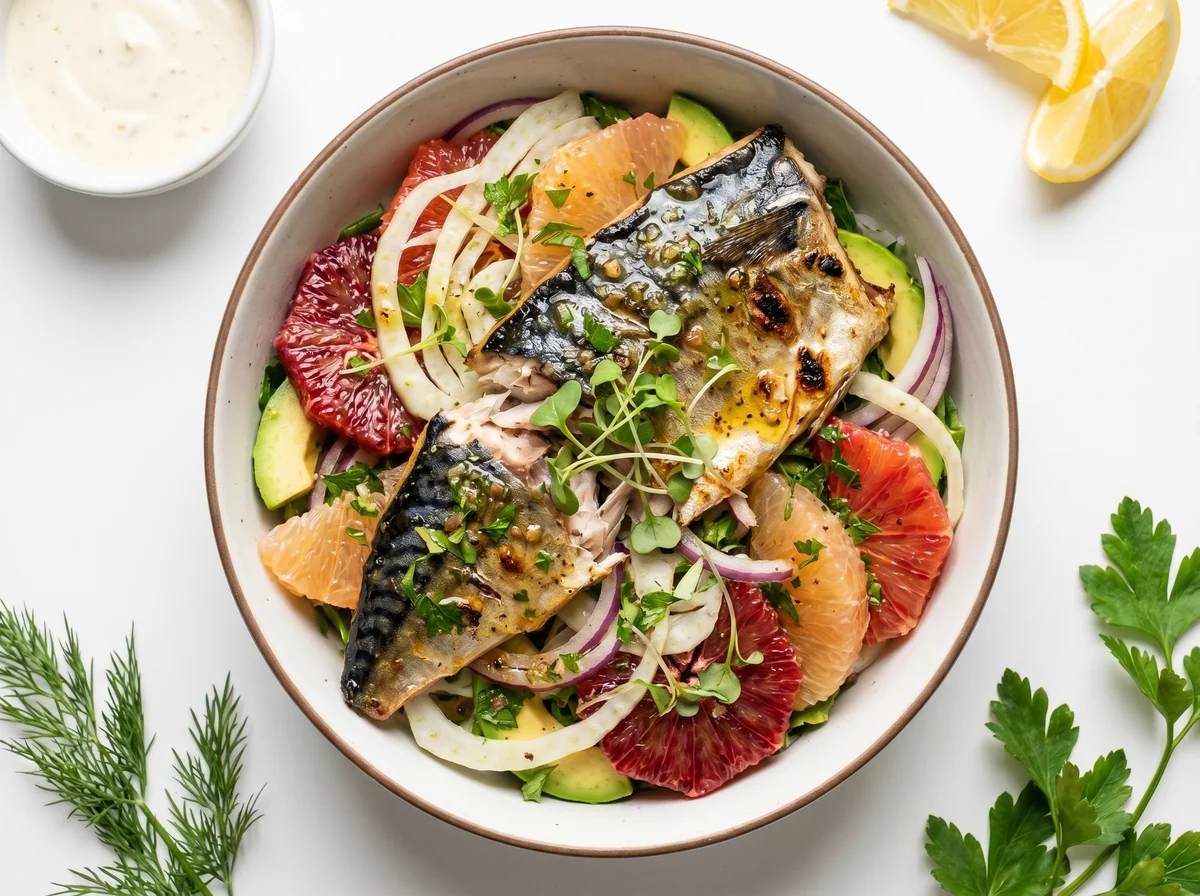
This salad brings together a cold-water fish rich in its own oils and the brightness of a citrus grove, in a Mediterranean combination that finds its echo on Gulf coastal tables where fresh fish is grilled and served with whatever cuts through its richness. Mackerel is an affordable, abundant fish, richer in omega-3 than many expensive varieties.
When it meets the acidity of orange, the bite of rocket, and the fragrance of fennel, it becomes a dish that stands on its own without needing much salt — because the citrus takes care of waking up the flavour. A meal that is light on the stomach, deep in taste, and perfect for a hot-day lunch.
Preparation Steps
Dry and season the fish
Pat the mackerel fillets thoroughly dry on both sides with kitchen paper — a dry surface is the only way to develop a golden crust instead of steaming in its own moisture. Brush with half a tablespoon of olive oil and sprinkle with black pepper, ground coriander seeds, and grated orange zest. Leave for ten minutes to reach kitchen temperature so the fish cooks evenly.
Heat the griddle pan
Heat a ridged griddle pan or grill over medium-high heat for three to four minutes until you can feel clear heat when you hold your palm at a hand's distance above it. A cold pan sticks the skin and tears the fillet; a well-heated one prints clean grill marks.
Grill the mackerel
Place the fillet skin-side down first and grill undisturbed for three to four minutes until it releases from the grill easily, then flip for two to three minutes. The fish is done when its internal temperature reaches 63°C and the flesh flakes easily with a light fork press. Do not go beyond that or it will dry out and lose its tenderness.
Segment the oranges
Cut the top and bottom off each orange, then remove the peel and white pith with a knife and cut into round slices half a centimetre thick. Collect the dripping juice in the dressing bowl — it replaces some of the salt in bringing out the flavour.
Slice the fennel and onion
Remove the tough fennel core and slice very thinly on a mandoline or with a sharp knife. Slice the red onion into fine rings. Soak the onion in cold water for five minutes then drain to mellow its sharpness while keeping it crisp and raw.
Make the citrus dressing
In the bowl with the collected juice, whisk in the remaining olive oil with the lemon juice, apple cider vinegar, and chopped mint until combined and slightly thickened. Taste: acidity here does the work of salt, so if balance is needed add a little more orange zest rather than salt.
Assemble and serve
Spread the rocket on the plate, arrange the orange segments, fennel, and onion on top, then place the warm mackerel fillet over everything in large pieces. Pour the dressing at the moment of serving only so the rocket stays fresh, and add a pinch of salt at the table for those who want it.
Blood Sugar Impact
The glycemic index (GI) measures how quickly a food raises blood sugar, while the glycemic load (GL) measures how much a full serving raises it. Together they give the complete picture.
Glycemic Index
GI
33Low
Low0–55Medium56–69High70+
A low value (≤55) means a gradual rise in blood sugar — the most suitable range for diabetes and insulin resistance.
Glycemic Load
GL
9Low
Low0–10Medium11–19High20+
Glycemic load reflects the impact of the full serving. To lower it: take half a serving, or pair the recipe with a source of protein and fiber.
Nutritional Information
Per ServingMakes 2 servings · one serving is about 515 g of raw ingredients
Calories412 kcal21%of Daily Value*
Protein32 g64%of Daily Value*
Carbohydrates35 g13%of Daily Value*
Fat17 g22%of Daily Value*
Fiber8 g29%of Daily Value*
Sodium299 mg13%of Daily Value*
* Percent Daily Values are based on a 2,000-calorie diet per FDA food-label reference values — your daily needs may be higher or lower. Values are derived from the recipe's ingredients via the USDA database.
Troubleshooting
The most common problems when preparing Grilled Mackerel and Citrus Salad, and how to fix them:
The fish skin stuck to the griddle and the fillet tore
The pan was not heated enough, or you moved the fish too early. Heat the griddle until you can feel its heat at a hand's distance, brush the surface with a thin layer of oil, and leave the fillet untouched until it releases itself after three to four minutes.
The fish dried out and became tough
You exceeded the 63°C internal temperature or the grilling time was too long. Mackerel is delicate and cooks quickly — remove it the moment the flesh flakes with a gentle fork press, remembering that it continues cooking in its retained heat after you lift it.
The rocket wilted and the dish became watery
You added the dressing too early and the acidity drew the moisture out of the leaves. Mix the dressing separately and pour it only at the moment of serving, placing the warm (not very hot) fish on top of the leaves.
The orange flavour is dominant and slightly bitter
The white pith was left on the segments — that is the source of bitterness. Remove the peel and white skin completely with a knife until the orange flesh is exposed, and segment away from the fibrous core.
The dish seems to lack flavour without salt
This dish relies on acidity, not salt. Increase a dash of lemon juice or apple cider vinegar, add more grated orange zest and ground coriander seeds — they give depth that makes sodium unnecessary. Those who wish can add a light pinch of salt at their own plate.
Storage and Make-Ahead
Grilled fish separately
Store the grilled mackerel in an airtight container in the refrigerator at 4°C or below — it keeps well for one day. Reheat gently or serve cold on the salad.
Salad without dressing
Keep the rocket, fennel, and orange dry in a closed container in the refrigerator for up to two days. Do not add the dressing until serving to prevent the vegetables wilting.
Citrus dressing
Keeps in a sealed jar in the refrigerator for up to three days. Shake before using as the oil separates from the juice when cold.
Safety note
Do not leave cooked fish outside the refrigerator for more than two hours (or one hour in hot weather above 32°C) according to the danger-zone rule. Do not freeze the assembled dish as leafy vegetables cannot withstand freezing.
Tested Ingredient Substitutions
Original Ingredient
Tested Substitute
Ratio
Flavor Difference
Mackerel
Fresh sardines or salmon
Same weight 300 g
Both are oily fish rich in omega-3 and serve the same heart-health goal; salmon is milder in flavour.
Rocket (arugula)
Baby spinach or mixed salad leaves
Same weight 80 g
Spinach is milder than peppery rocket and remains rich in fibre and folate.
Fennel bulb
Celery or thin cucumber
Same weight 150 g
For refreshing crunch without the anise flavour that fennel has.
Oranges
Grapefruit or mandarins
Same weight about 400 g
Grapefruit is more acidic and strengthens the citrus role in place of salt; check for interactions with any medications you take.
Apple cider vinegar
White wine vinegar or extra lemon juice
Same amount 5 ml
To maintain balanced acidity in the dressing without adding sodium.
How Much Does It Make? Scaling Guide
Ingredient
2 servings
4 servings
6 servings
Mackerel fillet
300 g
600 g
900 g
Arugula
80 g
160 g
240 g
Orange
2 pieces
4 pieces
6 pieces
Fennel bulb
1 piece
2 pieces
3 pieces
Olive oil
30 ml
60 ml
90 ml
EEINA Nutrition Tip
For oily fish like mackerel there is a golden rule: buy it very fresh and cook it the same day, because its rich fats oxidise quickly and develop a sharp taste if delayed. Smell the fish before buying — fresh mackerel has a clean sea smell, not pungent. If you substitute tinned mackerel in water (not in oil or salted sauce), rinse it well to reduce sodium and preserve the spirit of the no-added-salt dish.
Add This Recipe to Your Plan
The EEINA app saves your favorite recipes, calculates them from their real ingredients, and shows your daily numbers toward your goal. Try it free now.
Yes — choose tinned in water, not in oil or salted sauce, and rinse it under water to reduce sodium, preserving the spirit of the no-added-salt dish. Skip the grilling steps and flake it directly over the salad.
How do I know the fish is cooked without a thermometer?
Cooked flesh changes from translucent to opaque and flakes easily when pressed with a fork. Even so, an internal temperature of 63°C remains the most precise standard for fish food safety.
Why citrus instead of salt? Does it really work?
Acidity stimulates the taste buds and brings out natural flavours, reducing the need for sodium that burdens the heart and blood pressure. With orange zest, herbs, and pepper you get a satisfying depth of flavour without added salt.
Is the dish suitable for people with diabetes?
Yes in general — it is rich in protein, healthy fats, and fibre, and low in carbohydrates, a composition that tends towards a gentle effect on blood sugar. It remains a supportive food, not a substitute for a treatment plan and medical follow-up.
Can I prepare it in advance for a work lunch?
Yes — store the components separately: grilled fish, vegetables, and dressing each in a container, and combine them at eating time. That way the rocket stays fresh and the dish keeps its full texture.