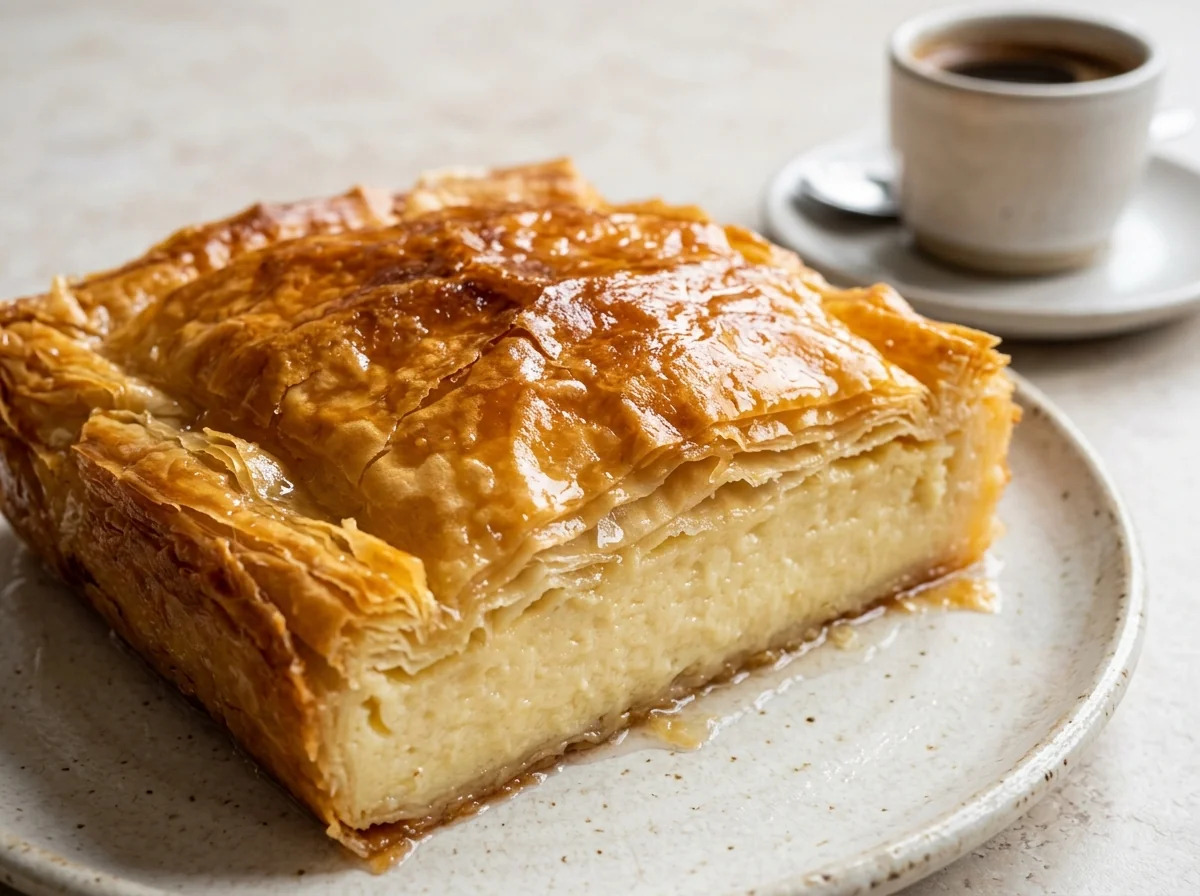
Galaktoboureko is one of the oldest Greek desserts; its name means "milk pie" in Greek. It was documented in the 13th century in Athens.
It shares its origins with Ottoman baklava but uses sweet custard instead of pistachios. At suhoor it works as a luxurious dessert that delivers immediate energy.
Preparation Steps
Prepare the custard
In a pot, warm the milk with the lemon zest until it boils. In another bowl, beat the eggs with the sugar and add the semolina. Pour the milk gradually over the egg mixture while stirring constantly.
Cook the custard
Return the mixture to the pot and cook over low heat while stirring constantly until it thickens (7-10 minutes). Add the butter and vanilla and stir. The custard should be thick.
Cover the custard
Place a plastic wrap directly on the surface of the custard to prevent a skin from forming. Let it cool completely.
Build the layers
Butter a baking pan and lay six phyllo sheets, brushing each with butter. Spread the custard evenly. Cover it with the other six sheets, brushing each sheet.
Cut and bake
Cut the squares before baking (a sharp knife through all the layers). Bake in a 170°C oven for 40 minutes until they turn golden.
Pour the syrup
As soon as the galaktoboureko comes out of the oven, pour the cold syrup gently over the surface. The temperature difference makes the syrup soak into the phyllo. Leave it to cool for at least two hours.
Serve
Cut the squares and serve at room temperature with tea or coffee. Galaktoboureko is one of Greece's most famous desserts in Ramadan and on special occasions.
Blood Sugar Impact
The glycemic index (GI) measures how quickly a food raises blood sugar, while the glycemic load (GL) measures how much a full serving raises it. Together they give the complete picture.
Glycemic Index
GI
64Medium
Low0–55Medium56–69High70+
A low value (≤55) means a gradual rise in blood sugar — the most suitable range for diabetes and insulin resistance.
Glycemic Load
GL
53High
Low0–10Medium11–19High20+
Glycemic load reflects the impact of the full serving. To lower it: take half a serving, or pair the recipe with a source of protein and fiber.
Nutritional Information
Per ServingMakes 8 servings · one serving is about 280 g of raw ingredients
Calories613 kcal31%of Daily Value*
Protein11 g22%of Daily Value*
Carbohydrates84 g31%of Daily Value*
Fat27 g35%of Daily Value*
Fiber1 g4%of Daily Value*
Sodium221 mg10%of Daily Value*
* Percent Daily Values are based on a 2,000-calorie diet per FDA food-label reference values — your daily needs may be higher or lower. Values are derived from the recipe's ingredients via the USDA database.
Troubleshooting
The most common problems when preparing Galaktoboureko (Greek Custard Pastry), and how to fix them:
The custard is lumpy
Beat the eggs well and add the milk slowly. Lumps come from pouring the hot milk in all at once.
The phyllo dries out
Cover the sheets with a damp towel while working. Phyllo dries out in 5 minutes.
The surface burns
Cover the pan with aluminum foil in the last minutes. An uneven oven burns the surface.
The syrup does not soak in
Pour it in batches and leave five minutes between each batch.
Storage and Make-Ahead
Airtight container at room temperature
Two days. The texture stays moist.
Refrigerator (4°C)
One week. Serve cold.
Freezer (-18°C)
Two months before baking. Bake directly from the freezer.
Tested Ingredient Substitutions
Original Ingredient
Tested Substitute
Ratio
Flavor Difference
Whole milk
Coconut milk
Same quantity
Different flavor.
Semolina
Cornstarch
40 g
Less firm texture.
Vanilla
Orange blossom water
1 spoon
Traditional Greek flavor.
Syrup
Warm honey
Same quantity
Different flavor.
How Much Does It Make? Scaling Guide
Ingredient
8 people
16 people
24 people
Milk
1000 ml
2000 ml
3000 ml
Semolina
120 g
240 g
360 g
Sugar
150 g
300 g
450 g
Phyllo
12 sheets
24 sheets
36 sheets
Syrup (qatr)
300 ml
600 ml
900 ml
EEINA Nutrition Tip
Choose fresh phyllo dough because it separates less than the frozen kind. Brush every sheet with butter to build the layers. Cool the syrup overnight before using.
Add This Recipe to Your Plan
The EEINA app saves your favorite recipes, calculates them from their real ingredients, and shows your daily numbers toward your goal. Try it free now.