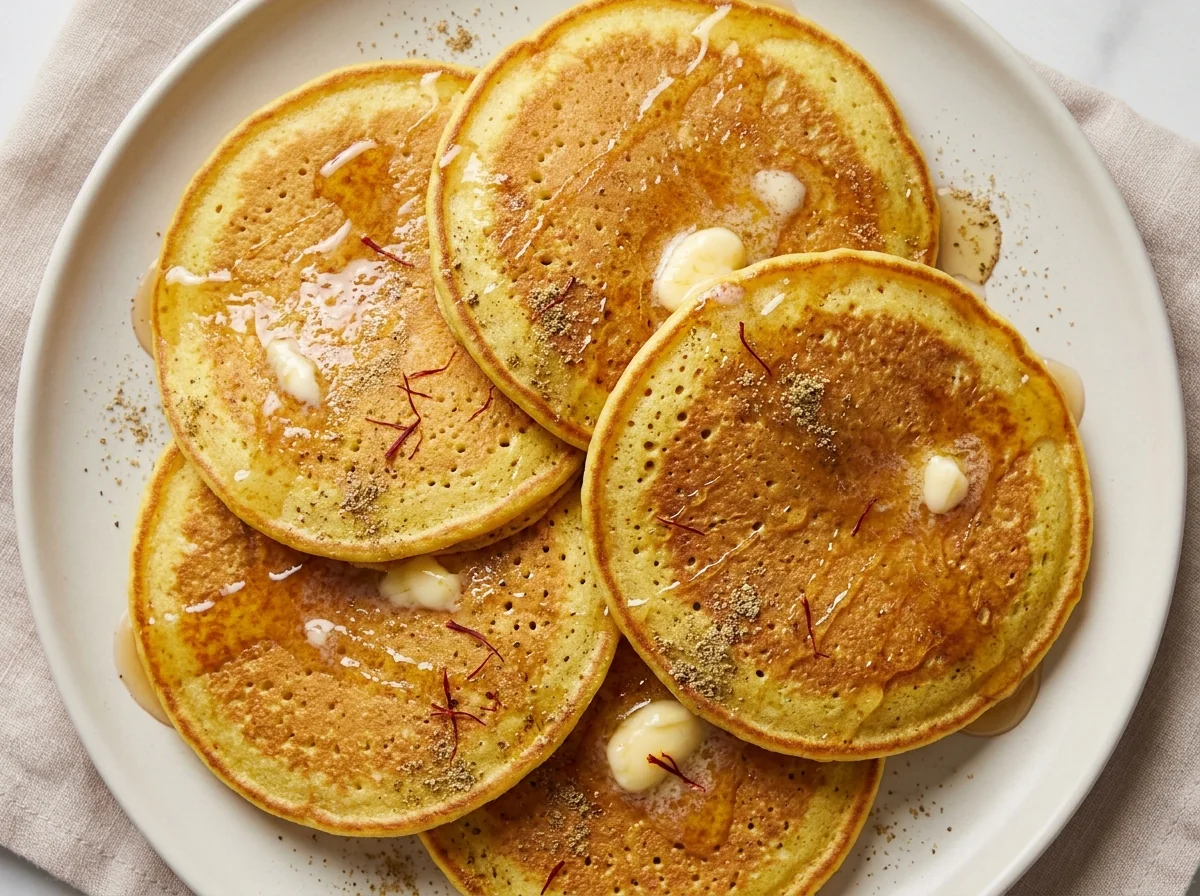
We make chebab as it is served on the tables of the Emirates: thin yeast pancakes fragrant with saffron and cardamom.
We let their loose batter ferment until it fills with bubbles, then pour it into golden discs on the pan, and serve them at breakfast and on the tables of Ramadan and Eid with butter and honey or date syrup.
Preparation Steps
Activating the yeast and saffron
Mix the warm water with the sugar, yeast, cardamom, and saffron in a wide bowl, and stir until the yeast dissolves and the saffron's color and aroma bloom.
Adding the egg
Add the egg to the mixture and whisk well until the blend is smooth.
Forming the loose batter
Add the flour and salt gradually and whisk until it becomes a loose, runny batter with no lumps.
Fermenting the batter
Cover the bowl and let the batter rest for a full hour in a warm place until many bubbles appear on its surface.
Cooking the pancakes
Heat a nonstick pan over medium heat, pour a ladle of batter into the center, and let it spread into a thin disc. When its surface dries and holes form, brush it with butter and flip it for a few seconds until it browns, then lift it out.
Serving
Arrange the pancakes warm and serve them with butter and honey or date syrup.
Blood Sugar Impact
The glycemic index (GI) measures how quickly a food raises blood sugar, while the glycemic load (GL) measures how much a full serving raises it. Together they give the complete picture.
Glycemic Index
GI
70High
Low0–55Medium56–69High70+
A low value (≤55) means a gradual rise in blood sugar — the most suitable range for diabetes and insulin resistance.
Glycemic Load
GL
36High
Low0–10Medium11–19High20+
Glycemic load reflects the impact of the full serving. To lower it: take half a serving, or pair the recipe with a source of protein and fiber.
Nutritional Information
Per ServingMakes 4 servings · one serving is about 165 g of raw ingredients
Calories309 kcal15%of Daily Value*
Protein7 g14%of Daily Value*
Carbohydrates54 g20%of Daily Value*
Fat7 g9%of Daily Value*
Fiber2 g7%of Daily Value*
Sodium119 mg5%of Daily Value*
* Percent Daily Values are based on a 2,000-calorie diet per FDA food-label reference values — your daily needs may be higher or lower. Values are derived from the recipe's ingredients via the USDA database.
Troubleshooting
The most common problems when preparing Emirati Chebab (Saffron and Cardamom Pancakes), and how to fix them:
The pancakes are dense and not airy
The batter most likely did not ferment enough or the yeast is old, so give it more time in a warm place and make sure the yeast is active before starting.
The chebab sticks to the pan
Use a nonstick pan and let it heat well before pouring the batter, and grease it with a little butter or oil when needed.
The surface burns while the inside is raw
Lower the heat to medium and give each disc enough time for the holes to form on its surface before flipping it.
Storage and Make-Ahead
Refrigerator
Keep the chebab in an airtight container for up to three days, and reheat it on the pan or in the toaster until it becomes warm and soft again.
Freezing
Freeze the discs between layers of parchment paper for up to three months, and reheat them directly without thawing first.
Tested Ingredient Substitutions
Original Ingredient
Tested Substitute
Ratio
Flavor Difference
white flour
whole wheat flour
a partial substitute for up to half the amount
It gives a darker color and deeper flavor, and may need a little more water
sugar
date syrup or honey
the same amount, 30 g
It brings the flavor closer to the traditional Emirati taste
butter
vegetable oil
the same amount, 25 ml
A dairy-free option for serving
honey
date syrup
the same amount, 40 g
Date syrup is closer to the authentic Gulf serving
How Much Does It Make? Scaling Guide
Ingredient
Half the quantity
The quantity (base)
Double
white flour
100 g
200 g
400 g
warm water
150 ml
300 ml
600 ml
sugar
15 g
30 g
60 g
egg
28 g
55 g
110 g
instant yeast
1.5 g
3 g
6 g
butter
12 g
25 g
50 g
EEINA Nutrition Tip
Let the batter rest for a full hour until it ferments, for good fermentation gives chebab its airy texture and softness. And cook it over medium, not high, heat so it cooks through inside before its surface burns.
Add This Recipe to Your Plan
The EEINA app saves your favorite recipes, calculates them from their real ingredients, and shows your daily numbers toward your goal. Try it free now.