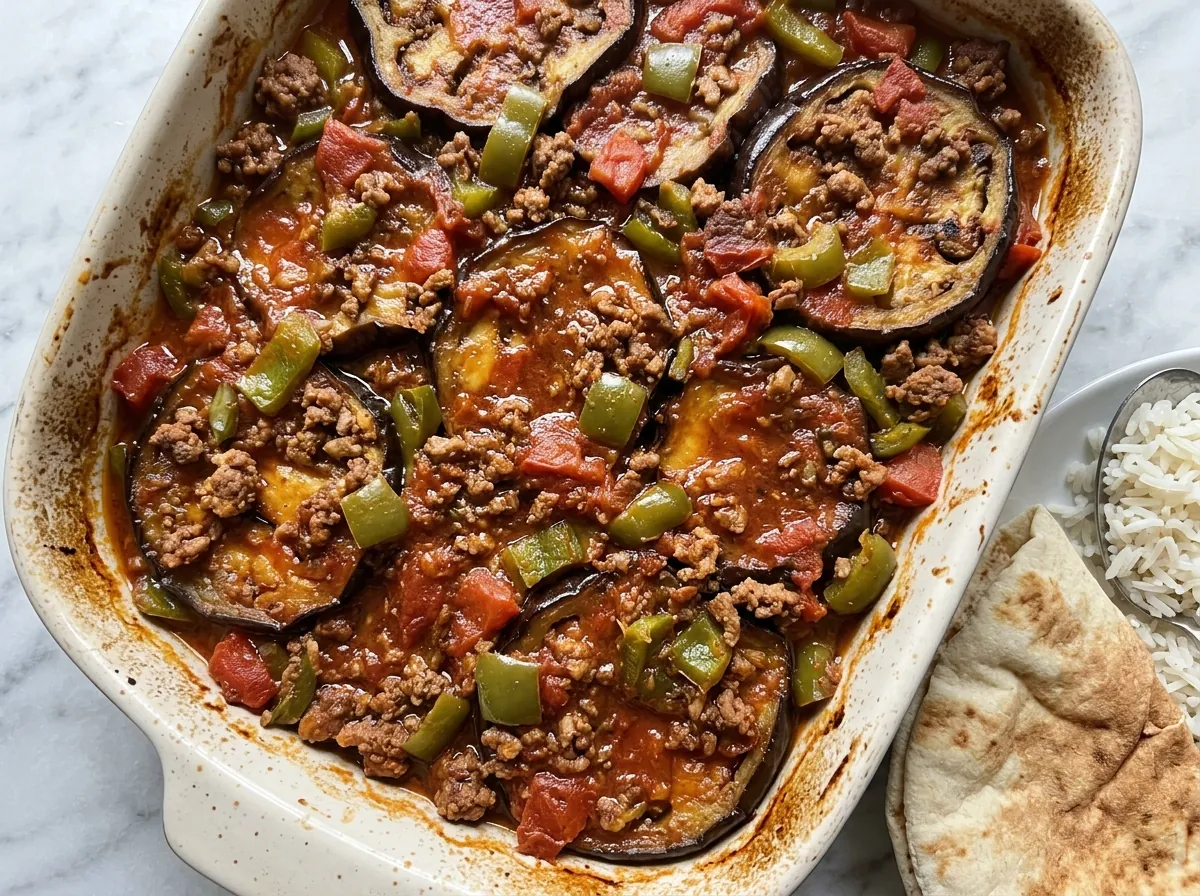
Traditional Egyptian moussaka with layers of fried eggplant and peppers, seasoned ground meat, and thick tomato sauce, baked until the flavors mingle and a golden crust forms. A hearty family main course from Egyptian cuisine.
Moussaka is one of the popular dishes in both Egypt and the Levant, but the Egyptian version relies primarily on ground meat and is baked in the oven, while the Levantine one may use chickpeas or be prepared with tahini.
Housewives used to prepare it in the abundant eggplant seasons in summer.
Preparation Steps
Salt the eggplant and fry it
Sprinkle the eggplant slices with salt and leave them for 20 minutes until they release their bitter water. Squeeze them and dry them, then fry them in the vegetable oil over medium heat until they brown on both sides. Take them out on paper towels to absorb the oil.
Fry the peppers
In the same oil, fry the green pepper slices until they wilt and brown slightly. Take them out and set them aside.
Prepare the tomato sauce
Fry the chopped garlic in the same oil until fragrant, then add the salt and black pepper. Add the tomato juice and leave it on low heat for 10 minutes until it thickens and becomes dense.
Arrange the layers
Arrange the eggplant slices in the bottom of a baking dish, then distribute the fried peppers over them, then the seasoned ground meat, then the tomato slices. Pour the tomato and garlic sauce over them all evenly.
Bake and brown
Cover the dish with aluminum foil and place it in an oven preheated to 180°C for 25 minutes. Remove the aluminum foil and complete the baking for 10 minutes until the top browns. Serve it hot with rice or Arabic bread.
Blood Sugar Impact
The glycemic index (GI) measures how quickly a food raises blood sugar, while the glycemic load (GL) measures how much a full serving raises it. Together they give the complete picture.
Glycemic Index
GI
14Low
Low0–55Medium56–69High70+
A low value (≤55) means a gradual rise in blood sugar — the most suitable range for diabetes and insulin resistance.
Glycemic Load
GL
2Low
Low0–10Medium11–19High20+
Glycemic load reflects the impact of the full serving. To lower it: take half a serving, or pair the recipe with a source of protein and fiber.
Nutritional Information
Per ServingMakes 5 servings · one serving is about 395 g of raw ingredients
Calories284 kcal14%of Daily Value*
Protein10 g20%of Daily Value*
Carbohydrates18 g7%of Daily Value*
Fat20 g26%of Daily Value*
Fiber7 g25%of Daily Value*
Sodium508 mg22%of Daily Value*
* Percent Daily Values are based on a 2,000-calorie diet per FDA food-label reference values — your daily needs may be higher or lower. Values are derived from the recipe's ingredients via the USDA database.
Troubleshooting
The most common problems when preparing Egyptian Moussaka, and how to fix them:
The moussaka is dry after baking
We double the amount of tomato sauce, or add half a cup of extra water before covering it with aluminum foil.
The eggplant is bitter
We increased the salting time to 30 minutes and squeezed it well. The salt draws out the bitterness in the water.
Storage and Make-Ahead
Moussaka in the refrigerator
Keeps for 3 days; we reheat it in the oven at 180°C with a tablespoon of water.
Moussaka in the freezer
Keeps up to a month. Thaw it overnight in the refrigerator before reheating.
Tested Ingredient Substitutions
Original Ingredient
Tested Substitute
Ratio
Flavor Difference
Ground meat
Beef cut into small cubes
1:1
We add 20 minutes to cook the meat until done.
Green bell pepper
Mixed colored bell peppers
1:1
Red, yellow, and green colors give a luxurious appearance.
EEINA Nutrition Tip
We sprinkle the eggplant with salt and leave it for 20 minutes before frying to release the bitterness and give a result with less oil absorption. Frying over medium heat preserves the texture of the layers so they do not fall apart in the oven.
Add This Recipe to Your Plan
The EEINA app saves your favorite recipes, calculates them from their real ingredients, and shows your daily numbers toward your goal. Try it free now.