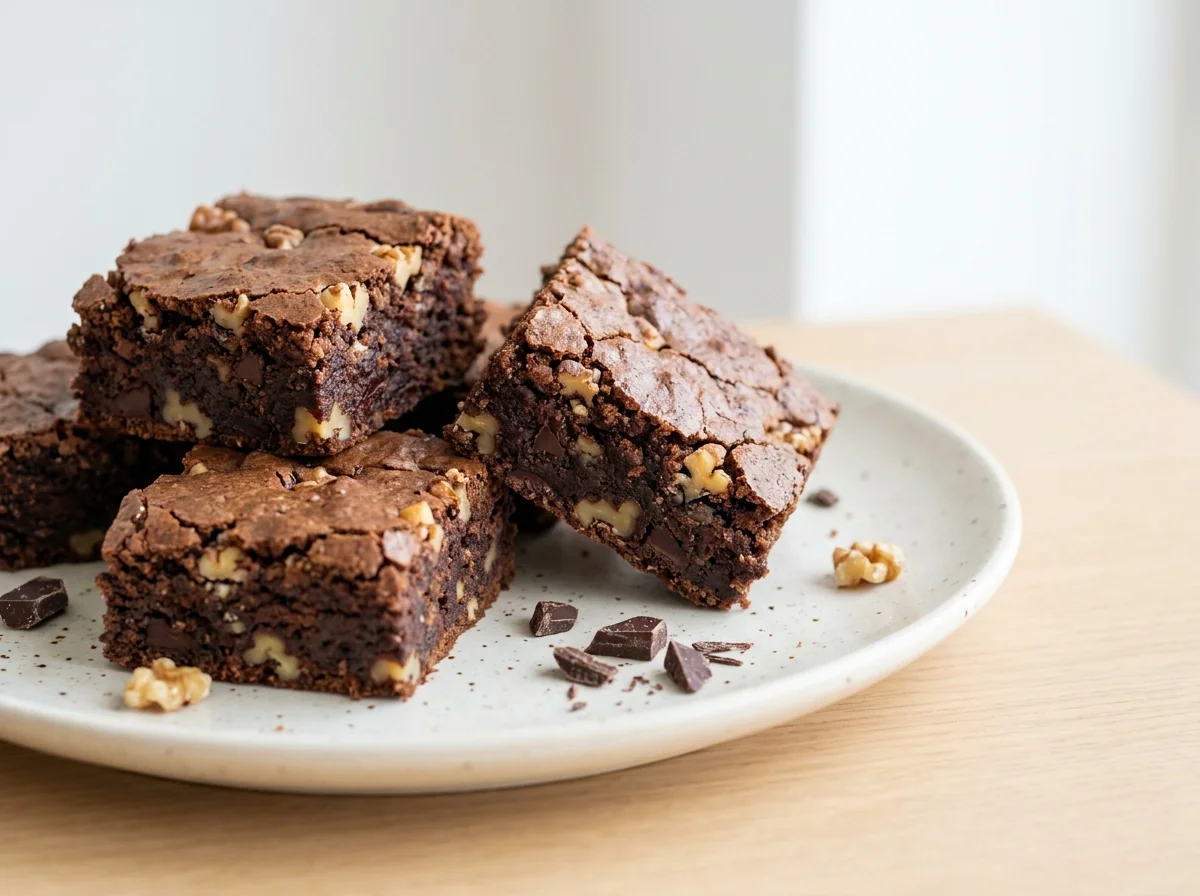
Date brownies are one of the best-known healthy desserts: date paste replaces both the sugar and the butter, giving the same dense texture with sweetness from whole fruit and its fiber.
A recipe that proves brownies can be healthy without losing their character.
Preparation Steps
Soak the dates and blend into a paste
If the dates are not soft, soak them in hot water for ten minutes and drain, then blend in a food processor until they form a smooth paste. The dates here are the source of both the sugar and the moisture.
Mix the wet ingredients
Add the eggs, oil, and vanilla to the paste and blend until the mixture comes together into a dark cream.
Add the dry ingredients with a gentle fold
Sift the cacao, almond flour, baking powder, and salt over the mixture and fold with a spoon just until they disappear. The batter comes out thick and glossy, not runny, and that is its nature, so do not add liquids; overmixing ruins the texture.
Add the chocolate and walnuts and bake
Fold the dark chocolate and crushed walnuts into the batter, spread it in a lined 20x20 pan, and bake at 175 degrees for twenty-two minutes. The test skewer comes out with moist crumbs rather than clean, since the remaining moisture is the fudgy texture you want.
Cool for an hour before cutting
Leave it a full hour in the pan, then cut into squares. Cutting while hot crumbles it, and cooling sets the dense texture.
Blood Sugar Impact
The glycemic index (GI) measures how quickly a food raises blood sugar, while the glycemic load (GL) measures how much a full serving raises it. Together they give the complete picture.
Glycemic Index
GI
52Low
Low0–55Medium56–69High70+
A low value (≤55) means a gradual rise in blood sugar — the most suitable range for diabetes and insulin resistance.
Glycemic Load
GL
14Medium
Low0–10Medium11–19High20+
Glycemic load reflects the impact of the full serving. To lower it: take half a serving, or pair the recipe with a source of protein and fiber.
Nutritional Information
Per ServingMakes 12 servings · one serving is about 60 g of raw ingredients
Calories212 kcal11%of Daily Value*
Protein4 g8%of Daily Value*
Carbohydrates30 g11%of Daily Value*
Fat10 g13%of Daily Value*
Fiber4 g14%of Daily Value*
Sodium350 mg15%of Daily Value*
* Percent Daily Values are based on a 2,000-calorie diet per FDA food-label reference values — your daily needs may be higher or lower. Values are derived from the recipe's ingredients via the USDA database.
Troubleshooting
The most common problems when preparing Date and Cacao Brownies with No Added Sugar, and how to fix them:
It came out dry and crumbly
It was baked until the skewer came out clean. Moist crumbs on the skewer are the correct sign of doneness, and two extra minutes are enough to ruin the texture.
The taste is bitter
There was too much cacao or too few dates. The balance is set for soft, sweet dates, and dry dates must be soaked before blending.
It crumbles when cut
It was cut while hot. The hour of cooling is a condition that cannot be skipped.
The date flavor shows over the chocolate
The paste is coarse and has visible chunks. Blend it in the processor until completely smooth so it sweetens without its flavor showing.
Storage and Make-Ahead
At room temperature
Three days in an airtight container, and its texture becomes firmer from the next day.
In the refrigerator
A week, eaten cold with a dense, chocolate-like texture.
In the freezer
Spread-out squares for two months, thawing in a quarter of an hour when needed.
Tested Ingredient Substitutions
Original Ingredient
Tested Substitute
Ratio
Flavor Difference
Almond flour
Finely ground oats
1:1
Cheaper and slightly less rich
Coconut oil
Butter or light olive oil
1:1
Three fat options with similar results
Walnuts
Omit for allergies
~
It remains a complete brownie without them
Dark chocolate
Date-cacao chocolate spread from our recipes
~
An alternative made from date ingredients themselves
How Much Does It Make? Scaling Guide
Ingredient
12 squares
6 squares
24 squares
Dates
300 g
150 g
600 g
Cocoa
50 g
25 g
100 g
Almond flour
100 g
50 g
200 g
EEINA Nutrition Tip
Take it out of the oven two minutes before it is fully dry. A clean test skewer means the cake has dried out and gone past its point, while the moist crumbs clinging to the skewer are the fudgy texture you want, and it will firm up as it cools.
Add This Recipe to Your Plan
The EEINA app saves your favorite recipes, calculates them from their real ingredients, and shows your daily numbers toward your goal. Try it free now.
No. The natural sugar of the dates is fully present and its carbohydrates are counted, the difference being that it comes within whole fruit and its fiber rather than as isolated sugar, with one square per serving.
Will it satisfy someone used to sugary brownies?
Its texture is true fudge and its sweetness is a notch quieter with a caramel character from the dates, and most who try it accept it quickly.
Why almond flour?
Because it is gluten-free, so the texture comes out denser, and its fats make up for the absence of butter. Ground oats are a cheaper substitute with a close result.
Is it suitable for children?
Yes, its ingredients are fruit, eggs, nuts, and cacao, and a square in the school box is a better choice than wrapped bars.