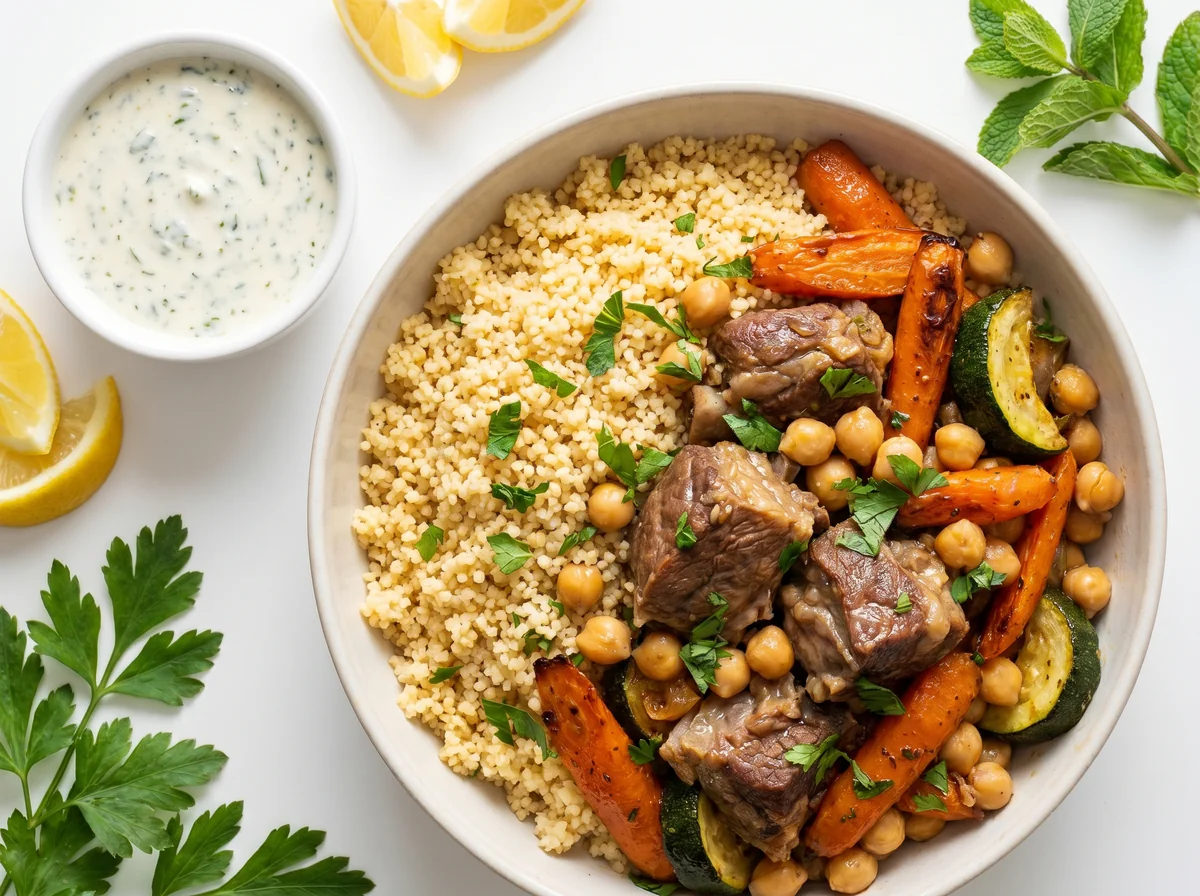
North Africa's national dish — fluffy steamed couscous over a richly spiced meat and vegetable broth with carrots, zucchini, pumpkin, and chickpeas. High glycemic load from the couscous, rich in fiber and protein, contains gluten.
Couscous is the national dish of Morocco, Algeria, Tunisia, and Libya, and is inscribed on the UNESCO Intangible Cultural Heritage list. It is wheat semolina grains that are steamed above a meat and vegetable broth until they emerge light and separate.
It has been tied to Friday gatherings and large family tables across North Africa, traditionally eaten communally from one plate. The art of fluffing through repeated steaming is passed down through generations, and it is a symbol of generosity and togetherness in North African culture.
Preparation Steps
Cook the meat and broth
In the lower pot of a couscoussier (or a regular pot), brown the onion in the oil, add the meat, spice blend, saffron, grated tomatoes, and a pinch of salt, and stir until the meat is sealed. Add enough water to cover and simmer over low heat for about an hour until almost tender.
First steaming of the couscous
The secret to fluffy couscous is repeated steaming: sprinkle the couscous grains with a little water and oil and rub with your hands to separate them, then place in the perforated upper section of the couscoussier above the simmering broth and let the steam cook them for about fifteen minutes.
Second fluffing
Turn the couscous out into a wide bowl, sprinkle with cold water, a little salt, and oil, and rub with your hands (carefully — it is hot) to separate and plump the grains. This repetition — steam then rub — is what gives couscous its light, fluffy texture rather than clumping.
Add the vegetables to the broth
Add the vegetables to the broth according to their cooking time: carrots and turnip first (firmer), then pumpkin, zucchini, and chickpeas (faster cooking). Let them cook in the broth until tender without falling apart, and taste to adjust the seasoning.
Final steaming
Return the couscous to the upper section and steam a third time over the broth for about ten minutes until fully cooked and light-textured, then transfer to a bowl and add a knob of butter and rub so the grains gleam and separate. The third steaming completes cooking and infuses the broth flavor.
Serve
In a wide serving dish, spread the fluffy couscous as the base, place the meat in the center, and arrange the vegetables around it, then ladle some broth over the top (serve the rest on the side). Serve hot — traditionally eaten communally from one shared platter. Couscous is the Friday and family dish of North Africa.
Blood Sugar Impact
The glycemic index (GI) measures how quickly a food raises blood sugar, while the glycemic load (GL) measures how much a full serving raises it. Together they give the complete picture.
Glycemic Index
GI
59Medium
Low0–55Medium56–69High70+
A low value (≤55) means a gradual rise in blood sugar — the most suitable range for diabetes and insulin resistance.
Glycemic Load
GL
41High
Low0–10Medium11–19High20+
Glycemic load reflects the impact of the full serving. To lower it: take half a serving, or pair the recipe with a source of protein and fiber.
Nutritional Information
Per ServingMakes 6 servings · one serving is about 375 g of raw ingredients
Calories744 kcal37%of Daily Value*
Protein32 g64%of Daily Value*
Carbohydrates78 g28%of Daily Value*
Fat33 g42%of Daily Value*
Fiber8 g29%of Daily Value*
Sodium249 mg11%of Daily Value*
Potassium730 mg16%of Daily Value*
Phosphorus351 mg28%of Daily Value*
* Percent Daily Values are based on a 2,000-calorie diet per FDA food-label reference values — your daily needs may be higher or lower. Values are derived from the recipe's ingredients via the USDA database.
Troubleshooting
The most common problems when preparing Couscous with Meat and Vegetables, and how to fix them:
The couscous is clumped and sticky
It was not fluffed with the repeated steam-and-rub technique. Repeat the steaming-then-rubbing cycle with water and oil two or three times — this separates the grains. Cooking directly in water (not steam) always results in clumping.
The couscous is hard or dry
Insufficient steaming or moisture. Steam it over the broth for enough time, sprinkle water between cycles, and add butter at the end. The grains need moisture and steam to plump and soften.
The vegetables fell apart
They were all added at the same time. Add vegetables according to cooking time: firm ones (carrots, turnip) first, and tender ones (zucchini, pumpkin) last, so they all cook through without the tender ones disintegrating.
The broth tastes flat
Insufficient spices or saffron. Brown the meat with the spices first, and use saffron, ginger, and turmeric generously — the broth is what flavors the couscous and the vegetables.
The meat is tough
It was not cooked long enough. Cook the meat for about an hour before adding the vegetables — it needs more time. Low and slow heat tenderizes it without causing it to fall apart.
Storage and Make-Ahead
Refrigerator (4°C)
Couscous, broth, and meat keep in airtight containers for 3 days (storing them separately is better). Reheat the couscous by steaming or with a sprinkle of water, and warm the broth over low heat.
Freezer (-18°C)
Broth with meat and vegetables can be frozen for 2 months. Couscous freezes well too and is reheated by steaming. Freeze them separately for best results.
Make-ahead
Prepare the meat broth ahead (it improves with rest), then steam the couscous fresh, or fluff it ahead of time and re-steam it at serving.
Food safety
Cook the meat until completely tender, and do not leave the couscous or broth outside refrigeration for more than 2 hours.
Tested Ingredient Substitutions
Original Ingredient
Tested Substitute
Ratio
Flavor Difference
Regular couscous
Whole-wheat couscous
Same amount
Higher fiber and lower glycemic load, with a nuttier flavor
Lamb
Chicken or a vegetarian version (vegetable couscous)
Same weight
The vegetarian version with abundant vegetables, chickpeas, and vegetable broth remains nutritious and delicious
Couscoussier steaming
Instant couscous
Per package instructions
Much faster — soaked in boiling water — but traditional steam-cooked couscous has a lighter, superior texture
How Much Does It Make? Scaling Guide
Servings
Couscous
Meat
Vegetables
3 (half recipe)
1.5 cups
300 g
half the amount
6 (base)
3 cups
600 g
full amount
12 (large family)
6 cups
1200 g
double
EEINA Nutrition Tip
Couscous with meat and vegetables is a complete meal: starches from the couscous, protein from the meat, and abundant fiber, vitamins, and minerals from the variety of vegetables and chickpeas. Its challenge is that wheat semolina has a high glycemic load. To soften that: increase the vegetables and meat at the expense of the couscous, choose whole-wheat couscous (higher fiber, lower glycemic index), and serve it in a moderate portion.
Add This Recipe to Your Plan
The EEINA app saves your favorite recipes, calculates them from their real ingredients, and shows your daily numbers toward your goal. Try it free now.
Repeated steaming with rubbing: steam the couscous over the broth, then turn it out and sprinkle with water and oil and rub with your hands to separate, then repeat two or three times. Cooking directly in water always results in clumping.
Do I need a special couscoussier pot?
It is ideal (a lower pot for the broth and a perforated upper section for steaming), but a colander set over a pot works too. Or use instant couscous soaked in boiling water for a faster, less refined result.
Is couscous healthy?
It is a complete meal: starches, protein, abundant vegetables, and fiber. Its challenge is that wheat semolina has a high glycemic load. Increase the vegetables, choose whole-wheat couscous, and serve a moderate portion for better balance.
What vegetables work well in couscous?
Traditionally: carrots, zucchini, pumpkin, turnip, and chickpeas, sometimes potatoes and bell peppers. Choose a colorful mix and add them by cooking time (firmer first) so they all finish without the tender ones falling apart.