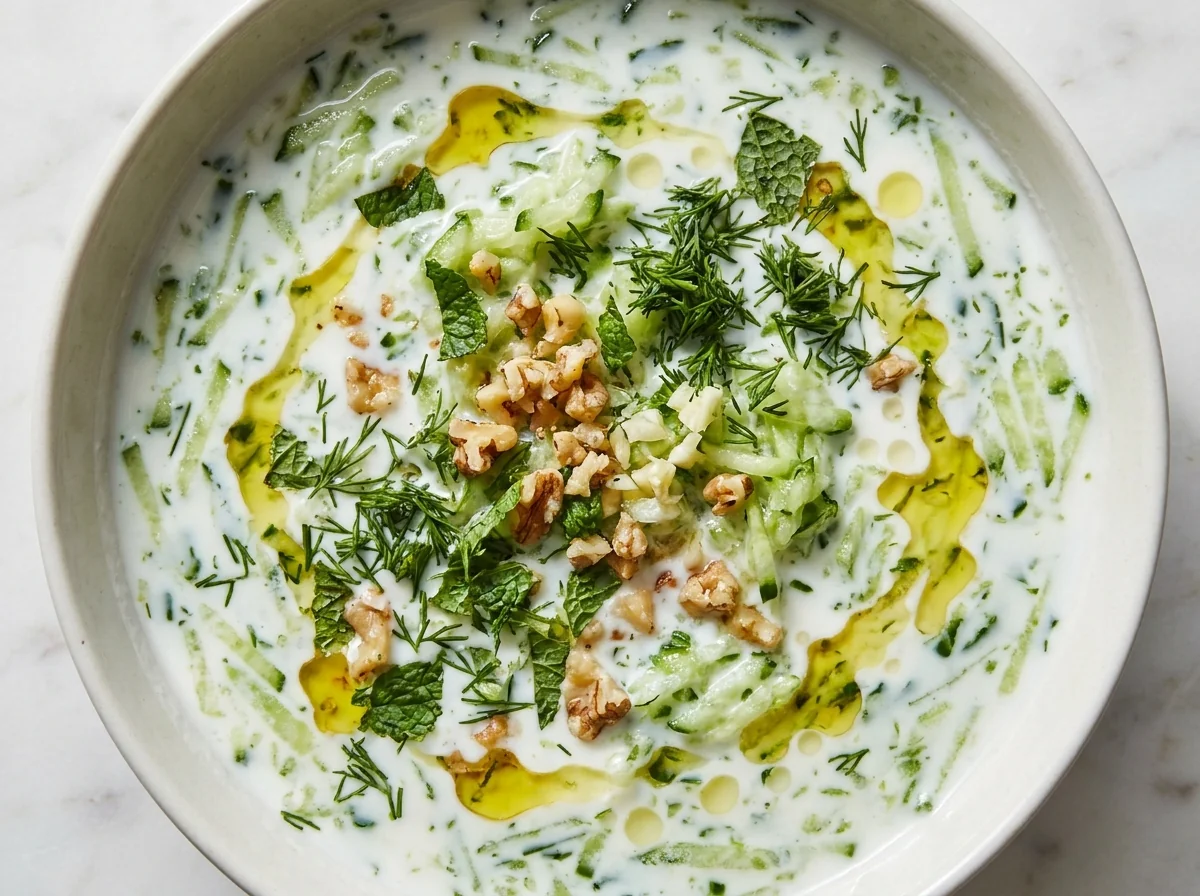
A cold soup widespread across the Balkans and the Levant for cooling the summer heat; it is whisked rather than cooked and served chilled.
Preparation Steps
Prepare the cucumber
Grate or finely chop the cucumber, sprinkle it with half the salt, and leave it for ten minutes, then gently squeeze out the excess water. This keeps the soup from becoming watery after chilling.
Whisk the base
Whisk the yogurt with the cold water until it becomes a smooth, sippable liquid. If the yogurt is heavy, add a little more water until you reach a soup consistency, not a whisked milk.
Combine the flavors
Add the squeezed cucumber, the crushed garlic, the dill, the mint, the olive oil, the vinegar, and the rest of the salt, and stir until the ingredients are evenly distributed. Taste and adjust the acidity and salt.
Chill
Cover the bowl and place it in the refrigerator for at least one full hour until it is completely cold and the flavors mingle. The sign is that it is cold on the tongue, not lukewarm.
Serve
Pour it into bowls and garnish with the chopped walnuts, a drizzle of olive oil, and a sprinkle of mint. Serve immediately while cold.
Blood Sugar Impact
The glycemic index (GI) measures how quickly a food raises blood sugar, while the glycemic load (GL) measures how much a full serving raises it. Together they give the complete picture.
Glycemic Index
GI
26Low
Low0–55Medium56–69High70+
A low value (≤55) means a gradual rise in blood sugar — the most suitable range for diabetes and insulin resistance.
Glycemic Load
GL
4Low
Low0–10Medium11–19High20+
Glycemic load reflects the impact of the full serving. To lower it: take half a serving, or pair the recipe with a source of protein and fiber.
Nutritional Information
Per ServingMakes 4 servings · one serving is about 400 g of raw ingredients
Calories239 kcal12%of Daily Value*
Protein10 g20%of Daily Value*
Carbohydrates17 g6%of Daily Value*
Fat16 g21%of Daily Value*
Fiber2 g7%of Daily Value*
Sodium474 mg21%of Daily Value*
Potassium562 mg12%of Daily Value*
Phosphorus241 mg19%of Daily Value*
* Percent Daily Values are based on a 2,000-calorie diet per FDA food-label reference values — your daily needs may be higher or lower. Values are derived from the recipe's ingredients via the USDA database.
Troubleshooting
The most common problems when preparing Cold Cucumber and Yogurt Soup (Tarator), and how to fix them:
The soup turned watery
The cucumber wasn't squeezed well of its water; squeeze it in a clean cloth before combining, or add two spoonfuls of yogurt to thicken it.
The garlic taste is too sharp
Reduce the amount next time, or soak the crushed garlic in the lemon juice for ten minutes before adding it to mellow it.
The flavor is dull
Usually because it was served lukewarm; chill it more and add a pinch of salt and a few drops of vinegar, as the cold dulls the perception of flavor.
Storage and Make-Ahead
Refrigerator
Keeps in a sealed container for up to two days. Stir it before serving as it may separate.
Freezer
Freezing is not recommended because the yogurt curdles and loses its texture after thawing.
Tested Ingredient Substitutions
Original Ingredient
Tested Substitute
Ratio
Flavor Difference
Walnuts
Chopped almonds
Same weight
The tree nut warning still applies.
Dill
Parsley or cilantro
Same weight
A different flavor but just as refreshing.
White vinegar
Lemon juice
Same amount
Lemon is a little more refreshing.
Full-fat yogurt
Low-fat yogurt
Same weight
A lighter, less dense texture.
How Much Does It Make? Scaling Guide
Ingredient
Two servings
Four servings (base)
Eight servings
Grated cucumber
300 g
600 g
1200 g
Yogurt
350 g
700 g
1400 g
Cold water
100 ml
200 ml
400 ml
Crushed garlic
3 g
6 g
12 g
Salt
2 g
4 g
8 g
EEINA Nutrition Tip
Yogurt is a source of protein and calcium, and cucumber's high water content gives a feeling of fullness for few calories. This is general nutritional information.
Add This Recipe to Your Plan
The EEINA app saves your favorite recipes, calculates them from their real ingredients, and shows your daily numbers toward your goal. Try it free now.