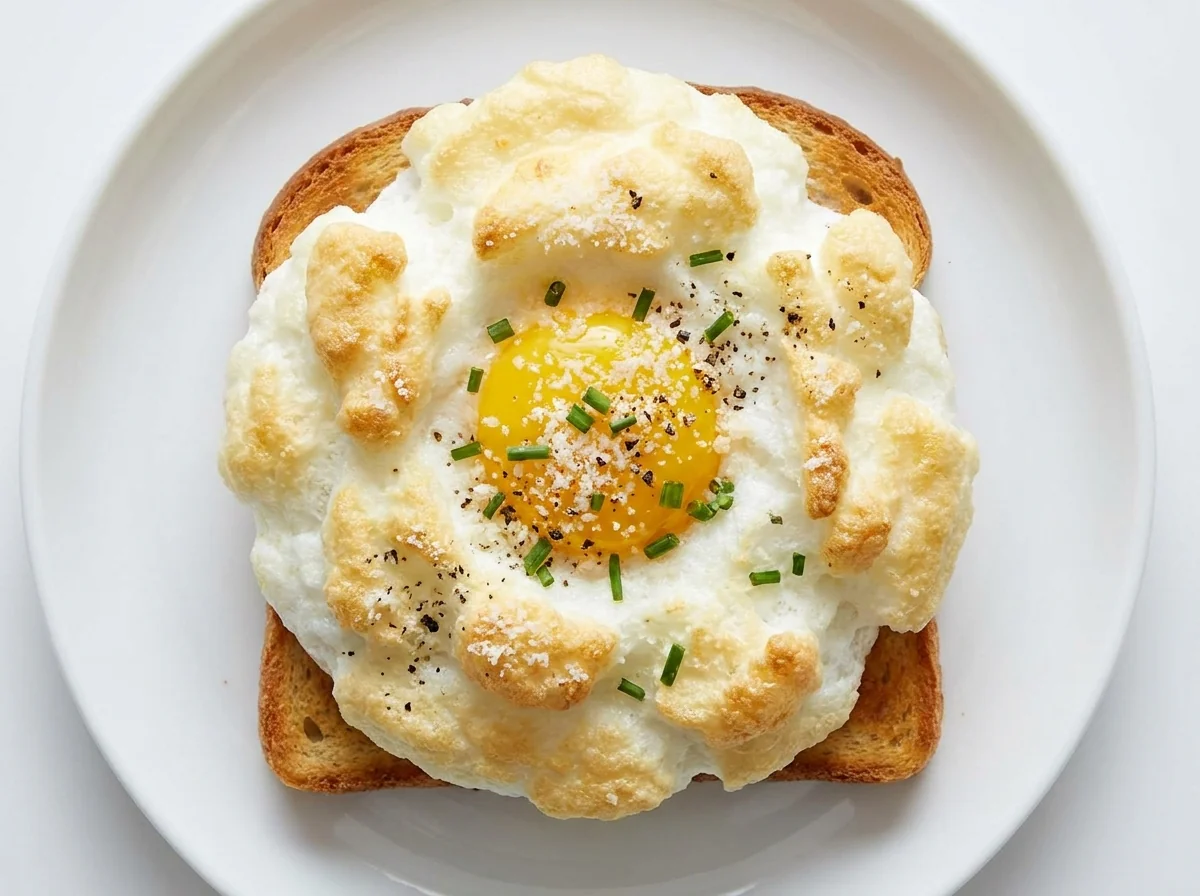
Cloud eggs are an old idea made new: whipped, baked whites with their yolk go back to old French kitchens, then social media brought them back into circulation until they became one of the most photographed breakfast dishes around the world.
Preparation Steps
Carefully separate the whites from the yolks
Separate each egg and keep every yolk intact in its own small cup. A pierced yolk loses its shape over the whites, and the individual cups keep each yolk until its moment.
Whip the whites to stiff peaks
Whip the whites with the pinch of salt using an electric beater to stiff peaks that don't collapse when you lift the beater, because this air is the texture of the whole dish. Then fold in the parmesan and the chopped chives lightly to preserve the air.
Shape mounds with a hollow in the center
On a parchment-lined tray, mound the whipped whites into four mounds (or two large ones), and press a wide hollow in the top of each mound with the back of the spoon for the yolk to settle into later.
Bake the whites, then drop in the yolks
Bake the mounds on their own in a preheated oven at 220 degrees for five minutes until their tops brown, then pull out the tray, drop a yolk into each hollow, and return them for a final three minutes, so the yolk warms and stays runny.
Serve it the moment it comes out
Serve with a pinch of black pepper and toast underneath or alongside. The dish's shape draws children in, so they eat it quickly before the whites deflate.
Blood Sugar Impact
The glycemic index (GI) measures how quickly a food raises blood sugar, while the glycemic load (GL) measures how much a full serving raises it. Together they give the complete picture.
Glycemic Index
GI
64Medium
Low0–55Medium56–69High70+
A low value (≤55) means a gradual rise in blood sugar — the most suitable range for diabetes and insulin resistance.
Glycemic Load
GL
11Medium
Low0–10Medium11–19High20+
Glycemic load reflects the impact of the full serving. To lower it: take half a serving, or pair the recipe with a source of protein and fiber.
Nutritional Information
Per ServingMakes 2 servings · one serving is about 140 g of raw ingredients
Calories252 kcal13%of Daily Value*
Protein18 g36%of Daily Value*
Carbohydrates18 g7%of Daily Value*
Fat13 g17%of Daily Value*
Fiber1 g4%of Daily Value*
Sodium525 mg23%of Daily Value*
Potassium217 mg5%of Daily Value*
Phosphorus268 mg21%of Daily Value*
* Percent Daily Values are based on a 2,000-calorie diet per FDA food-label reference values — your daily needs may be higher or lower. Values are derived from the recipe's ingredients via the USDA database.
Troubleshooting
The most common problems when preparing Baked Cloud Eggs, and how to fix them:
The whites didn't reach stiff peaks
There's a trace of fat in the bowl, or a drop of yolk slipped in. A clean, dry glass bowl and a careful separation, and room-temperature whites froth faster.
The mound deflated after coming out
Slight deflation is natural in any meringue, but a complete collapse is caused by under-whipping or opening the oven repeatedly.
The yolk set completely
It went in early or the minutes ran long. It goes in midway and stays only three minutes so it comes out runny.
The bottom stuck to the parchment
The parchment is poor quality. Use good parchment, and a light film of oil when in doubt.
Storage and Make-Ahead
Right away
Eat it in its first minutes, because air leaks out of the whites with every minute of waiting.
Don't store it
Whipped baked whites don't withstand the fridge, so make it fresh in a quarter hour.
Smart prep
Nothing here needs advance prep: four ingredients and a quarter hour only.
Tested Ingredient Substitutions
Original Ingredient
Tested Substitute
Ratio
Flavor Difference
Parmesan
Fine Romano cheese, or omit it
same amount
It's fine plain, and the cheese adds flavor
Chives
A pinch of dried thyme
same amount
A Levantine flavor on the French dish
Toast
Whole-wheat toast or cut-up shrik bread
same amount
All kinds of bread suit it
Baking in the oven
Air fryer at 200 degrees
4+2 minutes
A faster option for those who have one
How Much Does It Make? Scaling Guide
Ingredient
2 servings (4 clouds)
1 serving
4 servings
Eggs
4
2
8
Parmesan
15 g
8 g
30 g
Bread
2 slices
1 slice
4 slices
EEINA Nutrition Tip
Bake the whipped whites first and drop the yolk in midway through the baking, not before. A yolk that goes in from the start cooks and sets before the whites firm up, and this order of entry is the difference between a runny yolk and a set one.
Add This Recipe to Your Plan
The EEINA app saves your favorite recipes, calculates them from their real ingredients, and shows your daily numbers toward your goal. Try it free now.
No added fat at all: whipped whites with their air and a yolk warmed in the oven, so it's one of the lightest egg dishes and highest in pure protein.
Why do children love it?
The shape first: a white mound with a golden yolk at its heart. And the child's part in pressing the hollow and dropping the yolk makes them a partner in the cooking.
Does it work without an electric beater?
Yes, with a hand whisk for anyone patient: five minutes of continuous whipping is enough, and the electric one shortens it to a minute.
How do I make it a filling meal and not just a shape?
Two mounds over whole-wheat toast with a piece of fruit and a glass of milk: the egg protein with a fiber base keeps you full until lunch.