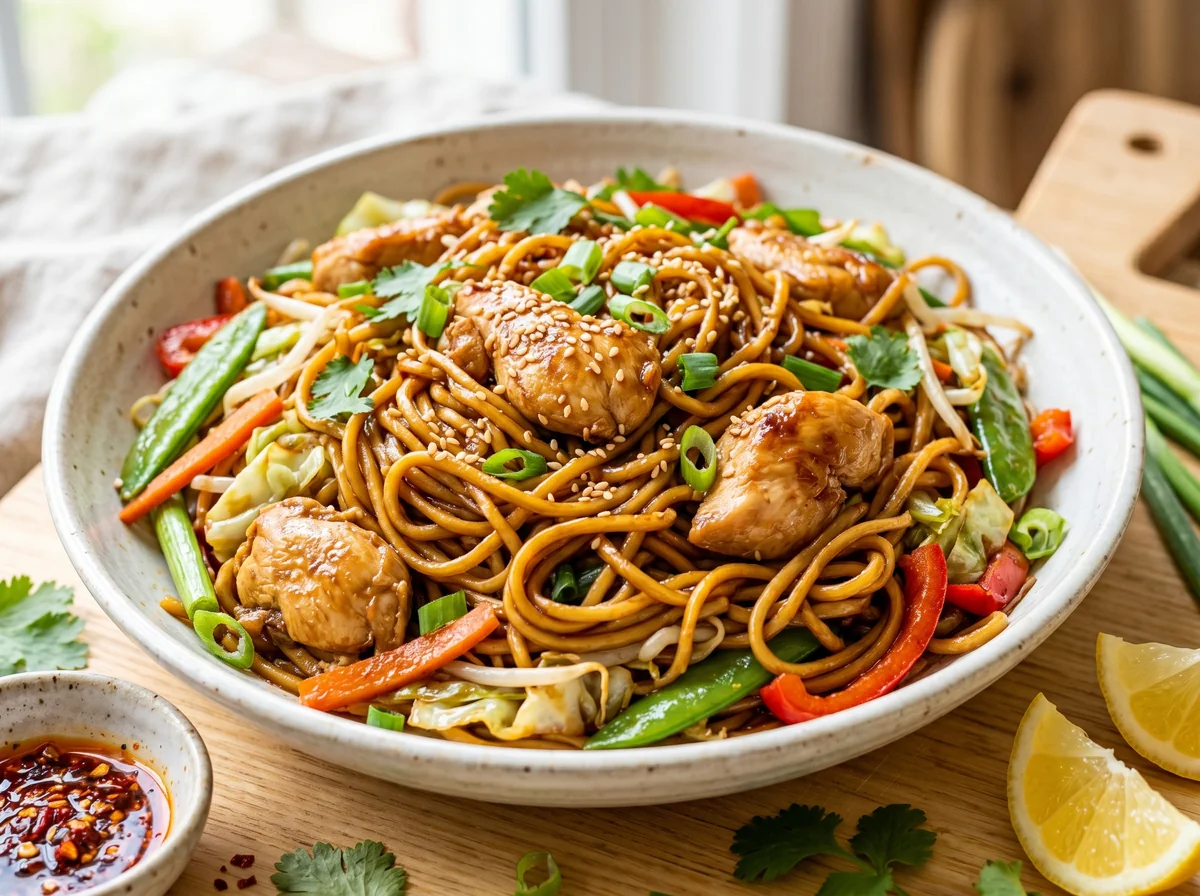
Wholegrain noodles quickly stir-fried with chicken and crisp vegetables in the Chinese style — high fibre and plenty of vegetables. A popular, quick, and balanced dinner.
Chow mein is China's beloved street dish: noodles, vegetables, and meat stir-fried quickly over high heat.
The eeina version uses wholegrain noodles and loads up on crisp vegetables while cutting the oil and sodium for a balanced dinner rich in fibre and protein.
Preparation Steps
Cook the noodles
Cook the noodles for 1 minute less than the packet instructions so they stay firm (they will finish cooking in the stir-fry). Drain and rinse with cold water to stop the cooking and prevent sticking, then set aside.
Stir-fry the chicken
Heat the vegetable oil in a wide pan (wok) over high heat until almost smoking. Add the chicken slices in a single layer and stir-fry for 4–5 minutes until coloured and cooked through (74°C [1]). Set aside.
Stir-fry the vegetables
In the same hot pan, add the garlic and ginger for 10 seconds, then the cabbage, carrot, and pepper and stir-fry over high heat for just 3 minutes until slightly tender but still crisp and vibrant in colour (high-heat, fast stir-frying is the secret of Chinese cooking).
Combine and season
Return the chicken, add the noodles, low-sodium soy sauce, sesame oil, and black pepper. Toss everything with a lifting and folding motion for 1–2 minutes until coated in the sauce and heated through.
Serve
Remove from the heat and scatter the sliced spring onion. Serve immediately while hot. Add toasted sesame seeds or chilli for those who like it.
Blood Sugar Impact
The glycemic index (GI) measures how quickly a food raises blood sugar, while the glycemic load (GL) measures how much a full serving raises it. Together they give the complete picture.
Glycemic Index
GI
36Low
Low0–55Medium56–69High70+
A low value (≤55) means a gradual rise in blood sugar — the most suitable range for diabetes and insulin resistance.
Glycemic Load
GL
15Medium
Low0–10Medium11–19High20+
Glycemic load reflects the impact of the full serving. To lower it: take half a serving, or pair the recipe with a source of protein and fiber.
Nutritional Information
Per ServingMakes 4 servings · one serving is about 335 g of raw ingredients
Calories401 kcal20%of Daily Value*
Protein32 g64%of Daily Value*
Carbohydrates51 g19%of Daily Value*
Fat8 g10%of Daily Value*
Fiber10 g36%of Daily Value*
Sodium513 mg22%of Daily Value*
* Percent Daily Values are based on a 2,000-calorie diet per FDA food-label reference values — your daily needs may be higher or lower. Values are derived from the recipe's ingredients via the USDA database.
Troubleshooting
The most common problems when preparing Chicken and Vegetable Chow Mein, and how to fix them:
The noodles are clumped and stuck together
They were not rinsed after cooking, or were overcooked. Cook for 1 minute less, rinse immediately with cold water to remove surface starch, and a drizzle of oil prevents sticking until it is time to stir-fry.
The vegetables wilted and became watery
The heat was too low or the pan was crowded. Chinese stir-frying needs very high heat and a short time (3 minutes) with continuous tossing. Cook in batches if the quantity is large.
The dish is too salty
Too much soy sauce, or not the low-sodium type. Start with one tablespoon and taste; use the low-sodium version. Sesame oil and lemon juice add flavour without extra salt.
The chicken steamed rather than browned
The pan was not hot enough, or it was overcrowded. Heat the wok until almost smoking, spread the chicken in a single layer without overlapping, and leave it for a moment before tossing so it browns.
No distinctive Chinese flavour
Not enough garlic, ginger, or sesame oil. These three are the foundation of Chinese flavour; add the sesame oil at the end, not during the stir-fry, to preserve its aroma.
Storage and Make-Ahead
Refrigerator (4°C)
Three days in an airtight container after cooling. Reheat quickly in a pan over high heat with a splash of water to restore the texture.
Freezer (-18°C)
Not recommended — the noodles and vegetables change texture after freezing and become soft. Better to make it fresh or keep for two days in the fridge.
Advance prep
Cut the chicken and vegetables and cook the noodles ahead, storing them separately. The quick stir-fry takes only 10 minutes at serving time.
Reheating
In a pan over high heat for 2 minutes with a splash of water or soy sauce — better than the microwave. Do not leave out of the fridge for more than two hours [2].
Tested Ingredient Substitutions
Original Ingredient
Tested Substitute
Ratio
Flavor Difference
Wholegrain noodles
Rice noodles or chickpea noodles
Same weight
Rice noodles are gluten-free; chickpea noodles are higher in protein
Chicken breast
Prawns or firm tofu
Same weight
Prawns cook in 2 minutes; tofu is a plant-based option (brown it first)
Soy sauce
Gluten-free tamari
Same quantity
For those sensitive to gluten — very similar flavour
Cabbage and carrot
Broccoli, mushrooms, and courgette
Same weight
Any firm vegetable works — add the softer ones later
Sesame oil
Omit
—
For those allergic to sesame — the distinctive Asian flavour will be slightly reduced
How Much Does It Make? Scaling Guide
Number of servings
Noodles
Chicken
Vegetables
Pan
2 (individual × 2)
100 g
200 g
2 cups
wide pan
4 (base)
200 g
400 g
4 cups
wok or large pan
6 (family)
300 g
600 g
6 cups
large wok or 2 batches
8 (entertaining)
400 g
800 g
8 cups
2 batches
EEINA Nutrition Tip
Wholegrain noodles and plenty of vegetables lower the dish's impact on blood sugar, and the protein from the chicken slows absorption. Use low-sodium soy sauce in a moderate quantity — sodium is the biggest challenge in Asian dishes for anyone monitoring their blood pressure.
Add This Recipe to Your Plan
The EEINA app saves your favorite recipes, calculates them from their real ingredients, and shows your daily numbers toward your goal. Try it free now.
With wholegrain noodles, plenty of vegetables, and protein, the glycaemic index is low-to-moderate (around 50) and the load is moderate. Keep to a moderate portion and increase the vegetables relative to the noodles, and monitor the sodium.
Why rinse the noodles with cold water?
Rinsing removes the surface starch that makes them sticky and stops the cooking so they do not go past the desired texture. The noodles finish cooking in the quick stir-fry with the sauce.
How do I make it gluten-free?
Use rice noodles and tamari sauce (gluten-free soy sauce). Note that regular soy sauce contains wheat.
What is the secret to Chinese flavour at home?
Very high heat (fast stir-fry), the trio of garlic, ginger, and sesame oil, and not crowding the pan. Add the sesame oil at the end rather than during the cooking.
Can it be made vegetarian?
Yes — replace the chicken with browned firm tofu or edamame, and increase the vegetables. Soy sauce and sesame oil are both vegetarian.
Sources: USDA · University of Sydney · Gulf GSO · Our methodology · Updated on