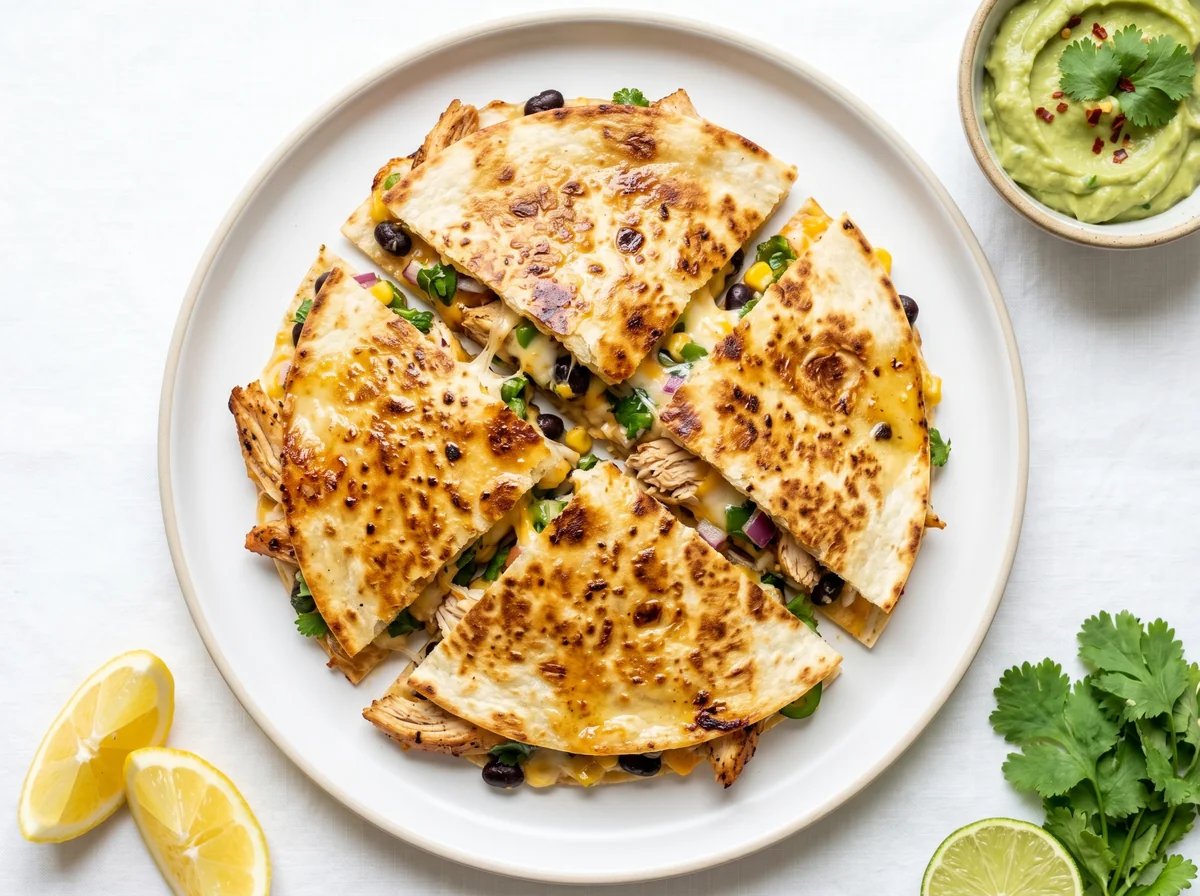
Mexican quesadilla of whole-wheat bread stuffed with seasoned chicken, cheese, and peppers · a healthy version with brown bread and lean chicken. A popular fast lunch or snack.
The quesadilla is one of Mexico's simplest and most beloved dishes: bread stuffed with cheese and chicken toasted until crisp.
EEINA's version uses whole-wheat bread, lean chicken, and low-fat cheese, so the pleasure of melted cheese and crunch remains with higher fiber and moderate carbs.
Preparation Steps
Sauté the vegetables
Heat the oil in a skillet over medium heat, and sauté the onion and pepper for about four minutes until they soften. The sautéed vegetables are the flavor base of the filling.
Add the chicken and spices
Add the shredded chicken, cumin, paprika, salt, and pepper and stir for two minutes until combined and heated, then set the filling aside. The spices give the Mexican character.
Assemble the quesadilla
Place a tortilla loaf in a dry skillet, scatter the cheese over half of it then the filling then more cheese, and fold the other half over it to make a half circle. The cheese on both sides acts as glue that holds the filling.
Toast
Cook the quesadilla over medium-low heat for two to three minutes per side until the bread turns golden and crisp and the cheese melts completely. The spotted golden color and the molten cheese are the sign of doneness; press it gently with the spatula so it sticks.
Cut
Transfer the quesadilla to the cutting board and leave it for a minute to set, then cut it into triangles with a sharp knife or a pizza cutter. Cutting it while very hot makes the cheese run.
Serve
Serve it warm with garlic yogurt, natural tomato sauce, or guacamole instead of high-calorie ready-made sauces, with a green salad for a balanced meal.
Blood Sugar Impact
The glycemic index (GI) measures how quickly a food raises blood sugar, while the glycemic load (GL) measures how much a full serving raises it. Together they give the complete picture.
Glycemic Index
GI
29Low
Low0–55Medium56–69High70+
A low value (≤55) means a gradual rise in blood sugar — the most suitable range for diabetes and insulin resistance.
Glycemic Load
GL
17Medium
Low0–10Medium11–19High20+
Glycemic load reflects the impact of the full serving. To lower it: take half a serving, or pair the recipe with a source of protein and fiber.
Nutritional Information
Per ServingMakes 4 servings · one serving is about 280 g of raw ingredients
Calories584 kcal29%of Daily Value*
Protein33 g66%of Daily Value*
Carbohydrates63 g23%of Daily Value*
Fat21 g27%of Daily Value*
Fiber5 g18%of Daily Value*
Sodium1325 mg58%of Daily Value*
Potassium512 mg11%of Daily Value*
Phosphorus514 mg41%of Daily Value*
* Percent Daily Values are based on a 2,000-calorie diet per FDA food-label reference values — your daily needs may be higher or lower. Values are derived from the recipe's ingredients via the USDA database.
Troubleshooting
The most common problems when preparing Chicken and Vegetable Quesadilla, and how to fix them:
The quesadilla falls apart when flipped
Not enough binding cheese or too much filling. Put a layer of cheese under and over the filling as it glues the layers, and do not overstuff. Flip it with a wide spatula confidently in one motion.
The bread burned and the cheese did not melt
The heat is too high. Cook it over medium-low heat so the cheese melts inside before the bread burns. A skillet lid for a minute helps melt the cheese faster.
The quesadilla is soft, not crisp
The skillet was not hot or had too much oil. Use a dry skillet or one with a little oil over medium heat, and leave each side for two to three minutes without stirring until it crisps.
The cheese ran out of the quesadilla
Too much cheese or it reached the edge. Leave an empty edge of a centimeter without cheese, and reduce the amount slightly. Leaking cheese burns on the skillet.
The filling is cold and the bread is cooked
The filling was not preheated. Sauté the chicken and vegetables until heated before assembling (step 1), since the toasting time is short and not enough to heat a cold filling.
Storage and Make-Ahead
Fridge (4°)
Two days in an airtight container after cooling. Reheat in a dry skillet to restore the crunch (the microwave makes it soft).
Freezer (-18°)
One month. Wrap each cooked quesadilla in parchment paper before freezing. Reheat directly in a skillet or oven from the freezer.
Make ahead
Prepare the chicken and vegetable filling and keep it for two days in the fridge. Assembling and toasting takes only 5 minutes at serving time.
Reheating
In a dry skillet over medium heat for two minutes per side, or in the oven (180°C) for 5 minutes. Do not leave it out of the fridge for more than two hours [1].
Tested Ingredient Substitutions
Original Ingredient
Tested Substitute
Ratio
Flavor Difference
Whole-wheat tortilla bread
Low-carb tortilla bread or brown griddle bread
same number
Lowers the carbs further for people with diabetes
Chicken breast
Lean ground beef or black beans
same weight
Beans are a fiber-rich vegetarian option
Cheese
Plant-based cheese or nutritional yeast
same amount
For the dairy-free version, less melting
Sweet pepper
Mushrooms, corn, or spinach
same weight
Alternative vegetables; sauté whatever releases water until it dries
Ready-made serving sauce
Guacamole or garlic yogurt
as desired
Healthy fats and fewer calories than ready-made creamy sauces
How Much Does It Make? Scaling Guide
Servings
Bread
Chicken
Cheese
Pan
2 (single × 2)
2 wraps
150 g
½ cup
medium pan
4 (base)
4 wraps
300 g
1 cup
large pan
6 (family)
6 wraps
450 g
1½ cups
2 pans or 2 batches
8 (hosting)
8 wraps
600 g
2 cups
large griddle or 2 batches
EEINA Nutrition Tip
Whole-wheat bread instead of white adds fiber and softens the quesadilla's effect on blood sugar. We stick to one loaf per serving, increase the chicken and vegetable filling, and reduce the cheese to lower the fat. We serve it with a salad for more satiety.
Add This Recipe to Your Plan
The EEINA app saves your favorite recipes, calculates them from their real ingredients, and shows your daily numbers toward your goal. Try it free now.
Is the quesadilla suitable for people with diabetes?
With whole-wheat bread and a moderate serving (one loaf), yes, since its glycemic index is low and its load is moderate. We increase the chicken and vegetables and reduce the cheese, and serve it with a salad. Low-carb bread is a better choice for them.
How do I keep it from falling apart?
The cheese is the glue: put a layer of cheese under and over the filling, do not overstuff, and leave an empty edge. Flip it with a wide spatula in one confident motion.
How do I make it gluten-free?
Use gluten-free tortilla bread (corn or alternatives). The chicken, vegetables, and cheese are gluten-free to begin with.
What is the vegetarian alternative?
Replace the chicken with lightly mashed black beans or sautéed mushrooms, and the cheese with plant-based cheese. You get a fiber-rich vegetarian quesadilla.
Is it good as a snack or work meal?
Yes, light and quick. Prepare the filling in advance and assemble at eating time, or keep the cooked quesadilla and reheat it in a skillet to restore the crunch.
Sources: USDA · University of Sydney · Gulf GSO · Our methodology · Updated on