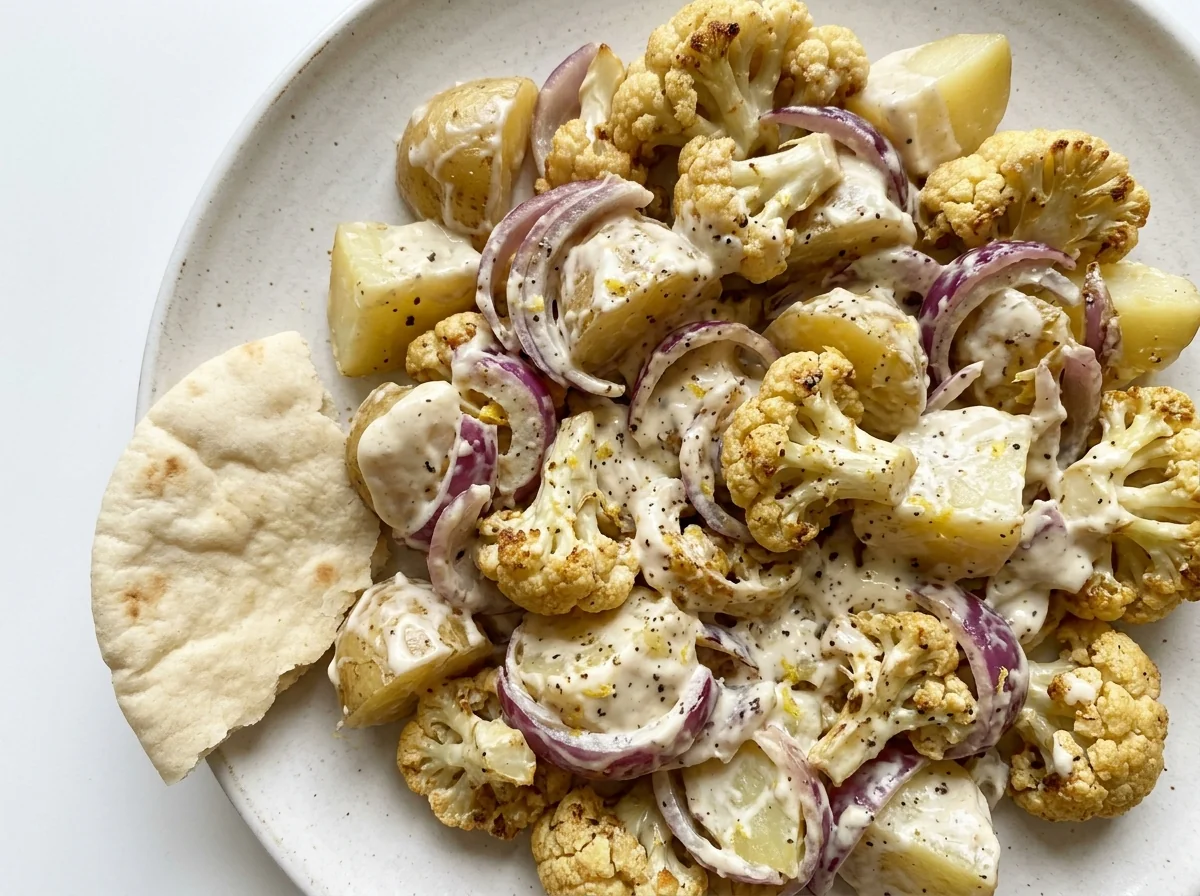
Fried cauliflower and potato salad with a yogurt sauce rich in tahini and mustard, served on a bed of arugula, mint, and purslane. A vegetable-rich main course, suitable for lunch and dinner.
Cauliflower and potato salad with white sauce is a classic Levantine dish that combines fried vegetables with a yogurt sauce of tahini and mustard, served cold or at room temperature.
It is widespread in winter seasons when cauliflower, potatoes, and purslane are abundant in the markets of the Levant.
Preparation Steps
Prepare the yogurt sauce
In a deep plate, combine the yogurt, tahini, mayonnaise, mustard, olive oil, lemon juice, salt, sugar, and black pepper, and stir with a hand whisk until you have a smooth, homogeneous sauce. Set it aside.
Fry the potato
Heat the vegetable oil in a wide deep pan over medium heat, add the grated potato, and wait two minutes, then gently turn it to the other side with a wide metal spoon and wait a few minutes until it is golden on both sides.
Fry the cauliflower
In the same pan, add the cauliflower florets and wait a few minutes, turning them gently, then turn them to the other side until they are golden. Lift them out and place them on paper towels to absorb the excess oil.
Arrange the vegetables
In a deep serving plate, place the fried potato and cauliflower with the lettuce leaves, grated carrot, arugula, chopped mint, and purslane leaves, and toss them gently to distribute.
Add the sauce and serve
Pour the yogurt sauce over the vegetables and stir gently with a fork until all the ingredients are coated in the sauce, then serve immediately in the serving dish with a piece of flatbread or lemon slices.
Blood Sugar Impact
The glycemic index (GI) measures how quickly a food raises blood sugar, while the glycemic load (GL) measures how much a full serving raises it. Together they give the complete picture.
Glycemic Index
GI
44Low
Low0–55Medium56–69High70+
A low value (≤55) means a gradual rise in blood sugar — the most suitable range for diabetes and insulin resistance.
Glycemic Load
GL
7Low
Low0–10Medium11–19High20+
Glycemic load reflects the impact of the full serving. To lower it: take half a serving, or pair the recipe with a source of protein and fiber.
Nutritional Information
Per ServingMakes 4 servings · one serving is about 360 g of raw ingredients
Calories519 kcal26%of Daily Value*
Protein8 g16%of Daily Value*
Carbohydrates23 g8%of Daily Value*
Fat46 g59%of Daily Value*
Fiber6 g21%of Daily Value*
Sodium501 mg22%of Daily Value*
* Percent Daily Values are based on a 2,000-calorie diet per FDA food-label reference values — your daily needs may be higher or lower. Values are derived from the recipe's ingredients via the USDA database.
Troubleshooting
The most common problems when preparing Cauliflower and Potato Salad with White Sauce, and how to fix them:
The sauce thinned when mixed with hot vegetables
This is normal when the vegetables are warm. Chill them in the refrigerator for 10 minutes before mixing, and add an extra tablespoon of mayonnaise to set the texture.
The cauliflower came out of the fryer oily
Place it on paper towels immediately and let it sit for 3 minutes so the oil absorbs. If it is very oily, transfer it to a preheated oven for 3 minutes to dry it out.
Storage and Make-Ahead
Sealed container in the refrigerator (4C)
The salad stays good for a full day after preparation, but the yogurt sauce stays separate in a jar for two days. Pour it over the vegetables right before serving.
Tested Ingredient Substitutions
Original Ingredient
Tested Substitute
Ratio
Flavor Difference
Mayonnaise
Labneh or cream cheese
1:1
Labneh gives a tangier flavor and a clearer Lebanese taste, and the cream cheese thickens the texture.
Purslane
Baby spinach or extra arugula
Same quantity
Baby spinach gives a milder flavor, and the extra arugula gives a strong, peppery flavor.
EEINA Nutrition Tip
Let the potato and cauliflower cool for 5 minutes before mixing them with the sauce, as the heat melts the yogurt and breaks the sauce's creamy texture. For a thicker sauce, add an extra tablespoon of tahini with a tablespoon of cold water.
Add This Recipe to Your Plan
The EEINA app saves your favorite recipes, calculates them from their real ingredients, and shows your daily numbers toward your goal. Try it free now.
Yes, boil it for 5 minutes in salted water then drain it and let it dry. Frying gives a richer flavor and a crispy texture, but boiling is lighter and healthier.
What is the difference between purslane and arugula?
Purslane is a leafy green with a sour taste that grows in winter seasons, and arugula has a larger leaf and a light peppery flavor. Both are suitable for the salad and can be mixed together.
Can the salad be prepared a day ahead?
Yes, keep the fried vegetables and the sauce in two separate containers in the refrigerator, then mix them right before serving.
Sources: USDA · University of Sydney · Our methodology · Updated on