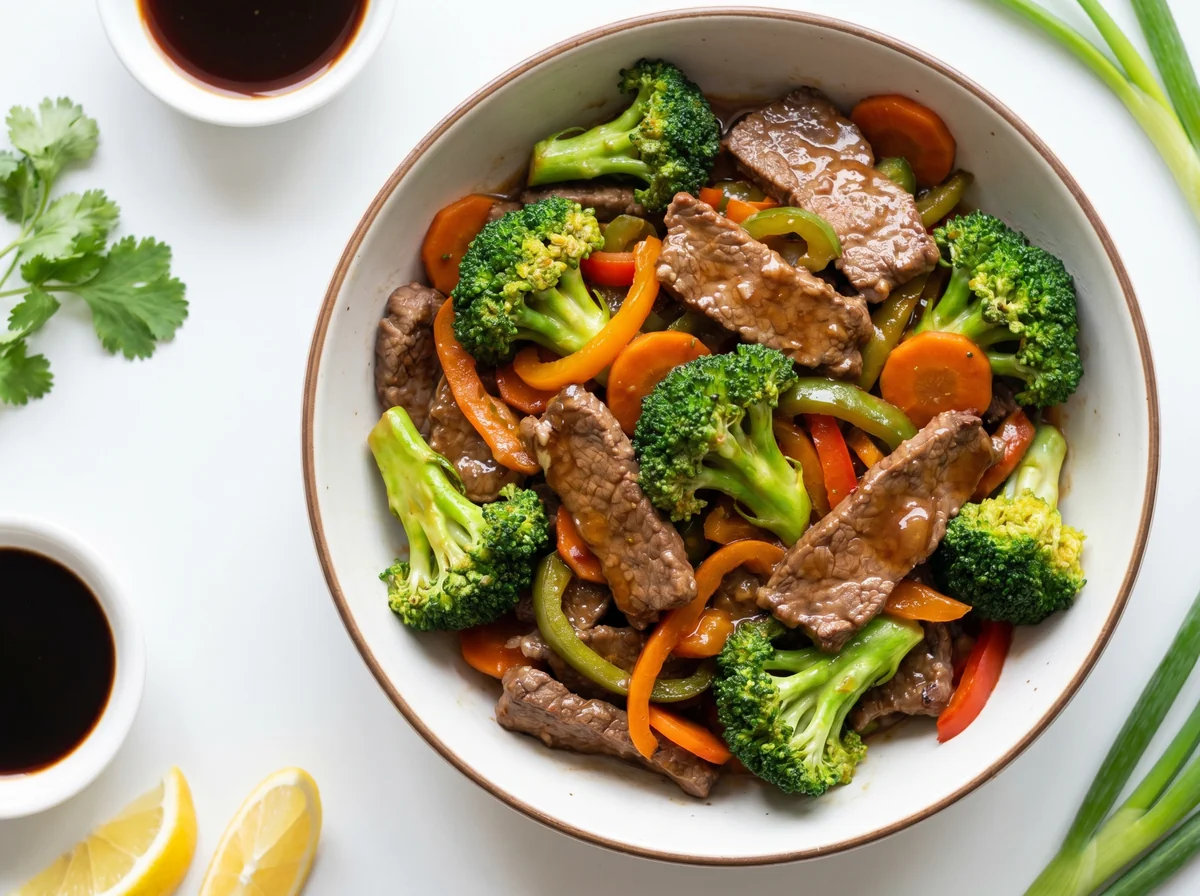
Thin beef strips and broccoli florets stir-fried quickly in soy sauce and ginger — very low carbs, low GI, and high protein. A popular Chinese dish, ready fast.
Beef with broccoli is one of the most beloved dishes in Chinese restaurants: tender beef strips and crisp broccoli in a glossy sauce.
The EEINA version chooses lean beef, loads up on broccoli, and cuts the sodium — a quick, high-protein, low-carb dish.
Preparation Steps
Marinate the beef
Toss the beef strips with 1 tablespoon soy sauce and half the cornstarch, and leave for 10 minutes. The cornstarch coats the beef to keep it tender and helps create a glossy sauce — a Chinese velveting technique.
Blanch the broccoli
Blanch the broccoli florets in salted boiling water for exactly 2 minutes until just tender but still bright green and crisp, then drain. This ensures they finish cooking perfectly during the stir-fry.
Sear the beef
Heat the vegetable oil in a wide pan (wok) over high heat until almost smoking. Add the beef in a single layer without crowding and cook 3 to 4 minutes until browned and cooked through. Transfer to the side.
Combine and glaze
In the same pan add the garlic and ginger for 10 seconds, then the broccoli. Whisk the remaining soy sauce and half teaspoon cornstarch with a quarter cup of water and pour in, stirring until the sauce thickens and turns glossy (about 1 minute). Return the beef along with the sesame oil and toss until evenly coated.
Serve
Remove from the heat and scatter the spring onions on top. Serve hot with brown rice or cauliflower rice to keep carbs low. A sprinkle of toasted sesame seeds makes a nice garnish.
Blood Sugar Impact
The glycemic index (GI) measures how quickly a food raises blood sugar, while the glycemic load (GL) measures how much a full serving raises it. Together they give the complete picture.
Glycemic Index
GI
23Low
Low0–55Medium56–69High70+
A low value (≤55) means a gradual rise in blood sugar — the most suitable range for diabetes and insulin resistance.
Glycemic Load
GL
1Low
Low0–10Medium11–19High20+
Glycemic load reflects the impact of the full serving. To lower it: take half a serving, or pair the recipe with a source of protein and fiber.
Nutritional Information
Per ServingMakes 4 servings · one serving is about 180 g of raw ingredients
Calories340 kcal17%of Daily Value*
Protein25 g50%of Daily Value*
Carbohydrates6 g2%of Daily Value*
Fat23 g29%of Daily Value*
Fiber1 g4%of Daily Value*
Sodium748 mg33%of Daily Value*
* Percent Daily Values are based on a 2,000-calorie diet per FDA food-label reference values — your daily needs may be higher or lower. Values are derived from the recipe's ingredients via the USDA database.
Troubleshooting
The most common problems when preparing Chinese-Style Beef and Broccoli Stir-Fry, and how to fix them:
Beef is tough and chewy
Cut with the grain or overcooked. Slice the beef thinly against the grain, coat with cornstarch, and stir-fry quickly over high heat for 3 to 4 minutes only.
Broccoli is mushy and limp, or still raw and hard
Blanching time is off. Two minutes in boiling water is enough to soften it while keeping the crunch and color. A plunge in cold water after sets the color if preferred.
Sauce is thin and watery
Not enough cornstarch or not cooked long enough. Mix the cornstarch in cold water well before adding, then let the sauce bubble until thickened and glossy before adding the beef.
Dish is too salty
Too much soy sauce or a regular-sodium variety. Use low-sodium soy sauce and start with less. The sesame oil and ginger add flavor without salt.
Beef steamed rather than seared
Cold pan or overcrowded — steam builds up and poaches the meat. Heat the wok until almost smoking, spread the beef without crowding, and cook in batches for large quantities.
Storage and Make-Ahead
Refrigerator (4°C)
Three days in an airtight container after cooling. Reheat quickly in a pan over high heat to restore the texture.
Freezer (-18°C)
Two months. The broccoli may soften slightly after freezing. Freeze in individual portions and thaw in the refrigerator before reheating.
Meal prep
Slice the beef and broccoli and prepare the sauce in advance, storing separately. The stir-fry itself takes only 10 minutes at serving time.
Reheating
In a pan over high heat for 2 minutes, preferable to the microwave which softens the broccoli. Do not leave outside the refrigerator for more than two hours [2].
Tested Ingredient Substitutions
Original Ingredient
Tested Substitute
Ratio
Flavor Difference
Beef
Sliced chicken breast or shrimp
Same weight
Chicken is leaner; shrimp cooks in about 2 minutes
Broccoli
Green beans, asparagus, or bell pepper
Same weight
Any firm vegetable works — adjust the blanching time to suit
Soy sauce
Gluten-free tamari
Same amount
For those sensitive to gluten; very similar flavor
Cornstarch
Potato starch or omit
Same amount
For thickening; can be omitted for a thinner sauce
Sesame oil
Omit
—
For sesame allergies; the Asian flavor profile will be slightly reduced
How Much Does It Make? Scaling Guide
Servings
Beef
Broccoli
Soy sauce
Pan
2 (single × 2)
250 g
200 g
1 1/2 spoons
Wide frying pan
4 (base)
500 g
400 g
3 spoons
Wok or large frying pan
6 (family)
750 g
600 g
4 1/2 spoons
Large wok or 2 batches
8 (hosting)
1 kg
800 g
6 spoons
2 batches
EEINA Nutrition Tip
An excellent dish for diabetics: very low carbs, high protein, and broccoli is rich in fiber. The only challenge is sodium from soy sauce, so use low-sodium soy sauce in moderation. Serve with cauliflower rice to keep the meal low glycemic load.
Add This Recipe to Your Plan
The EEINA app saves your favorite recipes, calculates them from their real ingredients, and shows your daily numbers toward your goal. Try it free now.
Very much so — it has very few carbs (about 12 g), low GI, high protein, and broccoli fiber slows absorption. Watch the sodium from soy sauce and serve with cauliflower rice rather than white rice.
How do I get restaurant-tender beef at home?
Slice it thinly against the grain, marinate with cornstarch and soy sauce (the Chinese velveting technique), and sear quickly over very high heat without crowding the pan.
How do I make it gluten-free?
Use tamari (gluten-free soy sauce) and cornstarch (gluten-free). Note that regular soy sauce contains wheat.
Can I use frozen broccoli?
Yes, but thaw and dry it thoroughly before stir-frying so it does not release water. It may not need blanching as it is already partially cooked.
Is it good for meal prep?
Yes, it keeps 3 days in the refrigerator. Best reheated quickly in a pan over high heat to keep the broccoli crisp. Prep the ingredients in advance for a quick stir-fry.
Sources: USDA · University of Sydney · Gulf GSO · Our methodology · Updated on