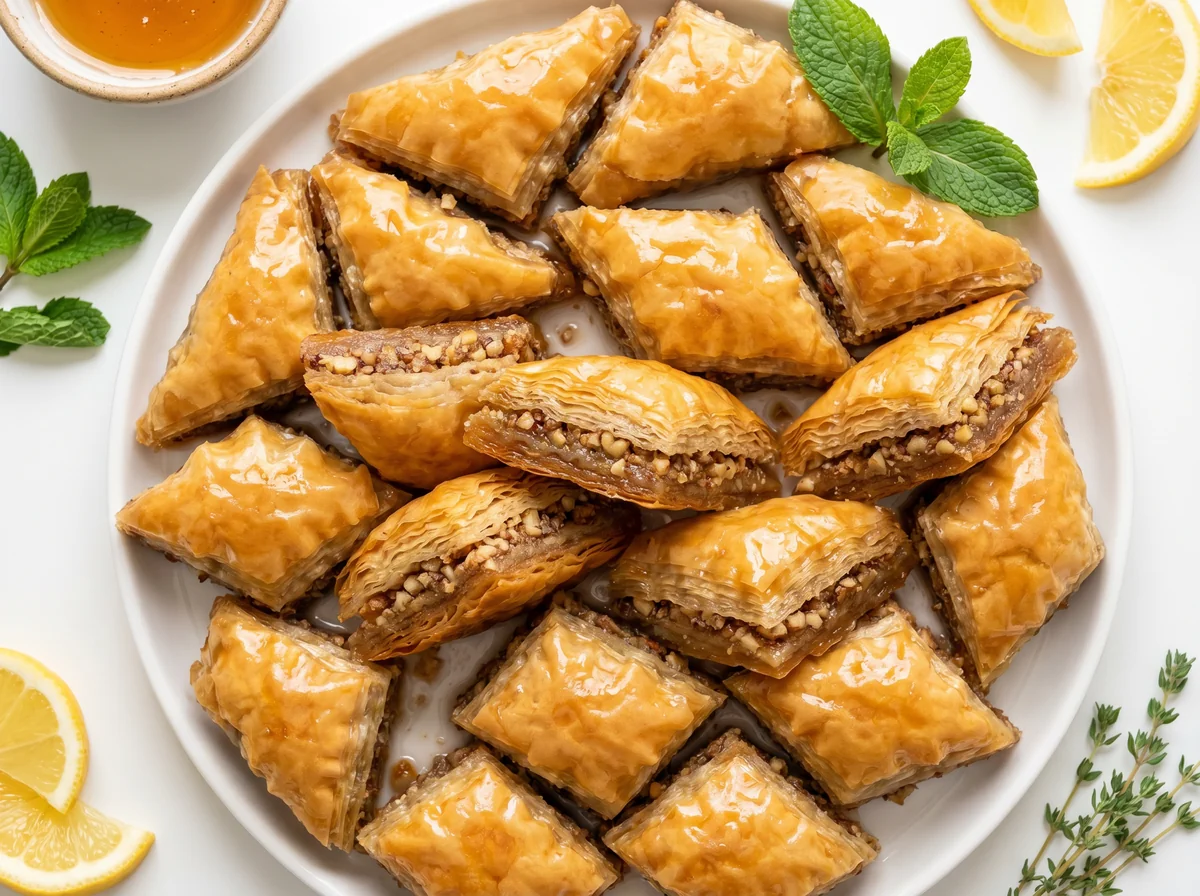
A Levantine and Turkish luxury pastry — thin layers of filo dough brushed with ghee, filled with crushed nuts, baked until golden, then drenched in sugar syrup. A celebration sweet with a medium glycaemic load. Contains gluten, tree nuts, and dairy.
Baklava is one of the finest sweets of the Levantine and Turkish kitchen, with its roots in the Ottoman cuisine that perfected the art of thin filo layers. It spread from Istanbul to Damascus, Aleppo, and Beirut and became the sweet of festivals, celebrations, and hospitality.
It is made from dozens of thin layers of filo brushed with ghee, filled with nuts, and drenched in syrup. Every city has its own version: Aleppo uses pistachios, Damascus uses walnuts. Making it is a craft that demands patience and precision in handling the sheets.
Preparation Steps
Make the syrup cold
Bring the sugar and water to a boil, add the lemon juice (which prevents crystallisation), and simmer over low heat for 10 minutes until slightly thickened, then add the orange blossom water and remove from the heat. Leave to cool completely. Cold syrup poured over hot baklava is the secret to crispness.
Prepare the filling
Crush the nuts to a medium grind — not too fine. Mix with the sugar and cinnamon. Walnuts, pistachios, or a combination all work well. A coarser crush gives better texture than a fine grind.
Layer the bottom sheets
Brush a baking dish with ghee. Place half the filo sheets one by one, brushing each sheet with ghee before placing the next. Keep unused filo sheets covered with a damp towel — they dry out and crumble in minutes when exposed to air.
Add the filling and top layers
Spread the nut mixture evenly over the bottom layer, then cover with the second half of the filo sheets, brushing each sheet with ghee. Brush the top generously with ghee, as this gives the golden colour and crunch.
Cut and bake
Before baking, cut the baklava into diamonds or squares with a sharp knife. Cutting before baking prevents the fragile baked layers from crumbling afterwards. Bake at 180 degrees C for approximately 40 to 45 minutes until golden and crispy on top and bottom.
Pour the syrup and serve
As soon as the hot baklava comes out of the oven, pour the cold syrup evenly over it until it soaks between the layers. You will hear a sizzle — a sign of good crispness. Scatter the crushed pistachios and leave to cool and absorb the syrup for one hour before serving. Serve at room temperature with coffee.
Blood Sugar Impact
The glycemic index (GI) measures how quickly a food raises blood sugar, while the glycemic load (GL) measures how much a full serving raises it. Together they give the complete picture.
Glycemic Index
GI
64Medium
Low0–55Medium56–69High70+
A low value (≤55) means a gradual rise in blood sugar — the most suitable range for diabetes and insulin resistance.
Glycemic Load
GL
37High
Low0–10Medium11–19High20+
Glycemic load reflects the impact of the full serving. To lower it: take half a serving, or pair the recipe with a source of protein and fiber.
Nutritional Information
Per ServingMakes 12 servings · one serving is about 130 g of raw ingredients
Calories478 kcal24%of Daily Value*
Protein7 g14%of Daily Value*
Carbohydrates60 g22%of Daily Value*
Fat25 g32%of Daily Value*
Fiber2 g7%of Daily Value*
Sodium181 mg8%of Daily Value*
Potassium191 mg4%of Daily Value*
Phosphorus128 mg10%of Daily Value*
* Percent Daily Values are based on a 2,000-calorie diet per FDA food-label reference values — your daily needs may be higher or lower. Values are derived from the recipe's ingredients via the USDA database.
Troubleshooting
The most common problems when preparing Baklava, and how to fix them:
The baklava went soft and did not stay crispy
Hot syrup was poured over hot baklava, or too much syrup was used, or the ghee between layers was insufficient. The rule: cold syrup on hot baklava, a moderate quantity, and generous ghee between every two sheets. Pouring hot syrup will steam away the crispness.
The filo sheets crumbled and tore
They dried out in the air. Always keep unused filo sheets covered with a damp towel, work quickly, and brush each sheet with ghee immediately after placing it. Filo dries out in minutes.
The baklava fell apart when cut after baking
It was not cut before baking. Cut into diamonds or squares with a sharp knife before putting it in the oven — the baked layers are brittle and will crumble if cut afterwards.
The top is pale and did not turn golden
Insufficient ghee on the top surface, or the oven temperature was too low. Brush the top generously with ghee and bake until golden. The heat can be raised in the last few minutes or the overhead grill switched on briefly to achieve the golden colour.
The syrup did not soak between the layers
The baklava was cold or the syrup was too cold and thick. Pour the cold syrup immediately after the baklava comes hot from the oven — the temperature difference draws the syrup between the layers with a satisfying sizzle.
Storage and Make-Ahead
Room temperature
Store in an airtight container at room temperature for one week. Do not refrigerate — cold solidifies the ghee and the baklava loses its crispness. It stays crisp as long as it is not exposed to moisture.
Freezer (-18 degrees C)
Freeze baked for up to three months, with layers of parchment paper between pieces, before or after adding syrup. Thaw at room temperature. Pieces without syrup can be drenched after thawing and reheating.
Advance preparation
Assemble, cut, and freeze raw, then bake from frozen when needed and drench with syrup. Or bake completely several days before the occasion — it keeps for a week.
Crispness note
Do not cover hot baklava tightly while warm — trapped steam will soften it. Leave it to cool uncovered then store in an airtight container.
Tested Ingredient Substitutions
Original Ingredient
Tested Substitute
Ratio
Flavor Difference
Walnuts
Pistachios, cashews, or a mix
Same quantity
Pistachios are more luxurious (Aleppo-style baklava), walnuts are more economical (Damascus-style), all are tree nuts
Ghee
Melted butter
Same quantity
Ghee is closer to the traditional flavour and has a higher smoke point, butter has a lighter flavour
Full quantity of syrup
Reduced or lightly drizzled syrup
To taste
Lowers the sugar content — baklava is still delicious with less syrup
How Much Does It Make? Scaling Guide
Number of pieces
Phyllo
Nuts
Sugar (syrup)
6 (half recipe)
0.5 pack
1 cup
1 cup
12 (base)
1 pack
2 cups
2 cups
24 (large tray)
2 packs
4 cups
4 cups
EEINA Nutrition Tip
Baklava is a celebration sweet high in sugar, fat, and calories — it is not everyday food. However the nuts inside add healthy fats, protein, and fibre, making it slightly better nutritionally than sweets that contain none. Moderation is everything: one small piece with coffee is enough. To lighten it: reduce the syrup (pour it more sparingly) and increase the nuts. For people with diabetes: a very small piece on a special occasion, with care.
Add This Recipe to Your Plan
The EEINA app saves your favorite recipes, calculates them from their real ingredients, and shows your daily numbers toward your goal. Try it free now.
Three secrets: cold syrup on hot baklava (or hot syrup on cold baklava — the temperature difference is key), generous ghee between every two sheets, and cutting it before baking. Following the temperature rule between syrup and baklava is the most important.
Why do I need to cover the filo sheets with a damp towel?
Because filo is extremely thin and dries out and crumbles in minutes when exposed to air. The damp towel keeps it flexible and workable without tearing while you build the layers.
Do I cut the baklava before or after baking?
Always before baking. The baked layers are extremely fragile and crumble if cut afterwards. Cut into diamonds with a sharp knife before putting it in the oven so the pieces separate cleanly.
Is baklava suitable for people with diabetes?
It is a celebration sweet high in sugar and is not a daily choice. The nuts add healthy fats but the syrup raises blood sugar. A very small piece with less syrup on a special occasion, with care.