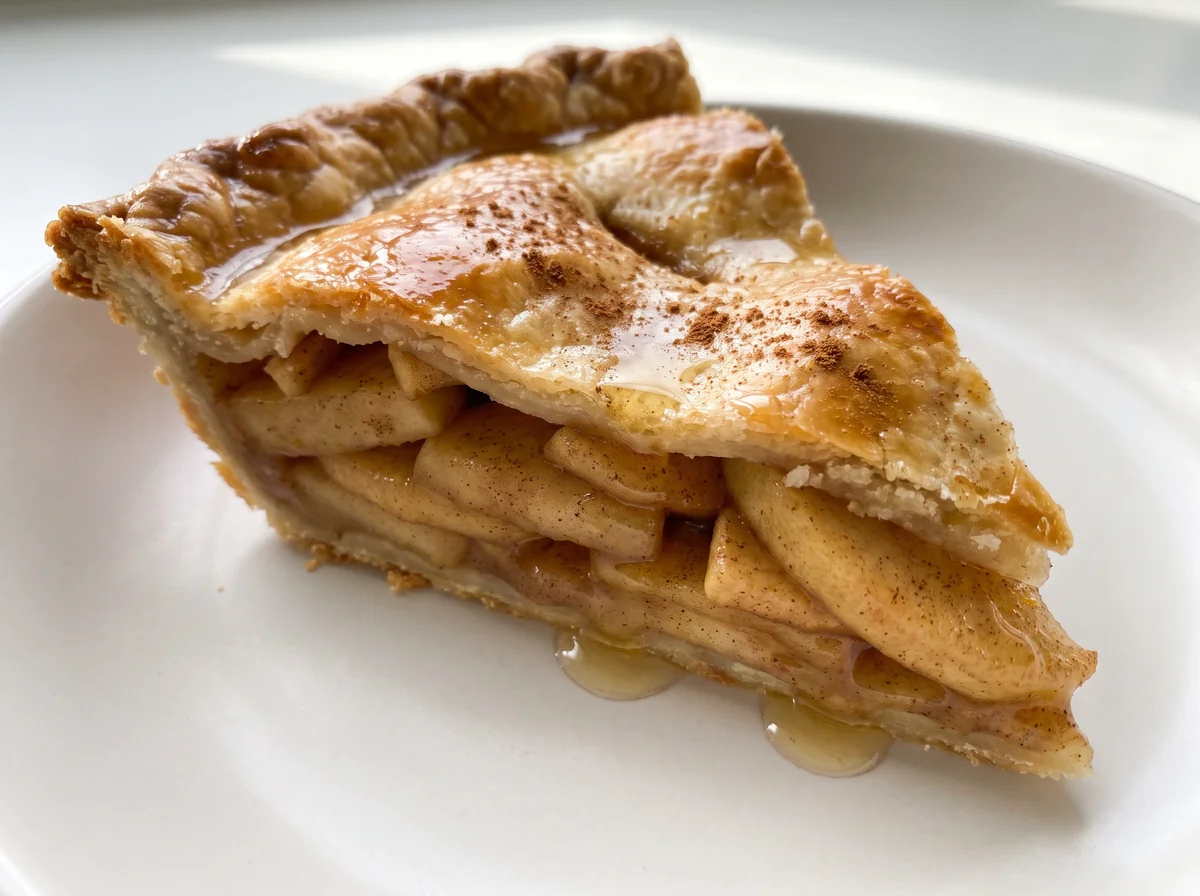
A dough mixed in a food processor from flour, milk, and oil, rolled out into a round and filled with apples seasoned with cinnamon, honey, and sugar, topped with strips of dough and pieces of butter, then baked until the surface browns and dusted with powdered sugar.
The best known Western dessert in a simplified home version: no laminated pastry needing resting and chilling, but a dough of oil and milk mixed in the processor in minutes and rolled out straight away.
The filling is steeped in cinnamon, honey, and sugar, then drained of its juice before it goes on, and that draining is what keeps the base from going soggy, so the pie comes out firm under a tender filling.
Preparation Steps
Season the apples
Put the cinnamon and honey over the cut apples, then add the sugar, mix, and set aside to release their juices.
Mix the dough
Mix the dough ingredients in a food processor: the flour, the pinch of salt, the liquid milk, the vegetable oil, and the sodium bicarbonate, until it becomes a smooth dough.
Roll out the base
Roll the dough out into a round and lay it in the baking dish, reserving a small piece of dough to decorate the top of the pie.
Add the filling
Drain the apples of the juice they have released, and spread them over the dough.
Decorate with dough strips
Roll the reserved dough out lengthwise, cut it into strips, and lay them over the apple filling.
Scatter the butter
Cut the butter into small pieces and scatter them over the surface of the pie after decorating.
Bake
Bake the pie at 300 degrees as given in the source for 15 to 20 minutes, or until the surface browns.
Dust and serve
Dust the surface of the pie with powdered sugar, and serve it hot with vanilla ice cream or cold, as you prefer.
Blood Sugar Impact
The glycemic index (GI) measures how quickly a food raises blood sugar, while the glycemic load (GL) measures how much a full serving raises it. Together they give the complete picture.
Glycemic Index
GI
61Medium
Low0–55Medium56–69High70+
A low value (≤55) means a gradual rise in blood sugar — the most suitable range for diabetes and insulin resistance.
Glycemic Load
GL
43High
Low0–10Medium11–19High20+
Glycemic load reflects the impact of the full serving. To lower it: take half a serving, or pair the recipe with a source of protein and fiber.
Nutritional Information
Per ServingMakes 8 servings · one serving is about 220 g of raw ingredients
Calories523 kcal26%of Daily Value*
Protein5 g10%of Daily Value*
Carbohydrates75 g27%of Daily Value*
Fat23 g29%of Daily Value*
Fiber4 g14%of Daily Value*
Sodium495 mg22%of Daily Value*
Potassium195 mg4%of Daily Value*
Phosphorus139 mg11%of Daily Value*
* Percent Daily Values are based on a 2,000-calorie diet per FDA food-label reference values — your daily needs may be higher or lower. Values are derived from the recipe's ingredients via the USDA database.
Troubleshooting
The most common problems when preparing Cinnamon Apple Pie, and how to fix them:
The base came out wet and doughy
The apples were not drained of their juice before going on, or they went on right after seasoning. Let them release their juices, then drain them well as the source's method does.
The top browned while the filling stayed cold
The heat was higher than it should be. The governing cue is the surface browning within 15 to 20 minutes; if the color runs ahead of that, lower the heat or move the pan down a rack.
The dough is brittle and cracks when rolled
It has dried out of liquid. Add a spoon of milk and knead for a moment until it softens; an oil dough should roll out supple and crack-free.
It came out very sweet
The filling's sugar together with the honey is the source's measure and it is generous. Anyone preferring a quieter sweetness can halve the sugar, and sweet apples make up the difference.
Storage and Make-Ahead
At room temperature
Covered for one day, and it is at its crispest on the first day.
Refrigerator (4°C)
In a sealed container for up to 3 days, and reheated in the oven for a few minutes so the base regains its crispness.
Freezing
Freeze baked and portioned for up to two months, and reheat straight from frozen in the oven.
Serving
Hot with vanilla ice cream as the source suggests, or cold with coffee.
Tested Ingredient Substitutions
Original Ingredient
Tested Substitute
Ratio
Flavor Difference
White sugar in the filling
Half the amount
75 g
With the honey and sweet apples the sweetness stays ample, and the calories drop noticeably.
Vegetable oil in the dough
Light olive oil
165 ml
Higher in monounsaturated fat, and its flavor is barely noticeable alongside the cinnamon.
White flour
Half whole wheat flour
180 g white with 180 g whole wheat
More fiber and a slightly denser texture; a full swap makes the dough heavy.
Honey
Date molasses
63 g
An Arab sweetness with more minerals, and its color darkens the filling slightly.
How Much Does It Make? Scaling Guide
Servings
Flour
Apples
Sugar
Milk
4 servings (half quantity)
180 g
375 g
75 g
120 ml
8 servings (base)
360 g
750 g
150 g
240 ml
16 servings (double, 2 pies)
720 g
1500 g
300 g
480 ml
EEINA Nutrition Tip
Do not skip draining the apples of their juice: the step that looks minor is the difference between a crisp base and a wet, doughy one. And the drained juice is not thrown away; a spoonful over the ice cream at serving carries the flavor of the whole pie.
Add This Recipe to Your Plan
The EEINA app saves your favorite recipes, calculates them from their real ingredients, and shows your daily numbers toward your goal. Try it free now.
The source says 'a temperature of 300' without naming a unit, and the governing cue it gives is more precise than the number: the surface browns within 15 to 20 minutes. Watch the color and go by it, whatever your oven.
Why sodium bicarbonate rather than baking powder?
That is how the source's ingredients read: a tablespoon of bicarbonate with a milk-and-oil dough. It gives the dough its crumb, and the acidity of the apples and honey in the filling helps it work.
Which apples suit the pie?
The source says only 'medium-sized apples'. Firm tart varieties such as Granny Smith hold their shape in the oven, while sweet ones such as Gala give a softer, sweeter filling.
Is the dough baked before filling?
No. The source's method lays the filling on the raw dough and bakes everything together, and draining the apples is what protects the base.
Sources: USDA · University of Sydney · Our methodology · Updated on