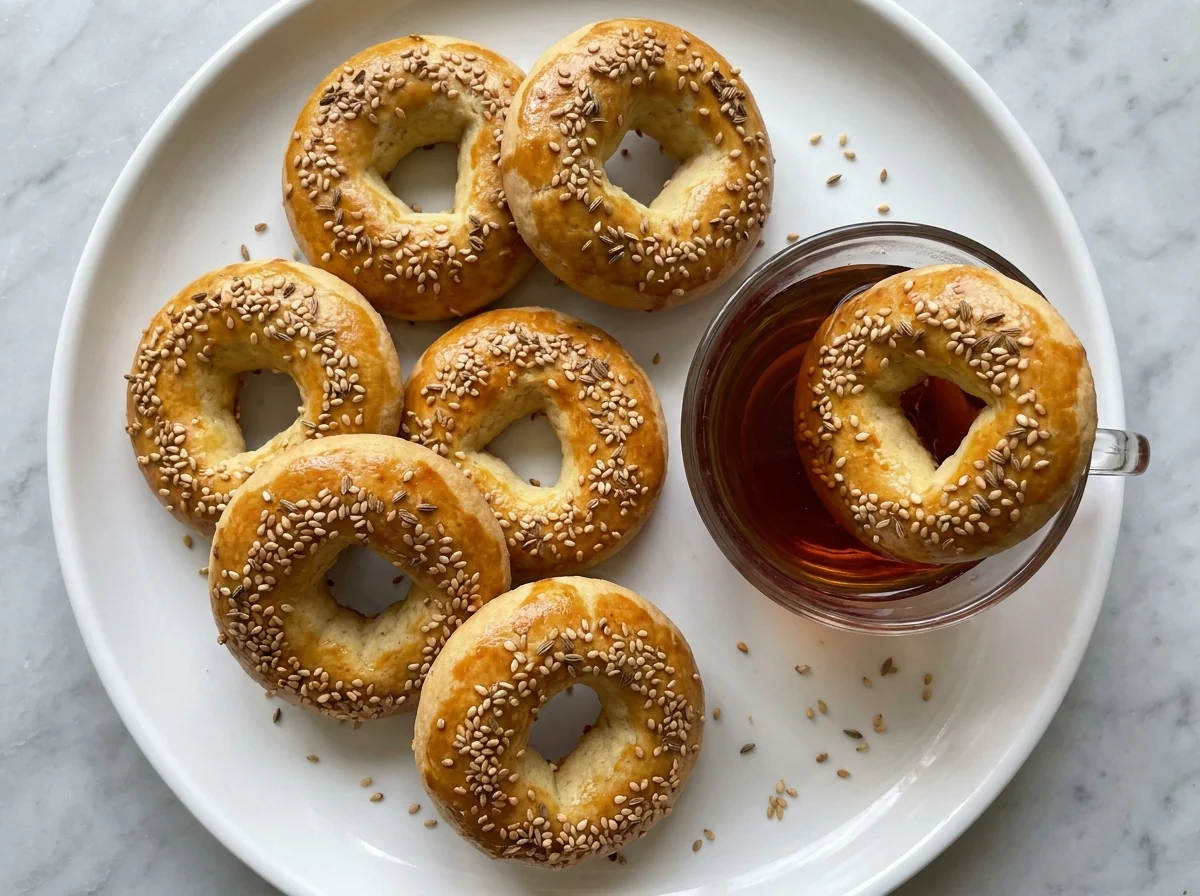
Anise and sesame kaak is one of the oldest tea pastries in the Levant, Egypt and the Arabian Peninsula: anise-scented rings baked dry and crisp so they keep in their tins for weeks, served with morning and afternoon hospitality, with recipes passed down through households.
Preparation Steps
Knead the anise dough
Mix the flour, yeast, sugar, salt, ground anise and anise seeds, and half the sesame, then add the oil and rub it into the flour. Add the warm milk and knead for eight minutes until you have a smooth, cohesive dough that smells of anise. Cover it for one hour until it rises.
Shape the rings
Divide the dough into small balls, roll each ball into a rope the thickness of a finger and the length of your palm, then join it into a ring and press the seam firmly. The ring shape is the familiar form of this kaak in the bakeries of the Levant and Jerusalem from long ago.
Brush and coat with sesame
Line the rings on a parchment-lined tray, brush them with the egg-and-milk mixture, scatter the remaining sesame over their tops and press it gently to set it.
Bake until browned and dry
Bake in an oven preheated to 180 degrees for twenty to twenty-five minutes until browned and dry. Tea kaak is deliberately baked drier than bread, and its crisp dryness is what makes it suitable for dipping and for keeping in its tin for two weeks.
Cool completely and store
Let it cool on a rack until fully crisp, then store it in an airtight tin. Serve it with tea and dip it in, an old custom in Arab homes morning and afternoon.
Blood Sugar Impact
The glycemic index (GI) measures how quickly a food raises blood sugar, while the glycemic load (GL) measures how much a full serving raises it. Together they give the complete picture.
Glycemic Index
GI
71High
Low0–55Medium56–69High70+
A low value (≤55) means a gradual rise in blood sugar — the most suitable range for diabetes and insulin resistance.
Glycemic Load
GL
33High
Low0–10Medium11–19High20+
Glycemic load reflects the impact of the full serving. To lower it: take half a serving, or pair the recipe with a source of protein and fiber.
Nutritional Information
Per ServingMakes 8 servings · one serving is about 100 g of raw ingredients
Calories338 kcal17%of Daily Value*
Protein7 g14%of Daily Value*
Carbohydrates48 g17%of Daily Value*
Fat13 g17%of Daily Value*
Fiber2 g7%of Daily Value*
Sodium165 mg7%of Daily Value*
Potassium129 mg3%of Daily Value*
Phosphorus113 mg9%of Daily Value*
* Percent Daily Values are based on a 2,000-calorie diet per FDA food-label reference values — your daily needs may be higher or lower. Values are derived from the recipe's ingredients via the USDA database.
Troubleshooting
The most common problems when preparing Anise and Sesame Kaak with Tea, and how to fix them:
The kaak came out soft
It was underbaked, and this kaak needs to be dry. Five extra minutes at a gentler heat will dry it without burning, and let it cool completely before the tin.
Too hard to eat without dipping
That is its nature; it is baked to be dipped in tea so it softens with every dip. For anyone who wants it tender without dipping, add two extra spoonfuls of oil to the dough.
The rings opened up in the oven
The seam was pressed in a hurry. Wet the two ends of the rope with a drop of water and press the seam firmly, or place the seam down on the tray.
The anise aroma faded after a few days
The anise is old, from a package opened months ago. Use freshly ground anise at kneading time, and in the airtight tin its aroma lasts as long as the kaak itself keeps.
Storage and Make-Ahead
In an airtight tin
Two weeks crisp at room temperature, and this is its main advantage: a hospitality pastry always ready.
In the freezer
Baked, for two months, reheated in a gentle oven for five minutes to bring back its crispness.
Not stored in the fridge
The fridge's humidity softens its crispness, and the airtight tin is its proper place.
Tested Ingredient Substitutions
Original Ingredient
Tested Substitute
Ratio
Flavor Difference
Anise
Ground fennel or mahlab
same amount
Familiar aromatic substitutes in Arab kaak
Sugar
Half of it
30 g
A nearly plain kaak that suits cheese alongside
Olive oil
Local ghee
1:1
Deeper flavor and richer crispness
Half the flour
Whole-wheat flour
1:1 for the half
A browner kaak with higher fiber
How Much Does It Make? Scaling Guide
Ingredient
~20 rings
~10 rings
~40 rings
Flour
400 g
200 g
800 g
Oil
80 ml
40 ml
160 ml
Sesame
25 g
13 g
50 g
EEINA Nutrition Tip
Use anise both ground and whole: the ground spreads its flavor through the whole dough, and the seeds give a clear burst of flavor when chewed. Relying on just one gives half the flavor.
Add This Recipe to Your Plan
The EEINA app saves your favorite recipes, calculates them from their real ingredients, and shows your daily numbers toward your goal. Try it free now.
Shabura is slices of sweet bread baked twice, and Eid kaak is stuffed with dates and dusted with sugar for the holidays, while this is dry-textured anise rings served with tea on ordinary days.
Why is it deliberately baked dry?
Because dryness extends its keeping for weeks without preservatives and makes it suitable for dipping: it softens in the tea cup, not in the tin.
How many pieces with tea make a reasonable serving?
Two pieces with a cup of milky tea, since its sugar is moderate to begin with and the strong anise flavor is enough in a small amount.
Does it make a good pantry gift?
Yes, a jar of kaak keeps for two weeks and makes a gift from the kitchen, in keeping with an old hospitality custom.