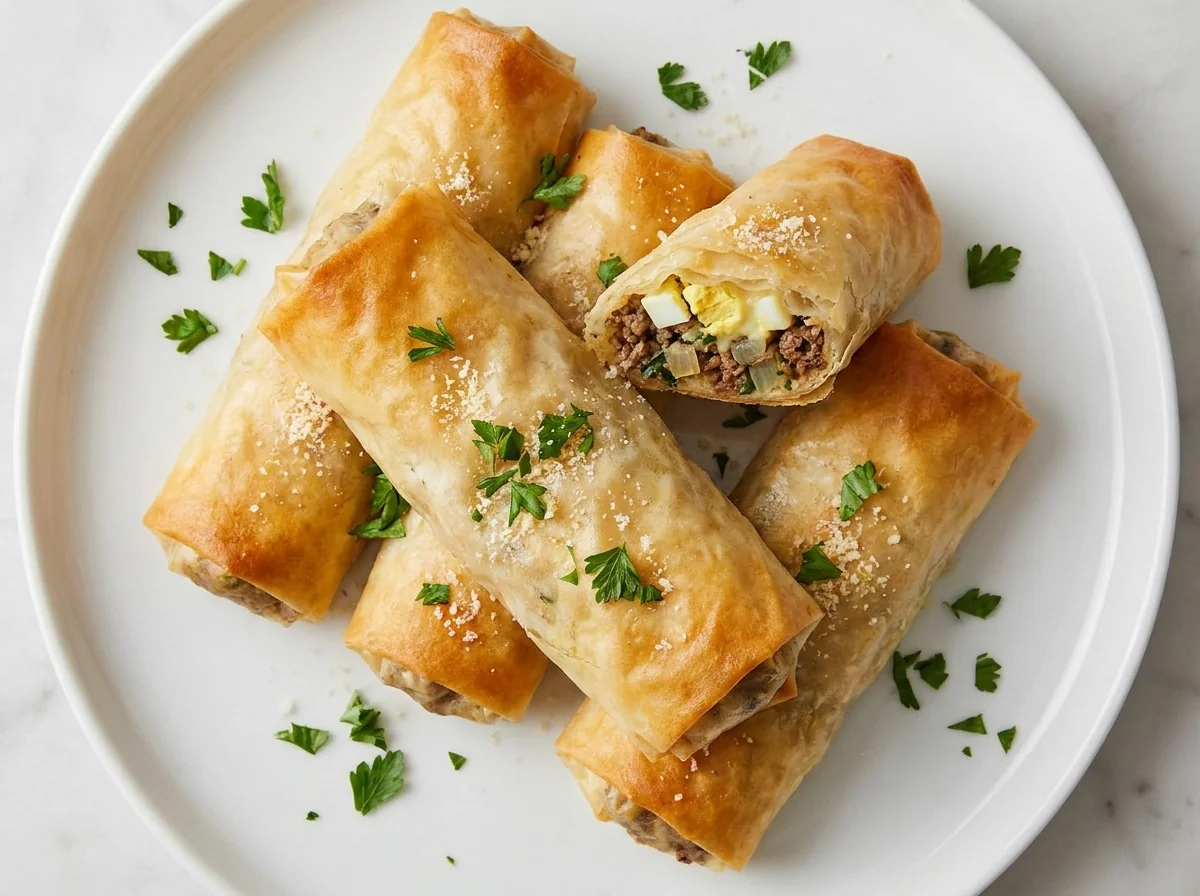
Bourek is a dish that arrived from the Ottoman kitchen and took root in Algeria until it became a staple of its Ramadan table: dioul fingers filled with meat and boiled egg, served alongside soup night after night throughout the month.
Preparation Steps
Cook the meat and onion filling
Peel the onion and chop it finely. In a pan, heat the oil and wilt the onion until it turns translucent, then add the ground meat and break it up until it crumbles, browns, and its water dries. Season with salt, pepper, and a pinch of cinnamon and turn off the heat.
Add the boiled egg to the filling
Boil the eggs, peel them, and chop them coarsely, and wash and chop the parsley. Mix the chopped boiled egg and parsley into the lukewarm filling, as the boiled egg inside the meat filling is what distinguishes Algerian bourek from other similar pastries. For more richness, add the grated cheese.
Roll thick, tight fingers
Spread out the dioul sheet, place a generous line of filling near its edge, fold the sides inward, and roll a thick cylinder the size of two fingers, as bourek is thicker than a spring roll and this is its known shape. Seal the end with a smear of water.
Bake instead of the traditional frying
Arrange the fingers on a parchment-lined tray with the roll seam facing down, brush them with a smear of oil, and bake them in an oven preheated to 200 degrees for fifteen to twenty minutes with one turn until they are crisp and golden on all sides.
Serve as it is served in Algeria
Served hot alongside soup and lemon wedges. In Algeria it appears on the Ramadan table throughout the month, and a squeeze of lemon over it is a customary habit.
Blood Sugar Impact
The glycemic index (GI) measures how quickly a food raises blood sugar, while the glycemic load (GL) measures how much a full serving raises it. Together they give the complete picture.
Glycemic Index
GI
64Medium
Low0–55Medium56–69High70+
A low value (≤55) means a gradual rise in blood sugar — the most suitable range for diabetes and insulin resistance.
Glycemic Load
GL
15Medium
Low0–10Medium11–19High20+
Glycemic load reflects the impact of the full serving. To lower it: take half a serving, or pair the recipe with a source of protein and fiber.
Nutritional Information
Per ServingMakes 6 servings · one serving is about 155 g of raw ingredients
Calories375 kcal19%of Daily Value*
Protein18 g36%of Daily Value*
Carbohydrates25 g9%of Daily Value*
Fat23 g29%of Daily Value*
Fiber2 g7%of Daily Value*
Sodium330 mg14%of Daily Value*
Potassium293 mg6%of Daily Value*
Phosphorus204 mg16%of Daily Value*
* Percent Daily Values are based on a 2,000-calorie diet per FDA food-label reference values — your daily needs may be higher or lower. Values are derived from the recipe's ingredients via the USDA database.
Troubleshooting
The most common problems when preparing Algerian Baked Meat Bourek, and how to fix them:
The sheet cracked when rolling
The dioul is dry. Cover the sheets with a damp, wrung-out towel and work one sheet at a time, and a smear of water on a small crack repairs it.
The bourek opened in the oven
The seam was facing up or the seal was dry. Always place the roll seam facing down with a generous smear of water on the end.
The filling is dry
The meat was cooked on the heat longer than needed or there was too little onion. The wilted onion is the source of the filling's moisture, and lift the meat off as soon as its water dries without delay.
The oven crispness is less than fried
This is the nature of baking, which is gentler than frying. A light coating of oil on all sides and a well-preheated oven bring the result much closer with far less fat.
Storage and Make-Ahead
Immediately
Hot with a squeeze of lemon in the Algerian style.
In the fridge
The filling alone for two days, rolled and baked fresh.
In the freezer
Rolled raw for two months between sheets of parchment, baked from frozen with five extra minutes.
Tested Ingredient Substitutions
Original Ingredient
Tested Substitute
Ratio
Flavor Difference
Dioul sheets
Large spring-roll wrappers
1:1
The most readily available in our markets
Ground meat
Seasoned ground chicken
1:1
A lighter version common in Algeria itself
Grated cheese
Omit it entirely
~
The older original version is without cheese
Baking in the oven
Air fryer at 180 degrees
12 minutes
Excellent crispness without heating a whole oven
How Much Does It Make? Scaling Guide
Ingredient
12 rolls
6 rolls
24 rolls
Bourek sheets
12
6
24
Meat
350 g
175 g
700 g
Boiled eggs
2
1
4
EEINA Nutrition Tip
Do not reduce the boiled egg or chop it too finely, for its small pieces visible in the bite are among the best parts of bourek, and chopping it too fine dissolves it into the filling so you cannot feel it.
Add This Recipe to Your Plan
The EEINA app saves your favorite recipes, calculates them from their real ingredients, and shows your daily numbers toward your goal. Try it free now.
The shape is a thick cylinder, not a triangle, and the filling is meat with boiled egg, and these two do not come together in a samosa or a spring roll.
Where do I find dioul sheets in Saudi Arabia?
In large supermarkets in the frozen section as 'bourek sheets' or 'dioul', and large spring-roll wrappers are a good substitute.
Is it eaten cold?
It loses its crispness cold, and reheating it in a hot oven for three minutes brings it back.
How many fingers per person?
Two fingers with soup and salad are enough, as its meat and egg filling is more satisfying than its size.