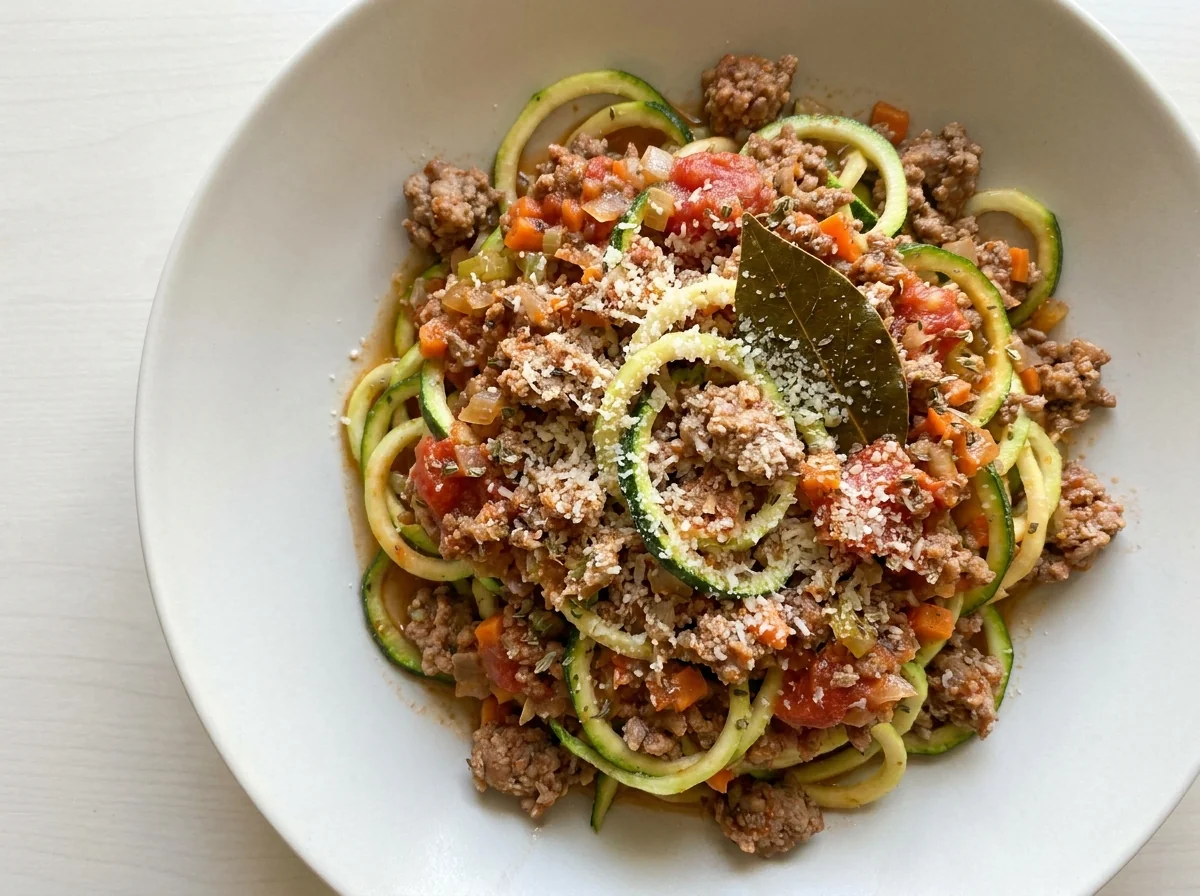
Zoodles, spiralized zucchini noodles, are the third pillar of substitution cooking and the most elegant: green strands that carry Italy's most venerable sauces at a salad's carbs.
And the golden rule, counter to intuition: the sauce is cooked with double care because it has become the star alone.
Preparation Steps
Spiralize the zoodles and salt them to sweat
Spiralize the zucchini with a spiralizer (or a peeler for wide ribbons) and sprinkle with light salt in a colander for a quarter hour. The salt draws out its abundant water in advance: zoodles that haven't sweated drown their sauce later.
An honest Bolognese with the Italian trio
Brown the ground meat until it dries (the peas lesson), then the onion, carrot, and celery (the soffritto), then the garlic, then the caramelized paste, then the tomatoes, and a twenty-minute simmer: the sauce here is the dish, so it's cooked with full dignity.
Dry the zoodles and sear them
Squeeze them in a towel and slip them into a hot pan with a film of oil for two minutes only, tossing with tongs. They soften to a noodle texture and keep their bite: the third minute is the start of dissolving.
Marry in the plate, not the pot
The zoodles in the plate and the hot Bolognese over them. They aren't cooked together: the hot sauce over the zoodles finishes softening them without drowning them.
Parmesan and a surprising bite
Spaghetti Bolognese in full spirit at an eighth of its carbs. The pasta plate returns to the diabetic's dinner.
Blood Sugar Impact
The glycemic index (GI) measures how quickly a food raises blood sugar, while the glycemic load (GL) measures how much a full serving raises it. Together they give the complete picture.
Glycemic Index
GI
14Low
Low0–55Medium56–69High70+
A low value (≤55) means a gradual rise in blood sugar — the most suitable range for diabetes and insulin resistance.
Glycemic Load
GL
2Low
Low0–10Medium11–19High20+
Glycemic load reflects the impact of the full serving. To lower it: take half a serving, or pair the recipe with a source of protein and fiber.
Nutritional Information
Per ServingMakes 3 servings · one serving is about 630 g of raw ingredients
Calories528 kcal26%of Daily Value*
Protein29 g58%of Daily Value*
Carbohydrates23 g8%of Daily Value*
Fat36 g46%of Daily Value*
Fiber6 g21%of Daily Value*
Sodium307 mg13%of Daily Value*
Potassium1463 mg31%of Daily Value*
Phosphorus394 mg32%of Daily Value*
* Percent Daily Values are based on a 2,000-calorie diet per FDA food-label reference values — your daily needs may be higher or lower. Values are derived from the recipe's ingredients via the USDA database.
Troubleshooting
The most common problems when preparing Zucchini Zoodles with Bolognese Sauce, and how to fix them:
A lake of water in the plate
Zoodles that didn't sweat. The salt and the squeeze. Its first and last law.
They dissolved into soft strands
They passed their two minutes or were cooked in the sauce. The sear and the marriage in the plate.
The sauce didn't cling to the strands
A thin Bolognese. The honest concentration of twenty minutes. The thick one climbs up.
A raw, grassy bite
A coarse spiralize with no pan. The two hot minutes. Raw is for salads, not Bolognese.
Storage and Make-Ahead
Immediately
The zoodles don't wait. They sweat in the plate.
The Bolognese alone
In the fridge four days or frozen two months, and the zoodles fresh each time: the familiar split.
Raw spiralized zoodles
In the fridge for the day with a paper towel, and they sweat and get seared at dinner.
Tested Ingredient Substitutions
Original Ingredient
Tested Substitute
Ratio
Flavor Difference
Zucchini
Yellow squash. Golden zoodles
to taste
The spiralizer accepts anything firm
Bolognese
Napoletana sauce or shrimp with garlic
to taste
The green strands are a free base
Full substitution
Half spaghetti and half zoodles
to taste
The familiar bridge
No spiralizer?
A peeler for wide ribbons. Green pappardelle
to taste
The tool doesn't monopolize the idea
How Much Does It Make? Scaling Guide
Ingredient
3 servings
1.5 servings
6 servings
Zucchini
800 g
400 g
1.6 kg
Meat
400 g
200 g
800 g
Tomatoes
430 g
215 g
860 g
EEINA Nutrition Tip
Salt the zoodles to sweat, then sear them two minutes. Zucchini is 95% water: unsweated ones release their lake into the plate so the Bolognese swims and the zoodles are unjustly blamed; a quarter hour of salt in a colander and a towel squeeze, then two minutes in a hot pan. They come out as strands that stand with a bite: every watery, dissolved zoodle plate in restaurants and homes broke one of the two rules.
Add This Recipe to Your Plan
The EEINA app saves your favorite recipes, calculates them from their real ingredients, and shows your daily numbers toward your goal. Try it free now.
The serving is ~16 g net carbs versus ~65 for a plate of spaghetti Bolognese, and fullness is close thanks to the sauce's meat: the pasta returned at a salad's price.
How is it different from the zucchini pasta in our notebook?
That one is real wheat pasta with zucchini as its guest; this one, the zucchini is the pasta itself. The first is for the family and the second for whoever counts their carbs.
The spiralizer. An investment worth it?
For a few riyals it opens a whole family of dishes (zucchini, carrot, squash). The smallest tool of the diabetic kitchen and the widest in impact: and the peeler is a zero-cost alternative.
The Italian soffritto, what did I learn?
The trio of chopped onion, carrot, and celery is the foundation of Italy's sauces and all of Europe's stews. Master it here and you own a continent of sauces.