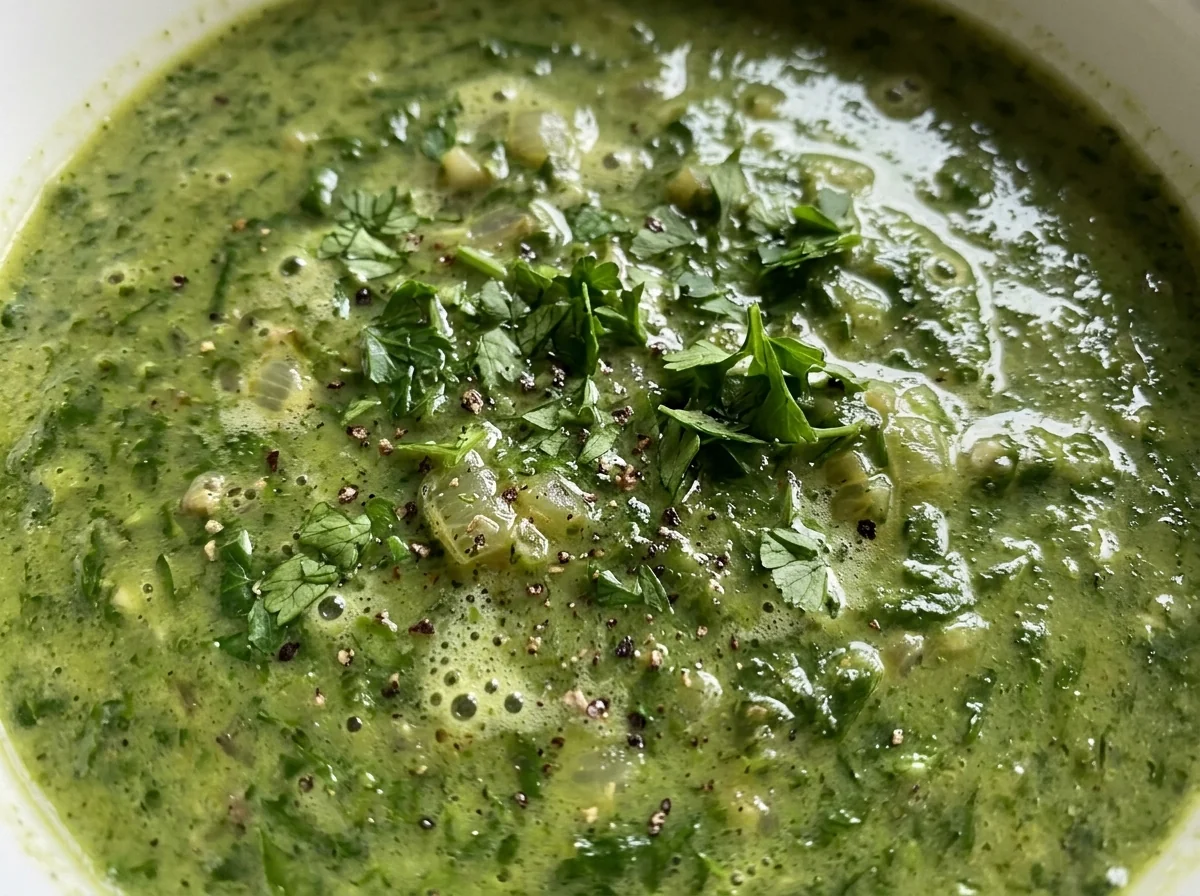
A green soup that brings together the gentle pepperiness of arugula (rocket) with the freshness of parsley. The ingredients are blended and then cooked briefly so the soup keeps its color and flavor. A light, low-calorie dish for anyone watching their weight who wants a warm green bowl.
Arugula usually appears on our tables as raw leaves in a salad, and this recipe, from the Shamlola website, turns it into a warm green soup alongside its companion, parsley.
We lightened the original by cutting the cream from a full cup down to 4 tablespoons of light cooking cream — the creamy touch stayed while the fat dropped considerably, an adjustment befitting a dish whose whole point is being light on calories.
Preparation Steps
Wash the greens well
Wash the arugula and parsley under running water and discard the thick, tough stems. Leafy greens carry soil between their leaves and need careful washing.
Blend the ingredients
Put the onion, garlic, arugula, and parsley in a blender with 1 cup of the water, and blend until the mixture is smooth and uniform with a bright green color.
Cook the mixture
Pour the green mixture into a pot over medium heat with the remaining water and the dissolved stock cube, and let it cook for about 10 minutes, stirring now and then. Do not overcook, or the green color will fade.
Add the cream and seasoning
Lower the heat and add the light cream, salt, and black pepper, stirring until blended. Taste before adding any extra salt — the stock cube is already salty.
Thicken and serve
Leave the soup over low heat for a few minutes until it simmers gently and thickens slightly, then ladle it into bowls, garnish with the chopped parsley, and serve hot.
Blood Sugar Impact
The glycemic index (GI) measures how quickly a food raises blood sugar, while the glycemic load (GL) measures how much a full serving raises it. Together they give the complete picture.
Glycemic Index
GI
8Low
Low0–55Medium56–69High70+
A low value (≤55) means a gradual rise in blood sugar — the most suitable range for diabetes and insulin resistance.
Glycemic Load
GL
1Low
Low0–10Medium11–19High20+
Glycemic load reflects the impact of the full serving. To lower it: take half a serving, or pair the recipe with a source of protein and fiber.
Nutritional Information
Per ServingMakes 4 servings · one serving is about 425 g of raw ingredients
Calories81 kcal4%of Daily Value*
Protein5 g10%of Daily Value*
Carbohydrates10 g4%of Daily Value*
Fat4 g5%of Daily Value*
Fiber3 g11%of Daily Value*
Sodium580 mg25%of Daily Value*
* Percent Daily Values are based on a 2,000-calorie diet per FDA food-label reference values — your daily needs may be higher or lower. Values are derived from the recipe's ingredients via the USDA database.
Troubleshooting
The most common problems when preparing Arugula and Parsley Soup, and how to fix them:
The green color faded and turned dark
The cooking went on too long. Stick to about 10 minutes after blending — green leaves lose their bright color with prolonged boiling. Add the cream and seasoning at the end and turn off the heat quickly.
The taste is more bitter or sharp than expected
Large, mature arugula is sharper than young leaves. Choose young bunches with small leaves, and balance the sharpness with a squeeze of lemon juice or one extra spoonful of cream — fat softens bitterness.
The texture is thin and watery
Leafy greens carry no starch to thicken with. Let the soup simmer gently uncovered for a few extra minutes to concentrate, or next time add a small boiled, mashed potato cube for a thicker body with limited calories.
The cream separated and white specks appeared
It was added at a hard boil. Lower the heat completely before adding it and stir immediately; if it separates, run the immersion blender for a few seconds and it will come back together.
Traces of soil or sand at the bottom of the bowl
The washing was not thorough enough. Soak the bunches in a bowl of cold water for a few minutes, swish them, then lift them out of the water rather than pouring the water over them — the sand stays at the bottom. Repeat until the water runs clear.
Storage and Make-Ahead
Refrigerator (4°C)
Keep in an airtight container for up to 2 days — leafy-green soups lose their freshness faster than root-vegetable soups. Reheat over low heat without a hard boil to protect the cream and the color.
Freezer (-18°C)
Best frozen before adding the cream, for up to 1 month, in an airtight container with room for expansion. Thaw overnight in the refrigerator, reheat, then add fresh cream — the color and texture suffer if frozen with the cream in.
Reheating
Over low heat with constant stirring until hot, without a strong boil, or in the microwave for a minute and a half, stirring halfway through. Do not reheat the same portion more than once.
Tested Ingredient Substitutions
Original Ingredient
Tested Substitute
Ratio
Flavor Difference
Light cream
Low-fat Greek yogurt
4 tablespoons added after taking the pot off the heat
Higher protein and less fat; add it off the heat so it does not separate.
Stock cube
Homemade vegetable stock
4 cups of stock instead of the water and cube
Full control over sodium and a cleaner flavor for anyone watching their salt.
Arugula
Fresh spinach
Same weight, 400 g
A calmer flavor without the peppery bite, and the calories stay similarly low.
Parsley
Fresh cilantro
Same volume, 1 bunch
A differently aromatic character — a welcome option for cilantro lovers.
How Much Does It Make? Scaling Guide
Servings
Arugula
Parsley
Water
Cream
2 servings
2 bunches (200 g)
1/2 bunch (50 g)
2 cups (500 ml)
2 tablespoons
4 servings
4 bunches (400 g)
1 bunch (100 g)
4 cups (1000 ml)
4 tablespoons
6 servings
6 bunches (600 g)
1 1/2 bunches (150 g)
6 cups (1500 ml)
6 tablespoons
EEINA Nutrition Tip
The sharpness of fresh arugula softens greatly with cooking, leaving a pleasant peppery note — no need to be wary of it. A squeeze of lemon juice at serving time lifts the green flavor and saves you from adding more salt, and anyone wanting a richer-feeling bowl without many calories can stir a spoonful of Greek yogurt into their serving.
Add This Recipe to Your Plan
The EEINA app saves your favorite recipes, calculates them from their real ingredients, and shows your daily numbers toward your goal. Try it free now.
Brief cooking preserves most of the nutritional value, though some heat-sensitive vitamins decrease partially, as with all cooked leafy greens. That is why we cook it for only 10 minutes and avoid prolonged boiling.
Does it taste as peppery as raw arugula leaves?
No — heat breaks down most of the sharp compounds, leaving a light, pleasant peppery note balanced by the parsley and cream. Most people who try it cannot tell it is the same arugula from the salad bowl.
Why did you lighten the cream compared to the original recipe?
The original uses a full cup of cream, which doubles the fat per serving in a dish whose point is lightness. Four tablespoons of light cream give nearly the same touch with far less fat, and we stated the change openly rather than hiding it.
Is it enough as a full dinner?
On its own it is a light, low-protein dish. Pair it with a boiled egg, a piece of low-fat cheese, or toasted whole-grain bread for a balanced dinner with longer-lasting satiety.