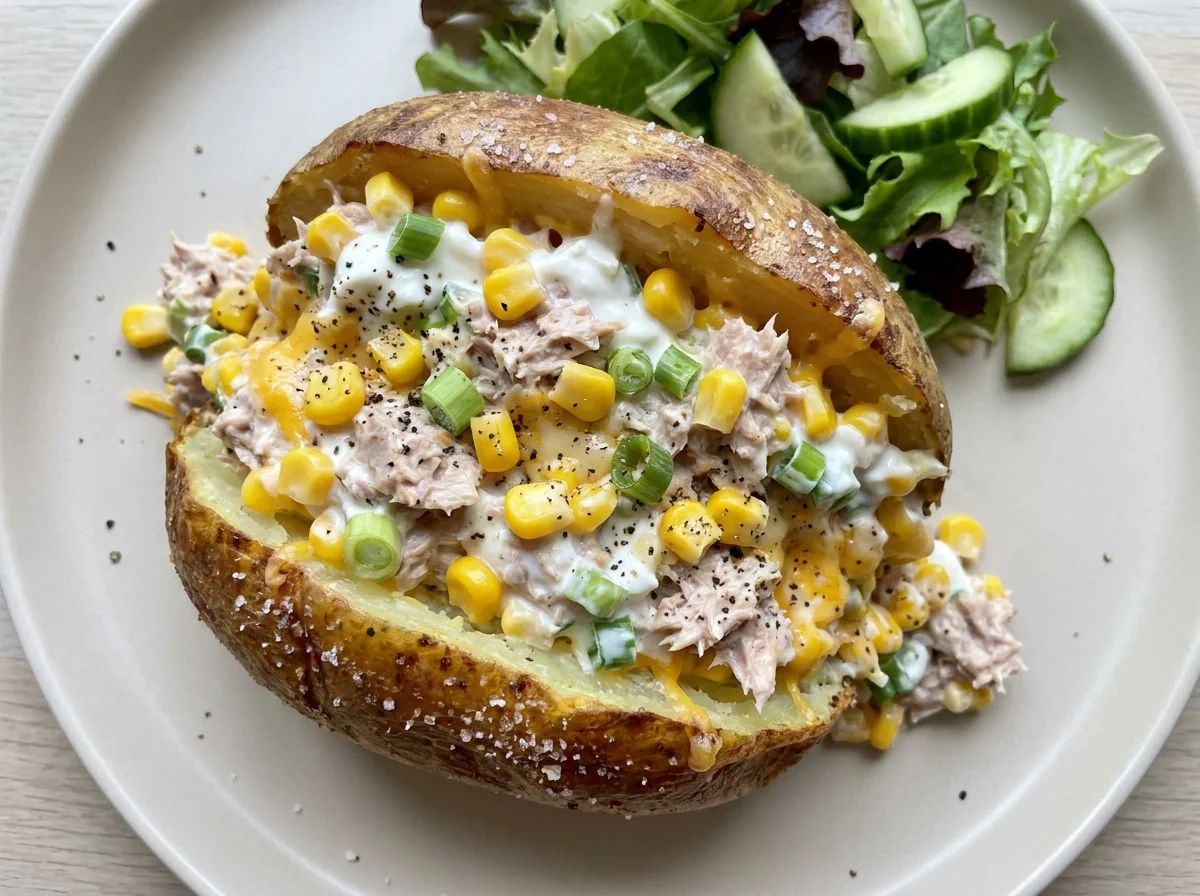
The stuffed potato, the jacket potato, Britain's venerable economical dinner and the staple of its winter street carts: a potato baked for an hour until its skin crisps and its center softens, then filled with whatever is on hand.
Creamy tuna is its most famous filling, and the cheapest complete dinner the British Isles know.
Preparation Steps
Bake the whole potatoes with salted skin
Prick the washed potatoes with a fork, brush them with the oil and coarse salt, and bake at 220 for a full hour directly on the oven rack. Pricking prevents bursting and the salt crisps the skin: the British jacket potato in its true form.
Whisk the creamy tuna filling
The tuna, yogurt, mayonnaise, corn, green onion, and lemon. The yogurt-forward creaminess is our familiar equation.
Split and fluff the center with a fork
Split each potato in a cross and press its ends so it opens up, then fluff its center with a fork with a small knob of butter or a drizzle of oil. The fluffing prepares the center to receive the filling, not just to have it placed on top.
Fill and crown with cheese
Generous tuna filling in the fluffed center, the cheddar on top, and five minutes under the broiler melt it to gold.
A complete dinner in a shell
Serve with a green salad. Protein, carbohydrates, and vegetables in one potato eaten with its crisp skin: Britain's economical dinner that lived for centuries for good reason.
Blood Sugar Impact
The glycemic index (GI) measures how quickly a food raises blood sugar, while the glycemic load (GL) measures how much a full serving raises it. Together they give the complete picture.
Glycemic Index
GI
70High
Low0–55Medium56–69High70+
A low value (≤55) means a gradual rise in blood sugar — the most suitable range for diabetes and insulin resistance.
Glycemic Load
GL
32High
Low0–10Medium11–19High20+
Glycemic load reflects the impact of the full serving. To lower it: take half a serving, or pair the recipe with a source of protein and fiber.
Nutritional Information
Per ServingMakes 4 servings · one serving is about 425 g of raw ingredients
Calories415 kcal21%of Daily Value*
Protein26 g52%of Daily Value*
Carbohydrates51 g19%of Daily Value*
Fat13 g17%of Daily Value*
Fiber6 g21%of Daily Value*
Sodium710 mg31%of Daily Value*
* Percent Daily Values are based on a 2,000-calorie diet per FDA food-label reference values — your daily needs may be higher or lower. Values are derived from the recipe's ingredients via the USDA database.
Troubleshooting
The most common problems when preparing Tuna-Stuffed Baked Potato, and how to fix them:
The skin came out rubbery
Foil wrapped it or a tray touched it. The bare rack and free air. The jacket creed.
The center is dense, not fluffy
An hour was short or the potatoes were giant and uneven. Whole, evenly sized ones, and a knife should slide in with no resistance as the verdict.
The filling soaked the center
Tuna with its liquids or thin yogurt. Serious draining and thick Greek yogurt.
It burst in the oven
The pricking was forgotten. Six pricks per potato. Its steam needs doors.
Storage and Make-Ahead
Immediately
With its crisp skin and melted cheese.
The baked potatoes alone
Bake a batch and cool for two days, then fill and reheat on demand: jacket meal prep.
The tuna filling
Two days in the refrigerator in a container. It serves sandwiches too.
Tested Ingredient Substitutions
Original Ingredient
Tested Substitute
Ratio
Flavor Difference
Tuna
Our shredded chicken in the same sauce or baked beans
~
All the fillings of the Peninsula
Cheddar
Our white cheese or drop it
~
The crown is optional
The shortcut route
Microwave 8 minutes then a hot oven 15 to crisp the skin
~
Two thirds of the result in half the time
White potato
Sweet potato in forty minutes
~
The sweeter version with higher fiber
How Much Does It Make? Scaling Guide
Ingredient
4 pieces
2 pieces
8 pieces
Potatoes
1 kg
500 g
2 kg
Tuna
280 g
140 g
560 g
Yogurt
120 g
60 g
240 g
EEINA Nutrition Tip
Bake the potatoes directly on the oven rack for a full hour with no foil. Foil traps steam and boils the potato with a rubbery, damp skin; the bare rack dries the salted skin into a crisp crust and cooks the center with free-flowing air into a fluff that collapses under a fork: the full hour at 220 is not an exaggeration. It is the difference between a truly baked potato and a microwave potato in disguise.
Add This Recipe to Your Plan
The EEINA app saves your favorite recipes, calculates them from their real ingredients, and shows your daily numbers toward your goal. Try it free now.
~395 calories with ~26 g protein and skin with its fiber. A complete, balanced dinner in one potato: those who go easy on the cheese drop below four hundred.
Is the potato skin eaten?
It is the star of the dish. Crisp and salted and holding most of the potato's fiber and potassium: a good wash and scrub, and eat it with confidence.
Why did this dish live for centuries in Britain?
A potato for a riyal becomes a complete dinner with a simple filling. Through wars and crises it was the pillar of survival: truly economical dishes do not die.
What other fillings from our library?
Our batch beans in tomato sauce (the famous second British version) · our shredded chicken with yogurt · our roasted vegetables with cheese. The jacket is a free base.