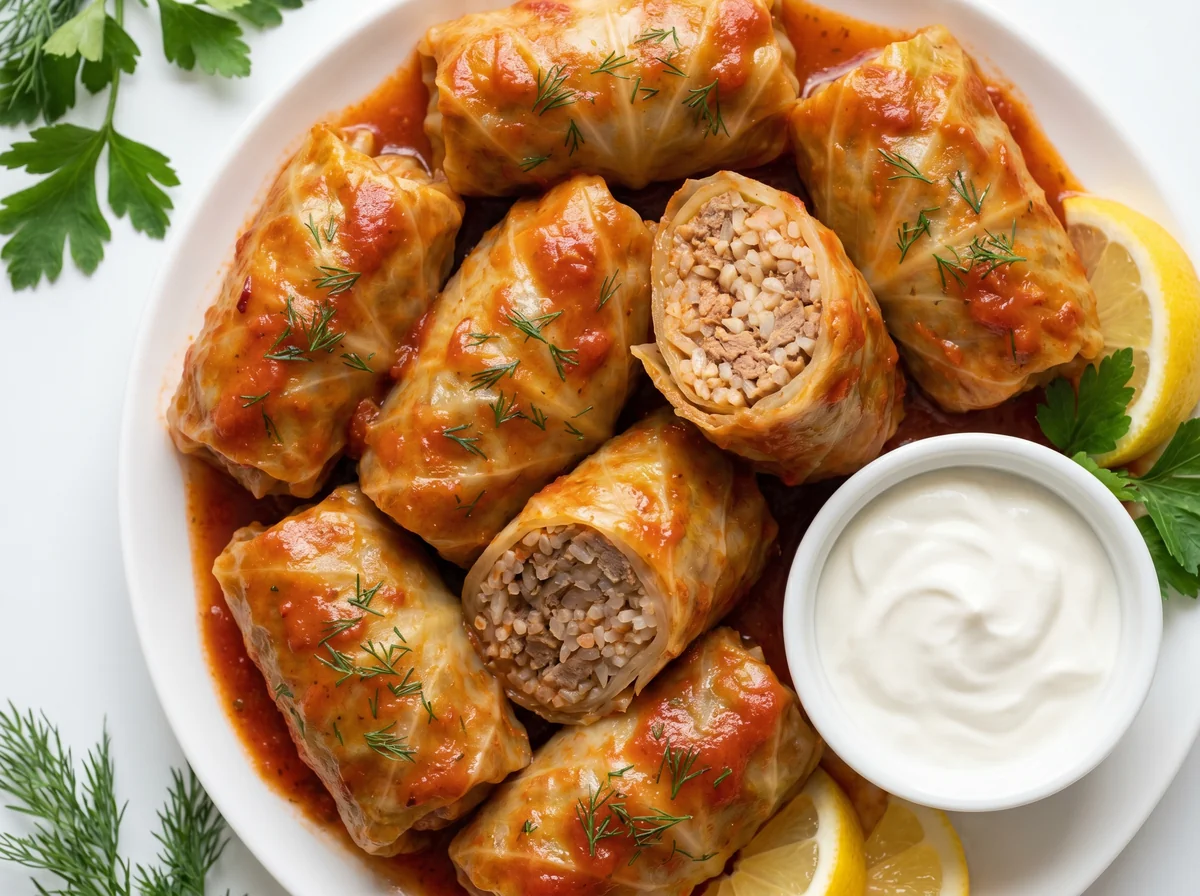
A beloved Levantine mahashi — thin cabbage leaves rolled around a rice and ground meat filling and cooked in a garlic and lemon broth. Low glycaemic load, rich in protein and free from common allergens.
Stuffed cabbage rolls are one of the most beloved mahashi on Levantine tables, especially in winter when cabbage is in season. Thin leaves are rolled around a rice and meat filling and cooked in a garlic and lemon broth, producing slender refreshingly tangy rolls.
Every household has its flavour secret: some use plenty of garlic, others add mint or coriander. This is a dish that gathers families around the rolling of tiny rolls — a complete meal in one pot.
Preparation Steps
Blanch the cabbage and separate the leaves one by one
Take the large head of white cabbage and cut out its tough core from the base with the tip of a sharp knife in a cone shape, loosening the leaves from the stem. Bring a large pot of water to a boil and submerge the whole head for a few minutes until the outer leaves soften and change colour slightly. Hold the head with tongs and gently peel the soft outermost leaf from its edge — it will detach cleanly without tearing — then return the remaining head to the boiling water to soften the next layer. Repeat until all the usable leaves are removed. A warm, pliable leaf bends without cracking; pulling leaves while raw would tear them.
Remove the thick central rib from each leaf
Lay each leaf flat on a cutting board and cut out the thick white rib in the centre with a angled knife (shave it down or cut a small triangle at its base) — it is the rigid part that makes rolling difficult. Very large leaves can be halved at the rib so the rolls come out a similar size. The thinner the base of the leaf, the easier it is to roll and the more even the cooking.
Wash the rice and mix the raw filling
Rinse the short-grain Egyptian rice under cold water, rubbing gently until the water runs clear of starch, then drain well. In a bowl, combine the drained rice with the 300 g of lean ground meat and season with half a teaspoon of the baharat (Gulf spice blend), allspice and salt mixture, plus a tablespoon of oil and a pinch of black pepper. Mix with your fingertips until combined. Leave it raw — it cooks inside the rolls. Do not overload on rice as it doubles in size during cooking and will burst the rolls open.
Roll the filling into thin cylinders
Place a leaf with its trimmed rib facing you, and spread a moderate spoonful of filling in a line at the near edge. Fold the two sides in slightly, then roll into a loose cylinder — not too tightly wound — leaving room for the rice to expand. Do not overfill. Thin, uniform rolls are tastier in appearance and cook more evenly than fat stuffed ones.
Line the pot and pack the rolls tightly
Peel the garlic cloves and leave them whole. Line the base of the pot with spare cabbage leaves, tomato slices or bones — they prevent the rolls from sticking and burning and add flavour to the broth. Pack the cabbage rolls tightly in alternating-direction layers, and tuck the garlic cloves between them here and there. Close packing supports the rolls against each other so they do not unravel during the boil.
Pour the lemon broth and cook over low heat
Squeeze both lemons and mix their juice with water or stock and a pinch of salt, then pour over the rolls until they are completely submerged. Place a heavy inverted plate on top of the stack to keep the rolls in place during cooking. Cover the pot and cook over low heat for about 40 to 45 minutes until the rice is cooked, the cabbage is tender and most of the liquid has been absorbed. If the broth dries up before the rice is done, add a little hot water — the rice needs sufficient moisture to cook inside the roll.
Add the mint, rest the pot and serve
Towards the end of cooking, rub the dried mint between your palms over the pot to release its fragrance, or brown some garlic in a little oil with the mint and pour it over the rolls for a deeper aroma. Turn off the heat and leave the pot to rest for five minutes to firm up, then either turn out onto a serving platter or lift the rolls neatly with a spoon. The brightness of lemon with garlic and mint is the hallmark Levantine flavour that makes these rolls distinctive.
Blood Sugar Impact
The glycemic index (GI) measures how quickly a food raises blood sugar, while the glycemic load (GL) measures how much a full serving raises it. Together they give the complete picture.
Glycemic Index
GI
71High
Low0–55Medium56–69High70+
A low value (≤55) means a gradual rise in blood sugar — the most suitable range for diabetes and insulin resistance.
Glycemic Load
GL
21High
Low0–10Medium11–19High20+
Glycemic load reflects the impact of the full serving. To lower it: take half a serving, or pair the recipe with a source of protein and fiber.
Nutritional Information
Per ServingMakes 5 servings · one serving is about 120 g of raw ingredients
Calories337 kcal17%of Daily Value*
Protein13 g26%of Daily Value*
Carbohydrates31 g11%of Daily Value*
Fat18 g23%of Daily Value*
Fiber1 g4%of Daily Value*
Sodium127 mg6%of Daily Value*
Potassium232 mg5%of Daily Value*
Phosphorus141 mg11%of Daily Value*
* Percent Daily Values are based on a 2,000-calorie diet per FDA food-label reference values — your daily needs may be higher or lower. Values are derived from the recipe's ingredients via the USDA database.
Troubleshooting
The most common problems when preparing Stuffed Cabbage Rolls, and how to fix them:
Rolls unravelled during cooking
The rolling was loose, the packing was not tight enough, or there was not enough weight. Roll with moderate firmness, pack the rolls tightly in layers, and place a heavy plate on top to keep them in place during the boil.
Rice still raw when cooking is done
Not enough liquid or too short a cooking time. Make sure the liquid covers the rolls, cook over low heat for the full time (40 to 45 minutes), and add hot water if the broth dries up before the rice is cooked.
Rolls burst open and rice escaped
Too much rice in the filling — it expanded and burst the roll. Use a moderate amount of filling (rice doubles in size), do not overfill the leaf, and roll with moderate firmness that leaves room for expansion.
Cabbage is bitter or has a strong smell
Over-blanched or the head was old. Blanch the leaves only until they soften, and use a fresh cabbage. The lemon and garlic balance any strong smell.
Rolls sticky and stuck to the bottom
The base was not lined. Line the bottom of the pot with cabbage leaves, tomato slices or bones before packing — they prevent sticking and burning and add flavour.
Storage and Make-Ahead
Refrigerator (4°C)
Keep in an airtight container for three days — the flavour improves the next day. Reheat over low heat with a splash of water or in a covered oven dish.
Freezer (-18°C)
Freeze cooked rolls for two months in an airtight container. You can also freeze the raw packed rolls and cook them later. Thaw in the fridge and reheat gently.
Advance preparation
Blanch the leaves, roll the rolls and pack them in the pot in advance, then refrigerate. Cook just before serving. The rolling takes time, so doing it in advance is a great help.
Food safety
Cook the meat in the filling through completely inside the rolls, and do not leave the dish out of the fridge for more than two hours.
Tested Ingredient Substitutions
Original Ingredient
Tested Substitute
Ratio
Flavor Difference
Rice
Mix rice with coarse bulgur wheat
Half and half
Higher fibre and lower glycaemic load with a nuttier flavour
Ground meat
Vegetarian filling (rice, tomato and parsley)
To amount
A refreshing plant-based fasting version, cooked in olive oil and lemon
Beef
Ground lamb
Same weight
Lamb has a richer flavour — choose lean for a lighter result
How Much Does It Make? Scaling Guide
Servings
Cabbage
Rice
Meat
3 (half recipe)
Half a head
½ cup
150 g
5 (base recipe)
1 large head
1 cup
300 g
10 (large family)
2 heads
2 cups
600 g
EEINA Nutrition Tip
Stuffed cabbage is one of the lightest mahashi: cabbage is low in calories and high in fibre, and the filling is moderate in rice, so the glycaemic load is low. To make it even lighter: use lean meat and moderate rice (or mix it with bulgur wheat to raise the fibre), and increase the garlic and lemon for flavour rather than fat. A balanced, filling meal for those watching their weight.
Add This Recipe to Your Plan
The EEINA app saves your favorite recipes, calculates them from their real ingredients, and shows your daily numbers toward your goal. Try it free now.
How do I separate the cabbage leaves without tearing them?
Remove the core with a knife, submerge the whole head in boiling water, then peel the soft outer leaves off one by one and return the rest to the water to soften. A pliable warm leaf separates and rolls easily.
Why do the rolls burst open?
Usually because there is too much rice (it doubles in size and bursts the roll) or the rolling was too loose. Use a moderate filling, roll with moderate firmness, and pack them tightly with weight on top.
Is stuffed cabbage healthy?
Yes — one of the lightest mahashi: cabbage is low in calories and high in fibre, and the filling is moderate. Make it even lighter with lean meat and rice mixed with bulgur, and it becomes a balanced meal for those watching their weight.
What is the secret of the Levantine flavour?
Plenty of garlic, lemon juice and dried mint. The rolls are cooked in a garlic and lemon broth, and mint is added at the end — they come out tangy and bright with a distinctive garlic note.