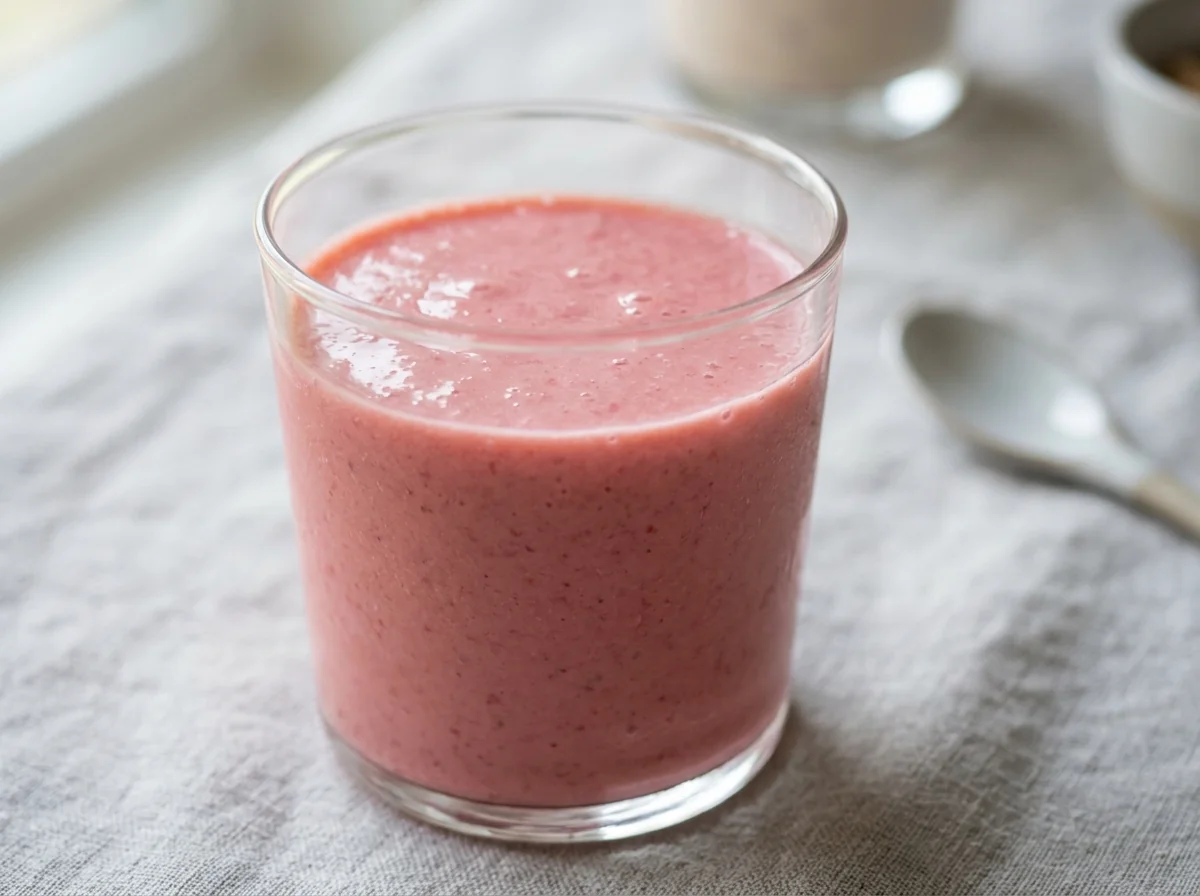
The most famous duo in the smoothie world: strawberries and banana with yogurt and cold milk — four ingredients and no added sugar at all. A ripe banana handles the sweetness while the strawberries bring the flavor and color, making a family drink children love, ready in ten minutes.
Strawberry and banana are a duo that never disappoints: the strawberries' light tartness is balanced by the banana's sweetness and creamy body, and the yogurt and milk bring them together in one glass.
The recipe circulating on Arabic cooking sites adds no sugar in the first place, and that is exactly what we kept — a ripe banana is a complete natural sweetener. A drink served to children after school or as a quick breakfast on rushed mornings.
Preparation Steps
Prepare the fruit
Wash the strawberries well, remove the green tops, and halve them; peel the bananas and cut them into slices. The riper the banana — brown spots and all — the higher the sweetness without any sugar.
Blend the ingredients
Place the strawberries, banana, yogurt, and cold milk in an electric blender and blend on high speed for about a minute until you get a smooth, even mixture with a light pink color.
Adjust the texture
If you want it thicker, add half a banana or a few ice cubes and blend again; if you want it lighter, add a little more cold milk.
Serve immediately
Pour the smoothie into four glasses and serve immediately while cold — standing separates its layers and changes its color.
Blood Sugar Impact
The glycemic index (GI) measures how quickly a food raises blood sugar, while the glycemic load (GL) measures how much a full serving raises it. Together they give the complete picture.
Glycemic Index
GI
45Low
Low0–55Medium56–69High70+
A low value (≤55) means a gradual rise in blood sugar — the most suitable range for diabetes and insulin resistance.
Glycemic Load
GL
9Low
Low0–10Medium11–19High20+
Glycemic load reflects the impact of the full serving. To lower it: take half a serving, or pair the recipe with a source of protein and fiber.
Nutritional Information
Per ServingMakes 4 servings · one serving is about 255 g of raw ingredients
Calories158 kcal8%of Daily Value*
Protein6 g12%of Daily Value*
Carbohydrates23 g8%of Daily Value*
Fat5 g6%of Daily Value*
Fiber2 g7%of Daily Value*
Sodium73 mg3%of Daily Value*
Potassium467 mg10%of Daily Value*
Phosphorus164 mg13%of Daily Value*
* Percent Daily Values are based on a 2,000-calorie diet per FDA food-label reference values — your daily needs may be higher or lower. Values are derived from the recipe's ingredients via the USDA database.
Troubleshooting
The most common problems when preparing Strawberry Banana Yogurt Smoothie, and how to fix them:
The taste is tart or flat
The strawberries or banana were underripe. Choose bananas with brown spots and red, aromatic strawberries, and if the taste is still thin, add a pitted date and blend.
The texture is thin and watery
Reduce the milk to 400 ml or use frozen fruit instead of fresh — it gives a cold thickness without ice diluting the flavor.
The color turned brown after a while
Natural banana oxidation on standing. Make the smoothie right before serving, and a small squeeze of lemon in the blender slows the change with hardly any effect on the taste.
Strawberry seeds are visible in the texture
Perfectly normal and harmless. If it bothers you, pass the mixture through a fine strainer after blending, at a small cost in fiber.
Storage and Make-Ahead
Serve immediately
Best drunk right after blending, before its layers separate and the banana oxidizes.
Refrigerator (4°C)
Keeps in a sealed container for up to 24 hours; shake well before drinking. Its color may drift slightly brown with no harm.
Freezing
Freeze it in ice-cube trays and re-blend the cubes later with a splash of milk, or freeze the chopped fruit ready for fresh blending.
Tested Ingredient Substitutions
Original Ingredient
Tested Substitute
Ratio
Flavor Difference
No sweetener (the default)
A pitted date
One date for the whole recipe
For those who want more sweetness; sweetness from a whole fruit with its fiber instead of white sugar — though a ripe banana usually makes it unnecessary.
Milk
Unsweetened plant milk (oat or almond)
1:1
A lactose-free alternative; check the label for allergens, and note the yogurt remains dairy unless swapped as well.
Plain yogurt
Greek yogurt
1/2 cup (120 g)
Higher protein and a thicker texture that brings the smoothie closer to a milkshake.
Fresh strawberries
Frozen strawberries
1:1
Available year-round and giving a colder, thicker texture, with nearly the same nutritional value.
How Much Does It Make? Scaling Guide
Servings
Strawberries
Banana
Yogurt
Milk
2 (half recipe)
80 g
1 banana (100 g)
1/3 cup (80 g)
250 ml
4 (recipe)
160 g
2 bananas (200 g)
2/3 cup (160 g)
500 ml
8 (family gathering)
320 g
4 bananas (400 g)
1 1/3 cups (320 g)
1 liter
EEINA Nutrition Tip
Keep very ripe bananas sliced in the freezer; they give the smoothie a cold, ice-cream-like thickness without ice or sugar. All the glass's sweetness comes from the fruit's natural sugar, so moderation still applies: one glass per sitting is enough, especially for anyone watching their blood sugar.
Add This Recipe to Your Plan
The EEINA app saves your favorite recipes, calculates them from their real ingredients, and shows your daily numbers toward your goal. Try it free now.
No; the original recipe itself has no sugar, and a ripe banana sweetens the whole glass. If you want more sweetness, a date in the blender is better than a spoon of sugar.
Is it suitable for children?
Yes — with its color and flavor it is one of their favorite drinks, and it has no added sugar. It works as an after-school drink or with a weekend breakfast.
Can I use frozen fruit?
Yes, frozen strawberries and banana give a colder, thicker smoothie without ice, and they are a practical choice outside strawberry season.
Does it work as breakfast?
A glass of it is a light breakfast with fruit plus the protein of the yogurt and milk. It becomes more complete with a spoon of oats or chia seeds in the blender for longer-lasting fullness.