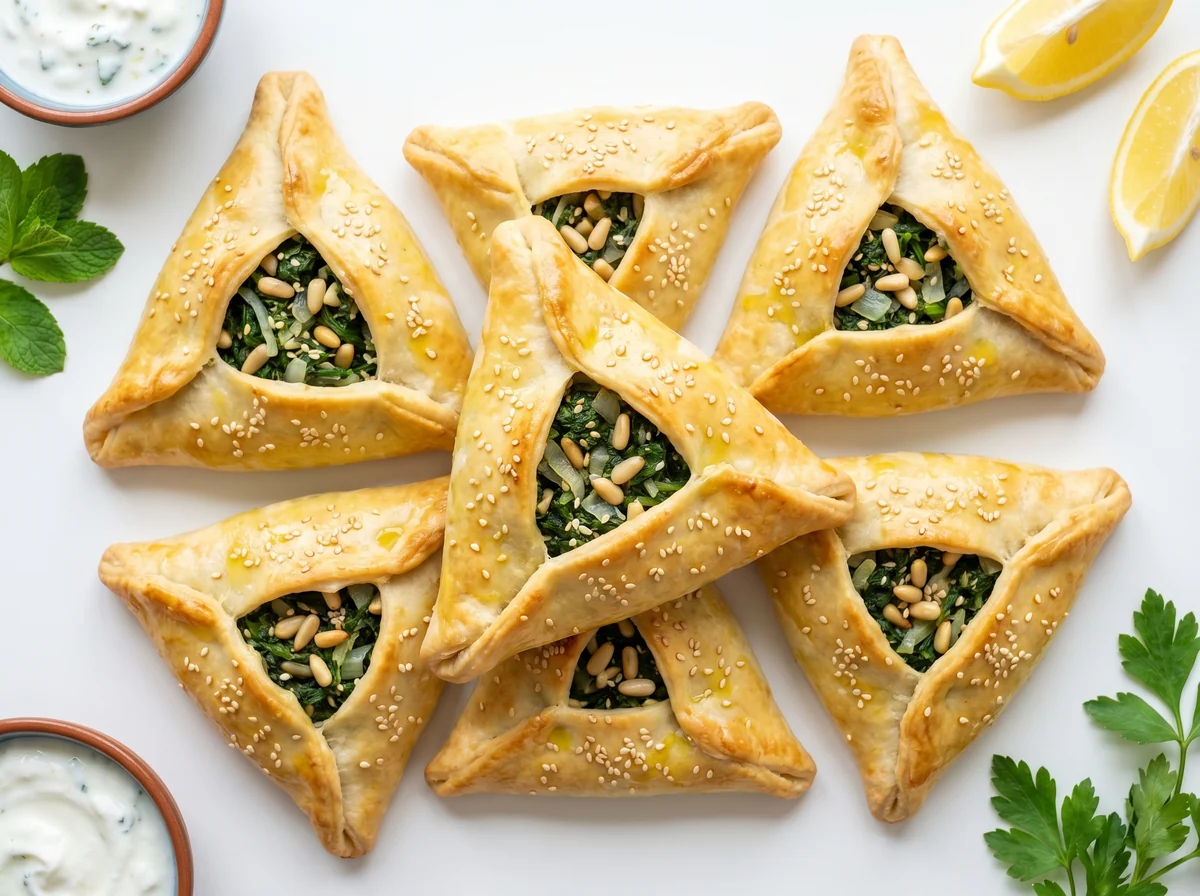
Levantine triangular pastries — thin dough filled with spinach seasoned with onion, sumac (tart purple spice), pomegranate molasses and lemon juice, folded into triangles and baked. Light, vegan, rich in iron from spinach, and contains gluten.
Spinach fatayer are the star of the Levantine mezze table and the traditional fasting pastry for Christian communities — they are entirely vegan. Their distinctive triangular shape, sealed on three sides, is their hallmark, and the filling of spinach with onion, sumac (tart purple spice) and pomegranate molasses gives a bright, tangy flavour.
They spread across Lebanon, Syria, Palestine and Jordan as a breakfast, snack and hospitality dish. The biggest secret is squeezing the spinach dry so the pastry stays sealed — that is what sets the skilled maker apart.
Preparation Steps
Make the dough
Dissolve the yeast and sugar in the warm water and leave for five minutes until foamy, then add to the flour and salt along with the olive oil. Knead for about eight minutes until a soft, smooth dough forms. Cover and leave to prove in a warm place for an hour until doubled in size.
Salt and squeeze the spinach
The most important step for a non-watery filling: chop the spinach, sprinkle it with salt and rub it with your hands, then leave for ten minutes and squeeze firmly with your hands or a piece of muslin until all the water is out. Spinach releases a lot of liquid — excess water will wet the dough and open the pastries in the oven.
Season the filling
In a bowl, mix the squeezed spinach with the finely chopped onion (also squeezed of its liquid with a pinch of salt), sumac (tart purple spice), pomegranate molasses, lemon juice, olive oil and pepper. Taste and adjust: the filling should be distinctly tart from the sumac and lemon. Sumac and pomegranate molasses are the signature flavours of Levantine spinach fatayer.
Roll out and cut rounds
Roll the proved dough thinly on a floured surface and cut it into circles with a cup or cutter (about 10 cm). Thin, medium-sized rounds give neat triangles that are easy to fold.
Fill and fold the triangles
Place a spoonful of filling in the centre of each round (drained of any collected liquid). Fold the circle from three sides towards the centre to form a triangle and press the edges firmly together, wetting them with a little water if needed. A tight seal prevents the pastry from opening and the filling from leaking.
Bake and serve
Arrange the triangles on a greased tray and brush the tops with a little olive oil. Bake in a 200°C oven for about 15 to 20 minutes until golden and cooked through on the base. Serve warm or at room temperature as a breakfast, snack or part of a mezze spread.
Blood Sugar Impact
The glycemic index (GI) measures how quickly a food raises blood sugar, while the glycemic load (GL) measures how much a full serving raises it. Together they give the complete picture.
Glycemic Index
GI
66Medium
Low0–55Medium56–69High70+
A low value (≤55) means a gradual rise in blood sugar — the most suitable range for diabetes and insulin resistance.
Glycemic Load
GL
36High
Low0–10Medium11–19High20+
Glycemic load reflects the impact of the full serving. To lower it: take half a serving, or pair the recipe with a source of protein and fiber.
Nutritional Information
Per ServingMakes 6 servings · one serving is about 255 g of raw ingredients
Calories417 kcal21%of Daily Value*
Protein10 g20%of Daily Value*
Carbohydrates61 g22%of Daily Value*
Fat15 g19%of Daily Value*
Fiber6 g21%of Daily Value*
Sodium71 mg3%of Daily Value*
* Percent Daily Values are based on a 2,000-calorie diet per FDA food-label reference values — your daily needs may be higher or lower. Values are derived from the recipe's ingredients via the USDA database.
Troubleshooting
The most common problems when preparing Spinach Fatayer, and how to fix them:
Fatayer split open in the oven
The filling was watery or the sealing was weak. Squeeze the spinach and onion thoroughly from their liquid, and press the triangle edges firmly together, wetting them with water. Excess water and weak sealing are the cause of opening.
Filling is runny and leaking
The spinach was not squeezed enough. Spinach releases a lot of water — salt it, leave it, then squeeze it firmly until dry. Also squeeze the onion, and drain any liquid that collects before filling.
Flavour flat and not tangy
Not enough sumac (tart purple spice), pomegranate molasses and lemon. Levantine filling is bright and tart — do not be stingy with the acidity. Taste and adjust before filling.
Dough hard after baking
Rolled too thick or baked too long. Roll it thinly and bake only until the base is cooked and the top just barely golden, brushing the top with oil helps keep it tender.
Onion raw and sharp-tasting
Chop the onion very finely, salt it and squeeze it before mixing. The salt and squeezing mellow its sharpness and draw out the liquid — and it cooks through during baking.
Storage and Make-Ahead
Refrigerator (4°C)
Baked fatayer keep in an airtight container for three days. Eat cold or warm in the oven for a few minutes. The filling alone keeps for two days.
Freezer (-18°C)
Freeze baked fatayer for two months, or freeze shaped uncooked ones on a tray then bag them and bake from frozen. Ideal for preparing a mezze batch in advance.
Advance preparation
Prepare the dough and filling in advance, then shape and bake fresh. Squeeze the filling on the day of baking for the best texture, and refrigerate the proved dough.
Room temperature
Keep in an airtight container at room temperature for one day. They are often eaten at room temperature as part of a mezze spread and do not always need reheating.
Tested Ingredient Substitutions
Original Ingredient
Tested Substitute
Ratio
Flavor Difference
Spinach
Swiss chard, mallow or chicory
Same weight
Other leafy greens work well for the filling in the same way — squeeze them all dry
White flour
Mix in a third whole-wheat flour
Same amount with a little more water
Higher fibre and lower glycaemic load
Pomegranate molasses
Extra lemon juice
To taste
Provides the acidity, but pomegranate molasses adds a rich sweet-sour depth
How Much Does It Make? Scaling Guide
Servings
Flour
Spinach
Onion
Sumac
3 (half recipe)
1 1/2 cups
250 g
1 onion
1 tablespoon
6 (base)
3 cups
500 g
2 onions
2 tablespoons
12 (large family)
6 cups
1 kg
4 onions
4 tablespoons
EEINA Nutrition Tip
Spinach fatayer are among the lightest and most nutritious pastries: spinach is rich in iron, folate and fibre, the filling is plant-based and low in fat, and baking (not frying) keeps them moderate. For a lighter version: replace a third of the flour with whole-wheat flour and brush with a small amount of olive oil. A smart breakfast or snack choice, especially with their abundance of vegetables.
Add This Recipe to Your Plan
The EEINA app saves your favorite recipes, calculates them from their real ingredients, and shows your daily numbers toward your goal. Try it free now.
Because of a watery filling or weak sealing. Squeeze the spinach and onion well, and seal the triangle edges firmly. Excess water is the number-one cause of opening.
How do I squeeze the spinach correctly?
Chop it, salt it and leave for ten minutes for the liquid to release, then squeeze firmly with your hands or muslin until completely dry. This step is the secret to a firm, non-watery pastry.
Are spinach fatayer vegan?
Yes, completely vegan if made with olive oil — they are one of the traditional fasting dishes. The filling is spinach, onion, sumac and olive oil with no animal products.
What is the difference between them and cheese or meat fatayer?
Only the filling. Spinach fatayer are vegan and tangy with sumac (tart purple spice), shaped as triangles. Cheese and meat varieties have their own fillings and different closing shapes. Spinach is the lightest and most vegetable-forward.