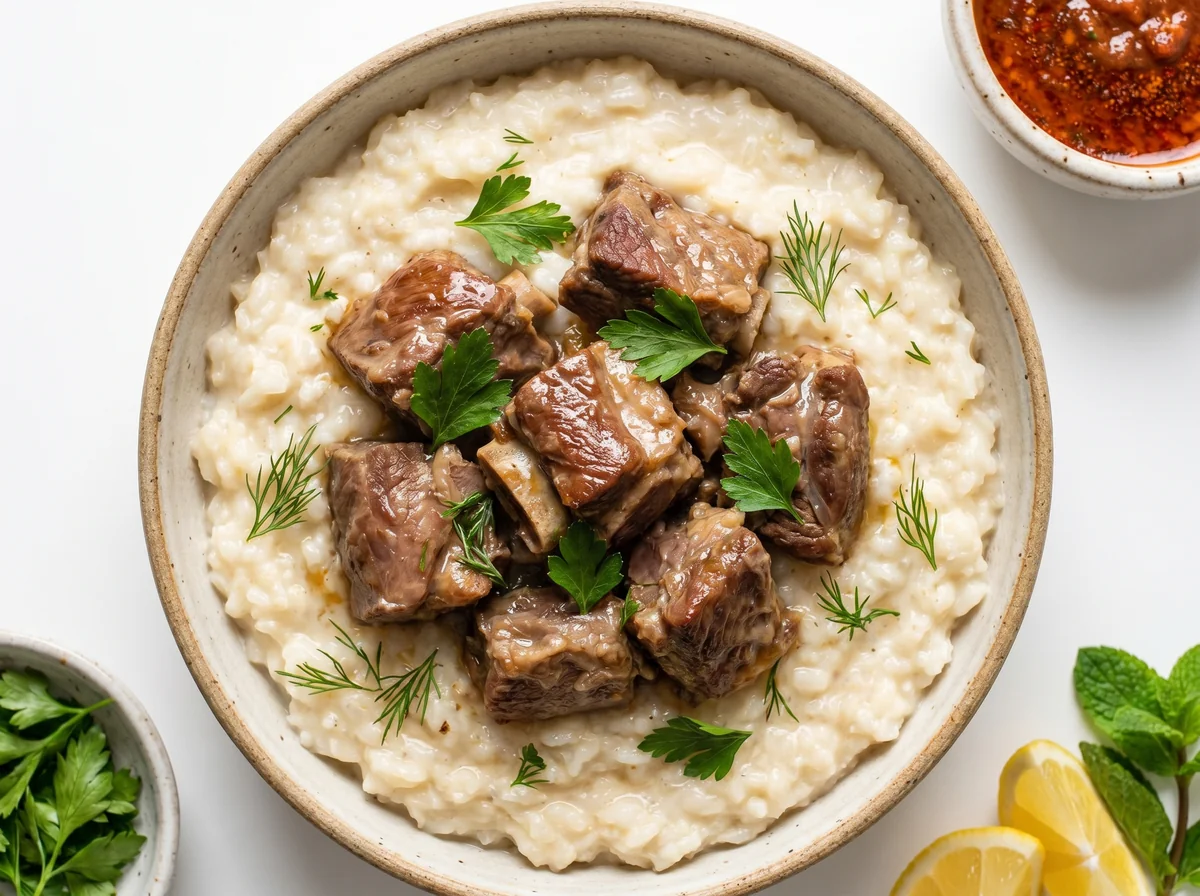
A creamy Hijazi classic from Taif — rice cooked in milk and lamb broth until silky-soft, crowned with tender lamb. EEINA's version uses low-fat milk and lean lamb, keeping Saleeg's signature softness and delicate flavour.
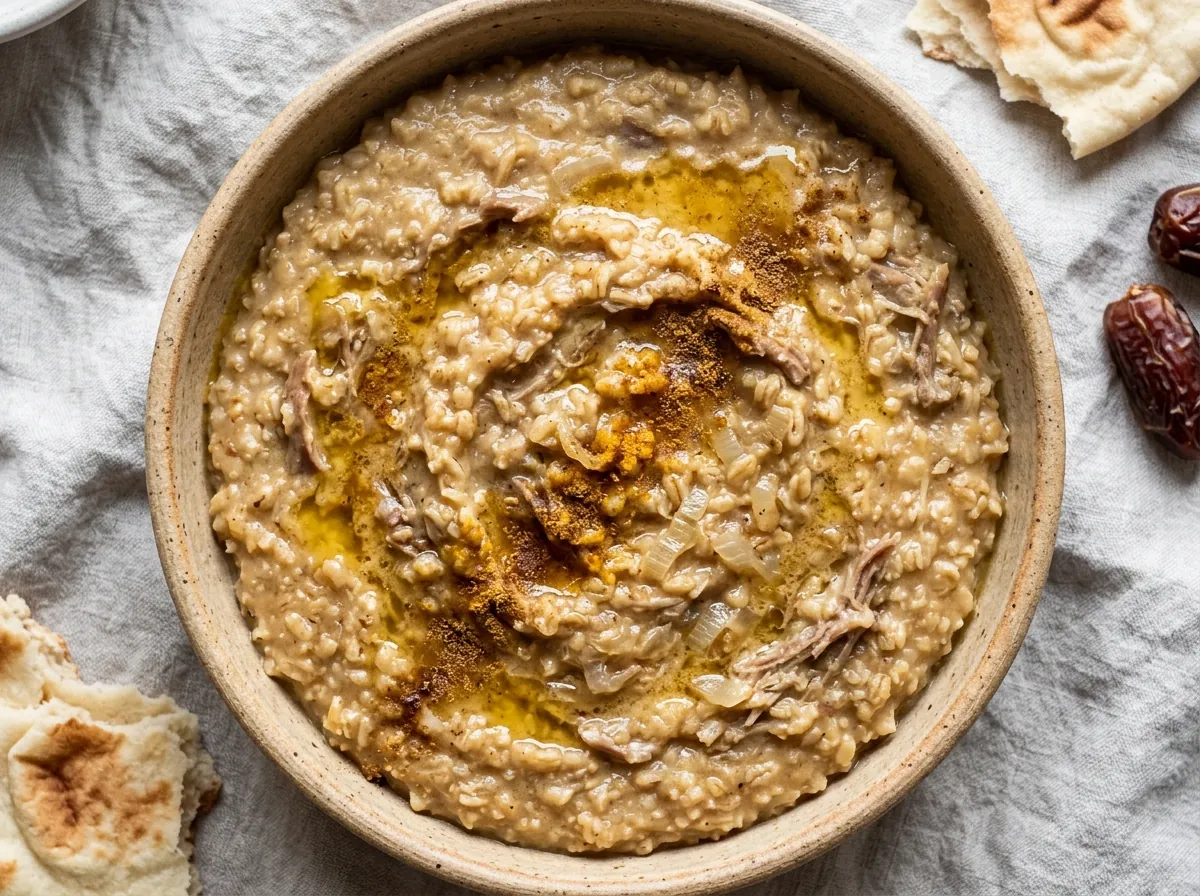
Saleeg is the venerable dish of Taif and the Hijaz, distinguished by rice cooked in milk and lamb broth until it becomes creamy-soft, close to a porridge, then crowned with tender meat.
It differs fundamentally from Kabsa (Saudi spiced rice dish) and Mandi (Yemeni-Saudi smoked meat and rice) in its creamy texture and the absence of tomatoes and hot spices — it is delicate in flavour and balanced by chilli sauce. EEINA's version uses low-fat milk and lean lamb, keeping Saleeg's softness and flavour with a lighter load.
Preparation Steps
Cook the lamb
Place the lamb pieces in a pot with the onion, cardamom, cloves, and a pinch of salt, and cover with hot water. Cook covered over low heat for 60 to 70 minutes until the lamb is tender, skimming the foam at the start for a clear broth.
Strain the broth
Lift out the lamb pieces and keep them warm. Strain the broth and skim off the floating fat. This clear broth is the foundation of the Saleeg's flavour.
Cook the rice in the broth
Wash the short-grain rice thoroughly and add it to the hot strained broth in the pot. Cook over low heat for about 15 minutes until it softens and begins to absorb the broth. Short-grain rice is the secret to the creamy texture.
Add the milk
Add the milk gradually with constant stirring, and allow the rice to cook over very low heat for 10 to 15 minutes as it absorbs the milk and becomes smooth and creamy. Constant stirring prevents sticking and gives the silky texture.
Adjust the consistency
Continue stirring until the Saleeg becomes soft and cohesive, close to a porridge consistency, and adjust the salt. If too thick, add a little hot milk — Saleeg is served smooth, not dry.
Serve
Spread the Saleeg on a serving platter and place the tender lamb pieces in the centre. Drizzle a little melted ghee over the top if desired. Serve hot with Saudi Daqoos sauce or hot chilli sauce, which balances its gentle creaminess.
Blood Sugar Impact
The glycemic index (GI) measures how quickly a food raises blood sugar, while the glycemic load (GL) measures how much a full serving raises it. Together they give the complete picture.
Glycemic Index
GI
64Medium
Low0–55Medium56–69High70+
A low value (≤55) means a gradual rise in blood sugar — the most suitable range for diabetes and insulin resistance.
Glycemic Load
GL
31High
Low0–10Medium11–19High20+
Glycemic load reflects the impact of the full serving. To lower it: take half a serving, or pair the recipe with a source of protein and fiber.
Nutritional Information
Per ServingMakes 5 servings · one serving is about 530 g of raw ingredients
Calories548 kcal27%of Daily Value*
Protein32 g64%of Daily Value*
Carbohydrates50 g18%of Daily Value*
Fat24 g31%of Daily Value*
Fiber1 g4%of Daily Value*
Sodium546 mg24%of Daily Value*
Potassium723 mg15%of Daily Value*
Phosphorus438 mg35%of Daily Value*
* Percent Daily Values are based on a 2,000-calorie diet per FDA food-label reference values — your daily needs may be higher or lower. Values are derived from the recipe's ingredients via the USDA database.
Troubleshooting
The most common problems when preparing Lamb Saleeg — Creamy Milk Rice with Lamb, and how to fix them:
Saleeg is clumpy or too sticky
Insufficient stirring or too much rice. Stir constantly while adding the milk, and add hot milk to loosen the consistency if it becomes too thick.
Dry texture, not creamy
Wrong rice variety or not enough milk. Use short-grain rice and add the milk gradually until the desired smooth consistency.
Cloudy broth
Foam was not skimmed. Skim the foam rising to the surface at the start of cooking the lamb for a clear broth and a bright white Saleeg.
Saleeg stuck to the base
Heat too high or stirring neglected. Cook over the lowest possible heat with constant stirring, and use a heavy-bottomed pot.
Flavour too bland
Saleeg is naturally delicate. Balance it at the table with hot chilli sauce or Saudi Daqoos sauce — they are its traditional companions.
Storage and Make-Ahead
Refrigerator (4°C)
Two days in an airtight container. It thickens on chilling; reheat with a little milk to restore its softness.
Freezer (-18°C)
Not recommended — rice cooked in milk changes texture after freezing. Best prepared fresh.
Advance preparation
Cook the lamb and broth in advance; cook the Saleeg rice with milk at serving time for the best creaminess.
Reheating
Over low heat with a little hot milk and gentle stirring until smooth. Do not leave cooked food outside the refrigerator for more than two hours [2].
Tested Ingredient Substitutions
Original Ingredient
Tested Substitute
Ratio
Flavor Difference
Lamb
Skinless chicken
Same weight
The more popular chicken Saleeg version; cooks faster in about 35 minutes
Full-fat cow's milk
Low-fat milk
Same quantity
Reduces fat while maintaining the creamy softness
Short-grain Egyptian rice
Basmati rice
Same weight
Slightly less creamy; stir more to compensate
Mastic
A drop of rose water
A little
A gentle fragrant alternative when mastic is unavailable
Ghee for serving
Omit it
-
Saleeg is delicious without it; omitting reduces fat and calories
How Much Does It Make? Scaling Guide
Servings
Meat
Rice
Milk
Pot
2 (single × 2)
240 g
100 g
2 cups
small pot
5 (base)
600 g
240 g
4 cups
wide pot
8 (family)
1 kg
400 g
6.5 cups
large pot
12 (banquet)
1.5 kg
600 g
10 cups
banquet pot
EEINA Nutrition Tip
Use low-fat milk and lean lamb to reduce saturated fat without sacrificing the dish's creaminess. Saleeg is a delicate, satisfying dish, but the rice and milk raise the carbohydrates — treat it as an occasional meal and serve with chilli sauce and a green salad to balance the plate.
Add This Recipe to Your Plan
The EEINA app saves your favorite recipes, calculates them from their real ingredients, and shows your daily numbers toward your goal. Try it free now.
The milk gives Saleeg its creamy, silky texture, its white colour, and its distinctive delicate flavour — what sets it apart from all other rice and meat dishes in the Hijazi kitchen.
What is the difference between Saleeg and Kabsa?
Saleeg is creamy and white, cooked in milk with no tomatoes or hot spices, and has a texture close to porridge with a delicate flavour. Kabsa (Saudi spiced rice dish) has firm, separate grains, spiced with tomatoes and loomi (dried black lime). They are entirely different dishes.
Is Saleeg suitable for people with diabetes?
The rice and milk raise the carbohydrates, so treat it as an occasional meal. Use low-fat milk, control the portion, and serve with chilli sauce and a green salad to balance the meal.
Which rice is best for Saleeg?
Short-grain Egyptian rice is ideal because it releases its starch and gives the creamy texture. If unavailable, use basmati with extra stirring to compensate for the creaminess.
What is Saleeg served with?
Served hot with hot chilli sauce or Saudi Daqoos sauce, which balance its creaminess and delicate flavour, and sometimes with a drizzle of melted ghee on top in the Taif style.
Sources: USDA · University of Sydney · Gulf GSO · Our methodology · Updated on