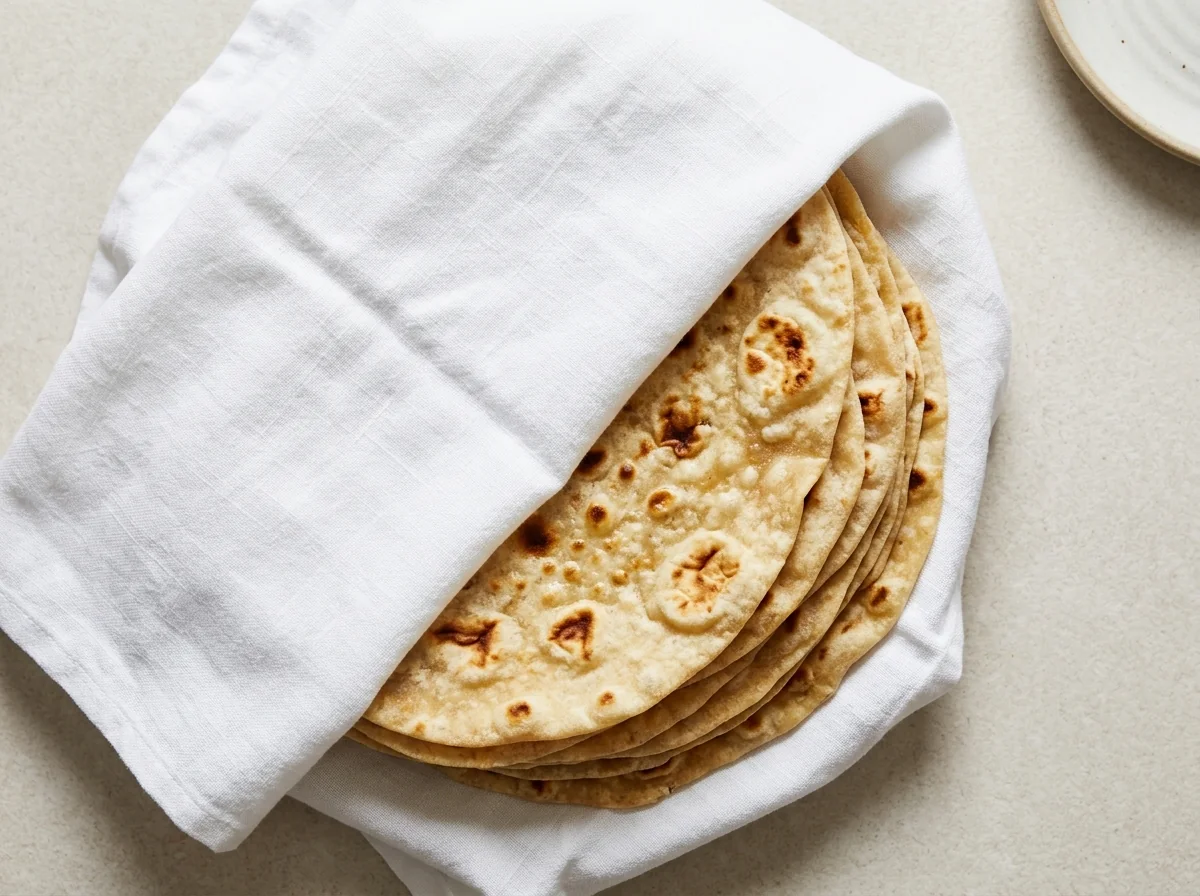
A Levantine yeasted dough divided into six balls, brushed with oil, rested, rolled paper-thin, and baked on a hot saj for a few seconds per side — then covered in cotton cloth to stay soft.
Saj bread is so thin you can see a hand through it, and its secret is the meeting of two opposites: a very high heat and a very short time.
Twenty seconds, no more — the thin loaf is not cooked but kissed by fire. That is how it comes off soft and rollable; every extra second turns it into a cracker.
Preparation Steps
Knead the dough
Mix the salt and flour thoroughly, then make a well in the center and add the instant yeast, sugar, and water. Knead well until the dough comes together and becomes soft and smooth under your hand.
Divide, oil, and rest
Divide the dough into six equal balls, brush them with oil, and leave them for 30 minutes to double in size and ferment. Brushing with oil prevents the surface from crusting during the rest.
Roll the balls thin
Take each ball one at a time and roll it out on a lightly floured surface until it is as thin as possible. Let it rest briefly while you roll out the others, until all six are done. Be careful not to over-flour the surface — too much flour dries out the bread.
Heat the saj
Heat a saj, skillet, or pan over high heat until very hot — the high heat is what cooks the loaf in seconds before it dries out.
Bake the loaf
Brush the top of the loaf with oil and place the oiled side down on the hot pan. Flip to the other side until golden. Each loaf takes about 20 seconds — no longer.
Cover with cloth
Cover the bread with a cotton cloth as soon as it comes off the heat and leave it in the cloth until serving. The trapped steam is what keeps it soft.
Blood Sugar Impact
The glycemic index (GI) measures how quickly a food raises blood sugar, while the glycemic load (GL) measures how much a full serving raises it. Together they give the complete picture.
Glycemic Index
GI
74High
Low0–55Medium56–69High70+
A low value (≤55) means a gradual rise in blood sugar — the most suitable range for diabetes and insulin resistance.
Glycemic Load
GL
13Medium
Low0–10Medium11–19High20+
Glycemic load reflects the impact of the full serving. To lower it: take half a serving, or pair the recipe with a source of protein and fiber.
Nutritional Information
Per ServingMakes 4 servings · one serving is about 90 g of raw ingredients
Calories331 kcal17%of Daily Value*
Protein3 g6%of Daily Value*
Carbohydrates19 g7%of Daily Value*
Fat28 g36%of Daily Value*
Fiber1 g4%of Daily Value*
Sodium146 mg6%of Daily Value*
Potassium31 mg1%of Daily Value*
Phosphorus29 mg2%of Daily Value*
* Percent Daily Values are based on a 2,000-calorie diet per FDA food-label reference values — your daily needs may be higher or lower. Values are derived from the recipe's ingredients via the USDA database.
Troubleshooting
The most common problems when preparing Saj Bread (Yeasted Flatbread), and how to fix them:
The bread cracks when rolled
It spent too long on the heat or was left uncovered after baking. Stick to the 20 seconds and cover it with the cloth the moment it comes off.
The dough shrinks while rolling
It did not rest enough after dividing. Allow the full 30 minutes, and if it resists, rest it a few more minutes before continuing to roll.
The loaf puffed up like a balloon
The heat was high and the loaf thin and even — this is not a flaw. Press it gently with a clean towel and it deflates into two thin layers.
The dough did not rise
The water was hot and killed the yeast, or cold and made it sluggish, or the yeast was old. Use hand-warm water and check the yeast is in date.
Storage and Make-Ahead
At room temperature
Wrapped in cloth, then in an airtight bag, up to two days — softest on the day it is baked.
Freezer (-18°C)
Separate the loaves with parchment paper and freeze in an airtight bag for up to two months. Reheat directly on the saj without thawing.
Reheating
Seconds on a hot saj, or a spritz of water then warm — the loaf regains its softness.
Raw dough
Keep the oiled and covered balls in the fridge for a day; bring them out 30 minutes before rolling.
Tested Ingredient Substitutions
Original Ingredient
Tested Substitute
Ratio
Flavor Difference
White flour
Half whole-wheat flour
45 g + 45 g
Higher in fiber; needs a little more water and is harder to roll thin.
Sugar
A teaspoon of honey
7 g
Feeds the yeast the same way sugar does and gives a warmer color.
Oil for brushing
A quarter of the amount
27 g
The source is generous with the brushing oil; reducing it cuts the fat considerably and still prevents sticking.
Instant yeast
Quick-rise instant yeast
3 g
Mixes straight into the flour without activation and shortens the proof time.
How Much Does It Make? Scaling Guide
Servings
Flour
Water
Yeast
Oil
2 servings (half amount)
45 g
80 ml
1.5 g
55 g
4 servings (base)
90 g
160 ml
3 g
109 g
8 servings (double)
180 g
320 ml
6 g
218 g
EEINA Nutrition Tip
The cotton cloth is not a tradition but part of the method: the steam trapped underneath keeps the loaf pliable. Bread left uncovered on the counter dries and cracks at the first fold.
Add This Recipe to Your Plan
The EEINA app saves your favorite recipes, calculates them from their real ingredients, and shows your daily numbers toward your goal. Try it free now.
The water-to-flour ratio seems high — is it right?
This is how it appears in the source: two-thirds cup water for three-quarters cup flour. We passed it on as written and did not correct it because a correction needs a citable source, not judgment. Anyone who finds the batter too loose can add flour until it becomes soft and smooth under their hand.
Why half a cup of oil for bread?
The source sets it aside for brushing, not for the dough — brushing the balls and the top of the loaf. Most of it stays on the surface and in the pan, but we have counted the amount as written and have not estimated what is lost.
How is it different from a tortilla?
Tortillas are unleavened and unproofed; this is a leavened bread rested for 30 minutes until doubled. The ingredients and method differ — they are two breads, not two versions.
How many loaves does the recipe make?
The source divides the dough into six balls and sizes the batch for four servings — about a loaf and a half per serving. We passed on its estimate as written and the nutrition values are calculated on that basis.
Is it good for shawarma and wraps?
Yes — it is its most famous use. Its thinness and softness under the cloth are what let it roll without cracking.
Sources: USDA · University of Sydney · Our methodology · Updated on