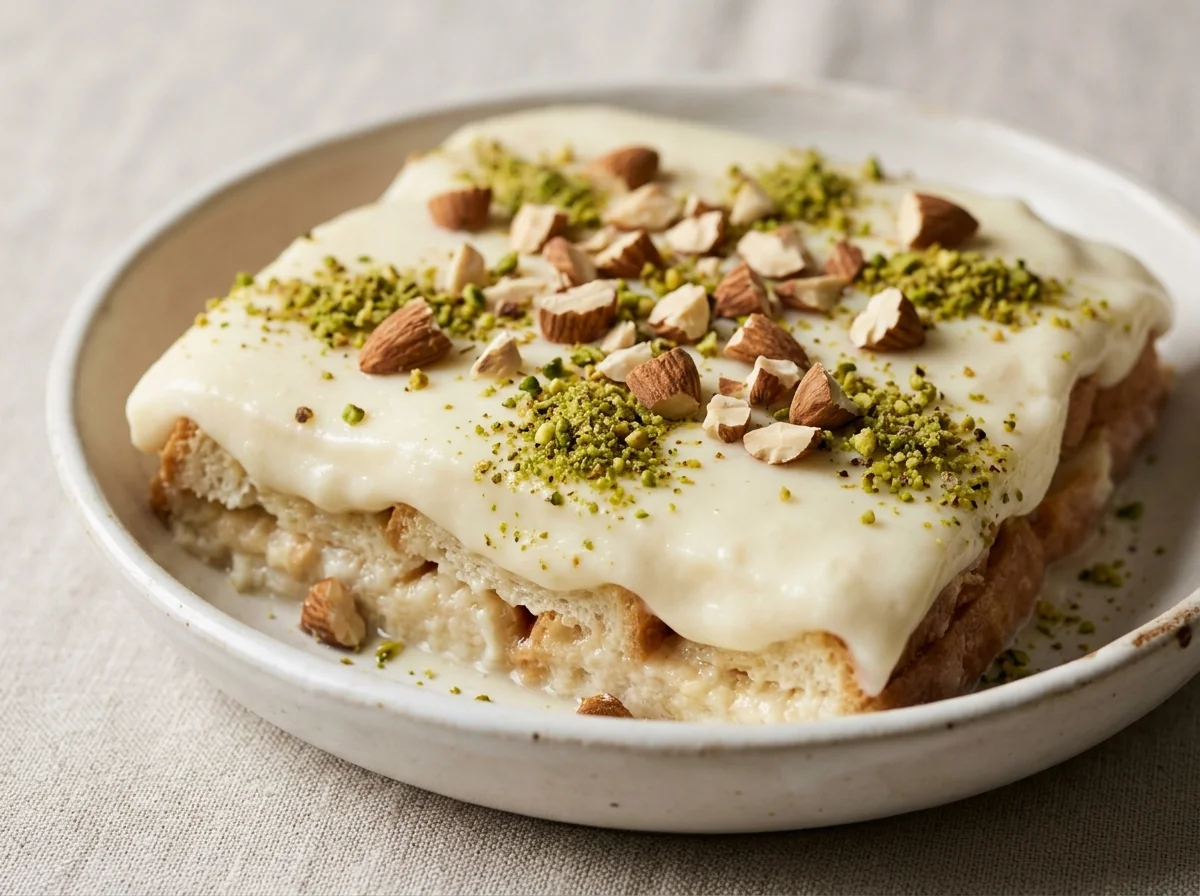
Creamy qeshtaliya (a traditional Levantine dessert) over a layer of toasted bread, decorated with pistachios and almonds. Served cold after hours of chilling.
Qeshtaliya is a traditional Levantine dessert consisting of a creamy layer over a base of biscuits or toast.
Its name is derived from the Spanish word 'Castilla,' since it came to the Levant in the early twentieth century with French and Mediterranean kitchen influences, and spread in Lebanon, Syria, and Palestine until it became one of the most famous hospitality sweets in that region.
Preparation Steps
Crumble the toast
Crumble the toasted bread slices by hand into small pieces and distribute them in the serving dish or in individual small dishes, and level the surface with a spoon so the toast covers the whole bottom.
Prepare the syrup
In a small saucepan, place the sugar, water, and lemon juice. Place it over medium heat and let the mixture boil gently for 6 minutes until it thickens slightly. Then pour it immediately over the crumbled toast so it soaks it and becomes soft.
Dissolve the cornstarch
In another saucepan, place the water, milk powder, cornstarch, orange blossom water, and rose water. Stir gently using a wire whisk until the cornstarch dissolves completely with no lumps, then continue stirring with a wooden spoon.
Cook the qeshtaliya
Place the saucepan over medium heat and continue stirring constantly and gently, and the mixture begins to set and turn into a thick creamy texture within 7 to 8 minutes. Stop stirring as soon as you notice the desired texture, then pour the qeshtaliya directly over the toast layer in the serving dish.
Chill and decorate
Cover the dish and place it in the refrigerator for hours until the qeshtaliya cools and its surface sets. When serving, scatter the broken almonds and the finely ground Aleppo pistachios over the top in a scattered pattern to decorate the dish and add extra flavor.
Blood Sugar Impact
The glycemic index (GI) measures how quickly a food raises blood sugar, while the glycemic load (GL) measures how much a full serving raises it. Together they give the complete picture.
Glycemic Index
GI
65Medium
Low0–55Medium56–69High70+
A low value (≤55) means a gradual rise in blood sugar — the most suitable range for diabetes and insulin resistance.
Glycemic Load
GL
43High
Low0–10Medium11–19High20+
Glycemic load reflects the impact of the full serving. To lower it: take half a serving, or pair the recipe with a source of protein and fiber.
Nutritional Information
Per ServingMakes 6 servings · one serving is about 290 g of raw ingredients
Calories395 kcal20%of Daily Value*
Protein10 g20%of Daily Value*
Carbohydrates68 g25%of Daily Value*
Fat10 g13%of Daily Value*
Fiber2 g7%of Daily Value*
Sodium271 mg12%of Daily Value*
Potassium372 mg8%of Daily Value*
Phosphorus223 mg18%of Daily Value*
* Percent Daily Values are based on a 2,000-calorie diet per FDA food-label reference values — your daily needs may be higher or lower. Values are derived from the recipe's ingredients via the USDA database.
Troubleshooting
The most common problems when preparing Qeshtaliya with Toast, and how to fix them:
The qeshtaliya has lumps
Dissolve the cornstarch in cold water before adding it to the milk, and stir constantly over the heat. Strong stirring at the beginning helps dissolve the cornstarch completely.
The syrup is light and does not pour easily
Leave it to boil for 6 minutes after the first boil, so it thickens and sticks to the toast. And add an extra teaspoon of lemon juice to prevent the sugar from crystallizing.
Storage and Make-Ahead
Refrigerator (4°)
Keep the qeshtaliya in the refrigerator for 3 days in a sealed container. And serve it cold straight from the refrigerator.
Tested Ingredient Substitutions
Original Ingredient
Tested Substitute
Ratio
Flavor Difference
toasted toast
crumbled plain tea biscuits
8 slices of toast to 12 biscuits
Gives a richer flavor and a slightly firmer base.
milk powder
liquid whole milk
1 cup milk powder to 4 cups liquid milk
Omit the added water and the qeshtaliya becomes more creamy.
EEINA Nutrition Tip
Chill the qeshtaliya for full hours before serving, so the mixture sets and the layers appear clearly. And continuous stirring with a wooden spoon prevents the cornstarch from clumping at the bottom.
Add This Recipe to Your Plan
The EEINA app saves your favorite recipes, calculates them from their real ingredients, and shows your daily numbers toward your goal. Try it free now.