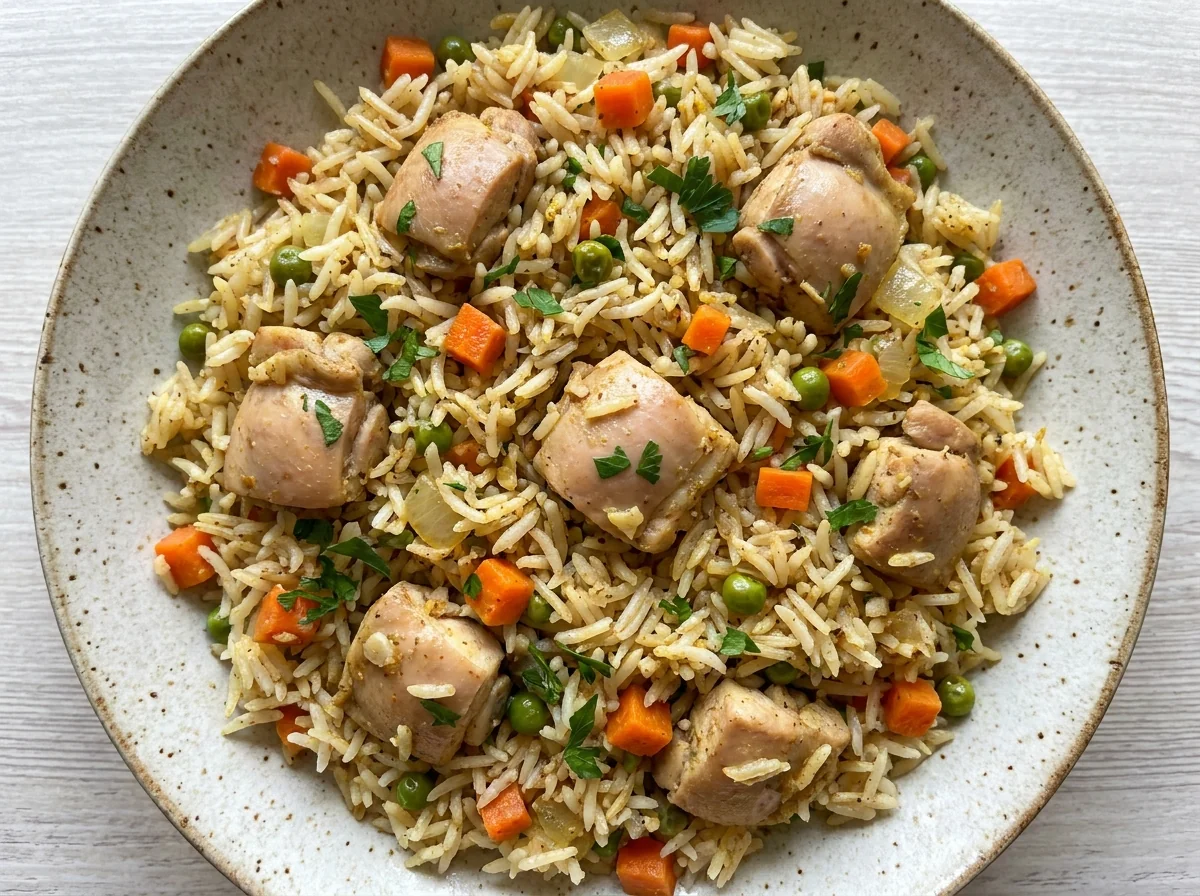
One-pot chicken and rice is the pillar of family dinners around the world in countless forms.
Chicken that browns then rice that coats in its fat then broth that brings them together. The neutral global formula that neighbors our Kabsa (Saudi spiced rice dish) and our pressure-cooker rice on the same tree with a faster branch.
Preparation Steps
Brown the seasoned chicken
The thigh cubes with the spices and salt are browned in the oil in a wide pot for four minutes. The thighs here are deliberate: they survive the rice's journey juicy where the breasts dry out.
Saute the base and the rice
The onion until translucent then the garlic, then the rinsed rice is stirred for two minutes coating in the seasoned fat.
Wet with the broth and arrange the vegetables
The hot salted broth and the carrots, a boil then a quieter heat and a tight lid for fifteen minutes.
Add the peas without stirring
They are scattered over the surface and covered for a final five minutes. They cook by steam green and alive, and stirring now breaks the rice's fluffiness.
Rest, fluff and serve
Five minutes of rest off the heat then a fork's fluff and parsley and a squeeze of lemon. A complete family dinner from a single pot in forty minutes: less washing up and a longer-lasting table.
Blood Sugar Impact
The glycemic index (GI) measures how quickly a food raises blood sugar, while the glycemic load (GL) measures how much a full serving raises it. Together they give the complete picture.
Glycemic Index
GI
65Medium
Low0–55Medium56–69High70+
A low value (≤55) means a gradual rise in blood sugar — the most suitable range for diabetes and insulin resistance.
Glycemic Load
GL
58High
Low0–10Medium11–19High20+
Glycemic load reflects the impact of the full serving. To lower it: take half a serving, or pair the recipe with a source of protein and fiber.
Nutritional Information
Per ServingMakes 4 servings · one serving is about 485 g of raw ingredients
Calories669 kcal33%of Daily Value*
Protein38 g76%of Daily Value*
Carbohydrates94 g34%of Daily Value*
Fat14 g18%of Daily Value*
Fiber4 g14%of Daily Value*
Sodium685 mg30%of Daily Value*
Potassium789 mg17%of Daily Value*
Phosphorus440 mg35%of Daily Value*
* Percent Daily Values are based on a 2,000-calorie diet per FDA food-label reference values — your daily needs may be higher or lower. Values are derived from the recipe's ingredients via the USDA database.
Troubleshooting
The most common problems when preparing One-Pot Chicken and Vegetable Rice, and how to fix them:
The rice is done and the chicken with it is dry
Breasts entered the thighs' journey. The thighs are the one-pot law, or breasts removed and returned for the last five minutes.
The bottom stuck
A strong simmer heat. The lowest and a thick pot, and the light scrapings are a spoil of war as usual.
The rice turned doughy
Excess water or stirring during cooking. The broth is double the rice minus a quarter and the hand is forbidden after the lid.
Pale in character
Quiet spices. The full spoonful on the chicken and the coating, and the finishing squeeze of lemon brightens it.
Storage and Make-Ahead
Right away
Fluffed with its lemon.
In the fridge
Three days in containers. A family meal prep reheated by steam.
In the freezer
One month. Among the most honest rice dishes for freezing.
Tested Ingredient Substitutions
Original Ingredient
Tested Substitute
Ratio
Flavor Difference
Thighs
Breasts with a late return
~
For anyone who only finds them. On condition of timing
Basmati
Brown rice with an extra quarter-hour and more water
1:1
The pot's full fiber
The recipe's vegetables
Corn, peppers and whatever is on hand
~
The single pot is generous of door
The neutral spices
Curry or Kabsa spices
~
Its passport changes with a spoonful
How Much Does It Make? Scaling Guide
Ingredient
4 servings
2 servings
8 servings
Chicken
500 g
250 g
1 kg
Rice
400 g
200 g
800 g
Broth
700 ml
350 ml
1.4 L
EEINA Nutrition Tip
The thighs, not the breasts, in one-pot dishes. The rice's twenty-minute journey inevitably dries out the breasts no matter how careful you are; the thighs with their light fat come out juicy and water the rice along the way: the choice of cut is half the pot's success.
Add This Recipe to Your Plan
The EEINA app saves your favorite recipes, calculates them from their real ingredients, and shows your daily numbers toward your goal. Try it free now.
How does it differ from our Kabsa and pressure-cooker rice?
Kabsa is a Saudi identity with its Loomi and spices and separate boiling, and the pressure-cooker shortcuts; this is the faster neutral global formula. Three branches of the chicken-and-rice tree.
Why does it lead tired families' dinners?
A single pot, forty minutes, half of them hands-off, and no two-pot washing up. The engineering of reality, not ideals.
Is it balanced on its own?
Protein, starches and two vegetables, and a cucumber-yogurt salad completes it into a triangle.
The secret of its bottom's flavor for those in the know?
The scrapings. The light golden crust of the bottom that the household fights over: an honest simmer heat makes it and does not burn it.